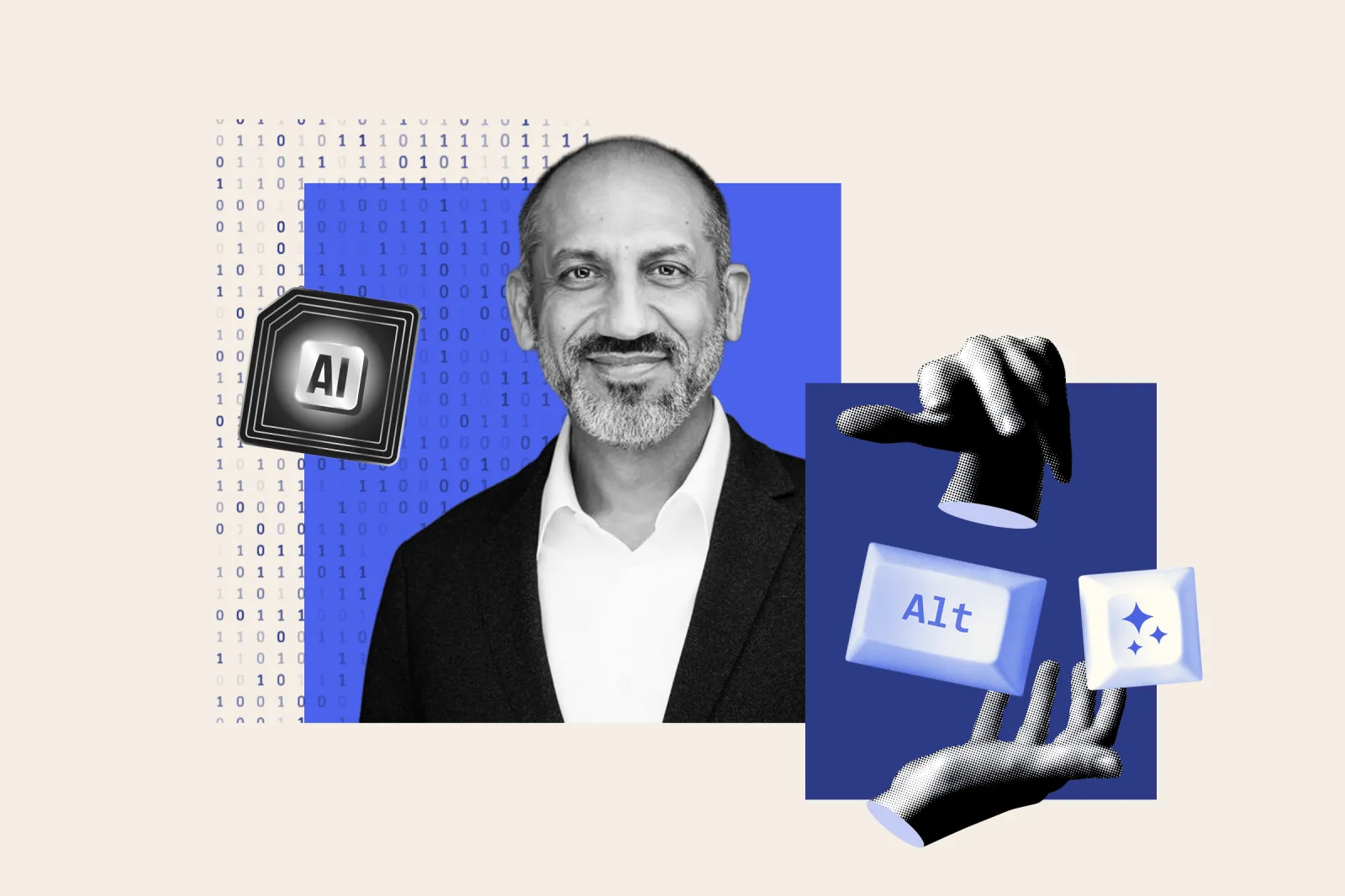
Courtesy of Balkrishan Kalra

By Balkrishan “BK” Kalra
0
Share
Newsweek is a Trust Project member
See more of our trusted coverage when you search.Prefer Newsweek on Googleto see more of our trusted coverage when you search.
For most of recorded history, business ran on a simple loop: humans processed the work, and humans validated it. Every invoice, every underwriting decision, every compliance check—a person did it, and another person approved it. The entire rhythm of the enterprise was metered by how fast people could think, read and decide.
That loop is gone. And it is never coming back.
Somewhere today, a loan officer is reviewing a credit decision she didn’t make. A compliance analyst is scanning an audit his department didn’t run. A supply chain manager is approving a routing plan no human wrote. In each case, the work was done in minutes—work that used to take days—and the human’s job is no longer to do the work. It is to own the outcome.
Read More on Opinion
This is not a pilot program. This is not a press release. This is the operating model that is quietly replacing the one your company was built on, and if you haven’t felt it yet, you will.
How work gets done has shifted to a new operating model—machine-processed, human-validated—and the companies making this shift are not gaining just a few points of efficiency. They are gaining orders of magnitude. They are rewriting the economics of their industries in real time, and the gap between them and everyone else is compounding daily.
The instinctive fear is obvious: if machines do the processing, what happens to the people who used to do it? Some roles will change. Some will vanish. The math in certain functions is blunt, and anyone offering you comfortable reassurances is selling something.
But comfortable reassurances aren’t what I'm offering. History is.
In 1865, the economist William Stanley Jevons noticed something that defied every intuition of his era: As steam engines grew more efficient, Britain didn't burn less coal. It used dramatically more. Efficiency didn't suppress demand. It detonated it. Cheaper energy made new applications viable, and the economy expanded into territory that had been economically impossible before.
We have already watched this movie in our own lifetimes. When the smartphone arrived, no serious forecaster predicted the app economy. No one saw that a device for making phone calls would conjure entirely new professions—UX designers, mobile platform engineers, social media managers, gig economy drivers—millions of jobs that had no name and no precedent. The phone didn't shrink the labor market. It invented new continents within it.
Agentic AI is the next Jevons moment. I say this not as optimism but as certainty grounded in pattern recognition. The jobs emerging at the intersection of human judgment and machine execution—roles we don’t yet have vocabulary for—will outpace displacement. As machines absorb the processing, the premium shifts decisively to what machines cannot supply: accountability, contextual judgment, the institutional knowledge that lives in a person’s head and nowhere else. The humans in this new loop aren't doing less. They are finally doing the work that actually matters—the exceptions, the edge cases, the calls that carry real risk and real consequence.
Here is where the conversation gets uncomfortable for the technology industry: the frontier models emerging from the world's best research labs are extraordinary—and they are not enough.
Deploy a leading foundation model against a real business process, and it will handle roughly 80 percent of it beautifully. The remaining 20 percent—the edge cases, the outlier scenarios, the decisions that don’t fit a standard pattern—is where the actual business lives.
That last mile is where “just add AI” projects go to die. Any company can automate the routine. The high-stakes decision carrying genuine risk and genuine upside is where generic AI breaks, because real, mission-critical operations are built on nuance accumulated over decades: institutional memory, regulatory scar tissue, workflow logic that no model trained on the open internet has ever encountered.
There is no Artificial Intelligence without Process Intelligence.
That sentence should be a bumper sticker in every boardroom running an AI strategy. Technical fluency without domain fluency produces impressive demos and disappointing results. Domain fluency without technical fluency produces PowerPoint strategies that never ship. You need both, fused together, aimed at the actual friction points and bottlenecks of how your business runs—not how a vendor imagines it runs.
Here is what I have observed, consistently, across every organization that has made this transition genuinely: Once people work this way, they refuse to go back. Not because the technology dazzles them—but because the outcomes are measurably, unmistakably better.
And, crucially, since every successful deployment creates reusable components, trained models and encoded institutional knowledge, the next deployment will be faster and cheaper. The first move is the hardest. The tenth is dramatically easier. That is the nature of compounding—and it punishes whoever is slowly deliberating as powerfully as it rewards whoever moved first.
The companies that will define the next decade are not piloting. They are executing. The window is open. It is closing. The only variable is which side of it you end up on.
So, let me leave you with a thought I want you to carry out of this article: We are the last generation of business leaders who will manage only human workers. We are the first to build and lead hybrid teams of people and intelligent agents. Twenty years from now, that sentence will sound as quaint as “we were the first company to get a website.” But right now, in this window, the decisions you make about this transition will compound for decades. The leaders who move will set the terms. Everyone else will operate on those terms.
The shift from human-processed to machine-processed, human-validated work is not coming. It is here. The new economic model is taking hold. The premium on human judgment at the last mile is rising fast.
You can lead this transformation, or you can inherit the consequences of watching it happen.
The machines are already doing the work. The only question left is whether you're ready to make the decisions that matter.
Balkrishan “BK” Kalra is the President and CEO of Genpact.
View 0 Comments
Submit Correction
View Editorial & AI Guidelines