

By Shane Croucher and Amanda Castro
0
Share
Newsweek is a Trust Project member
See more of our trusted coverage when you search.Prefer Newsweek on Googleto see more of our trusted coverage when you search.
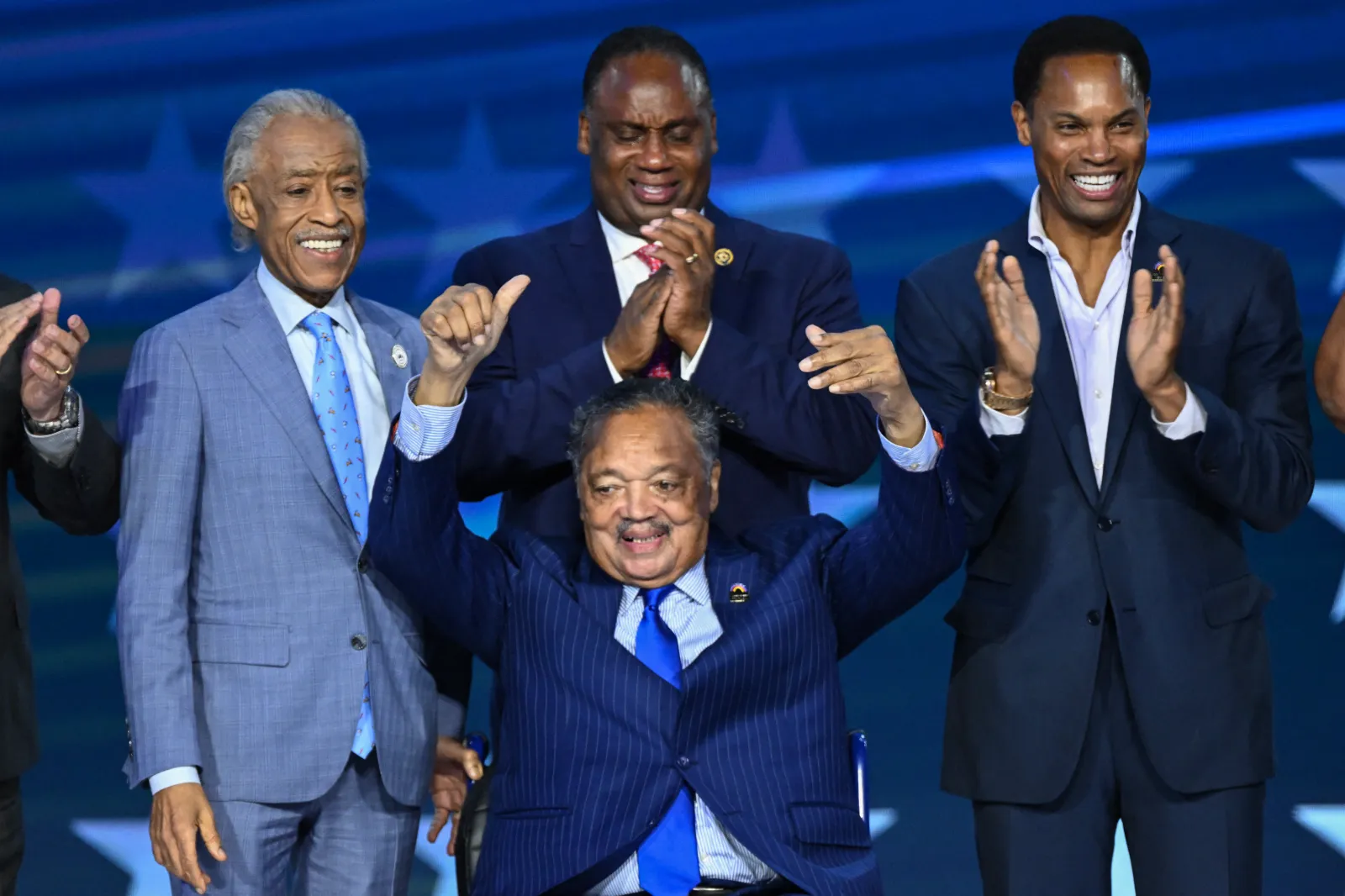
The civil rights leader Rev. Jesse Jackson has died at the age of 84, his family said in a statement. Jackson died peacefully on Tuesday morning surrounded by his family, they said.
“Our father was a servant leader — not only to our family, but to the oppressed, the voiceless, and the overlooked around the world,” said the Jackson family.
“We shared him with the world, and in return, the world became part of our extended family. His unwavering belief in justice, equality, and love uplifted millions, and we ask you to honor his memory by continuing the fight for the values he lived by.”
...
What To Know
- Rev. Jesse Jackson was a major figure in the civil rights movement and worked closely with Martin Luther King Jr.
- Jackson ran for president twice, seeking the Democratic nomination in both 1984 and 1988, though he lost out both times.
- The ordained Baptist minister founded what would become the Rainbow PUSH Coalition to advance civil rights and social justice.
- Jackson had struggled with his health in later years, having been diagnosed with Parkinson's Disease. He was hospitalized in November for progressive supranuclear palsy.
- He is survived by his wife, Jacqueline; their children Santita, Jesse Jr., Jonathan, Yusef, and Jacqueline; another daughter, Ashley Jackson, and grandchildren.
Read also: Jesse Jackson and Donald Trump’s Unique Relationship
This live blog is now closed.
In a polarized era, the center is dismissed as bland. At Newsweek, ours is different: The Courageous Center—it's not "both sides," it's sharp, challenging and alive with ideas. We follow facts, not factions. If that sounds like the kind of journalism you want to see thrive, we need you.
When you become a Newsweek Member, you support a mission to keep the center strong and vibrant. Members enjoy: Ad-free browsing, exclusive content and editor conversations. Help keep the center courageous. Join today.


Feb 17, 2026 at 10:29 AM EST
How many children did Jesse Jackson have?
Jesse Jackson’s public life has long been intertwined with a deeply rooted family story and a wide circle of cultural and political relationships. He married Jacqueline Lavinia Brown on December 31, 1962, beginning a partnership that would span decades of activism and public service.
Together they raised five children—Santita, Jesse Jr., Jonathan Luther, Yusef DuBois, and Jacqueline Lavinia—each of whom grew up in the shadow of their father’s national prominence.
Feb 17, 2026 at 10:22 AM EST
Labor leaders honor Rev. Jesse Jackson’s legacy of worker advocacy
AFL‑CIO President Liz Shuler and Secretary‑Treasurer Fred Redmond issued a tribute Monday honoring the Rev. Jesse L. Jackson, calling him a transformative figure whose decades of activism helped shape both the labor and civil rights movements. In their statement, the union leaders described Jackson as a moral force who consistently linked economic justice with the broader fight for equality.
Jackson’s organizing roots trace back to the Southern Christian Leadership Conference, where he worked closely with Dr. Martin Luther King Jr. before leading Operation Breadbasket, a campaign that pressured companies to hire and promote Black workers. His later work through Operation PUSH and the Rainbow Coalition expanded that mission, uniting communities around the idea that civil rights and fair economic opportunity are inseparable.
Shuler and Redmond highlighted Jackson’s long record of supporting workers on picket lines, at bargaining tables and in national mobilizations. They noted his efforts to ensure women and people of color were fully included in union protections, as well as his advocacy for laid‑off Enron employees in 2002 and his willingness to confront global corporations over labor abuses abroad.
The AFL‑CIO leaders said Jackson embodied the movement’s core values, insisting that workers deserved not charity but fairness and dignity. They extended condolences to his family and praised his enduring influence on generations of organizers.
“May he rest in power,” the statement concluded.
Feb 17, 2026 at 10:16 AM EST
Inside Jesse Jackson’s final decade at Rainbow/PUSH and his evolving national role
...
In the early 2010s, Jesse Jackson remained a prominent national voice on civil rights, economic inequality, and criminal justice. He joined the 2010 “Jobs, Justice and Peace” march in Detroit to push for stronger federal attention to urban decline, and he continued to challenge the Obama administration on issues ranging from economic policy to its relationships with Black leaders. Jackson strongly supported marriage equality, praising President Obama’s 2012 endorsement and framing LGBTQ rights as part of a broader struggle for civil rights.
Jackson became deeply involved in high‑profile cases of racial injustice. He stood with Trayvon Martin’s family, condemned stand‑your‑ground laws, and urged federal civil‑rights charges after George Zimmerman’s acquittal. He also advocated for Marissa Alexander, whose lengthy prison sentence he contrasted with Zimmerman’s freedom. Jackson was active in Ferguson after the police killing of Michael Brown, calling for federal intervention and urging protesters to channel their anger into organized action.
Throughout the decade, Jackson continued to speak out on national politics. He endorsed Hillary Clinton in 2016 after remaining neutral during the primary, criticized Donald Trump’s rhetoric, and urged voters to defend civil‑rights gains. He marched in the Women’s March, denounced harsh immigration policies, and called for protecting voting rights. Jackson also defended Colin Kaepernick and encouraged an NFL boycott in response to the league’s treatment of the quarterback.
Jackson remained a fixture in moments of national crisis. He traveled to Minnesota after George Floyd’s murder, demanded charges against the officers involved, and stood with the Floyd family after Derek Chauvin’s conviction. He supported the withdrawal of U.S. troops from Afghanistan, was arrested during voting‑rights protests in 2021, and continued to push for economic and racial justice through op‑eds and public appearances.
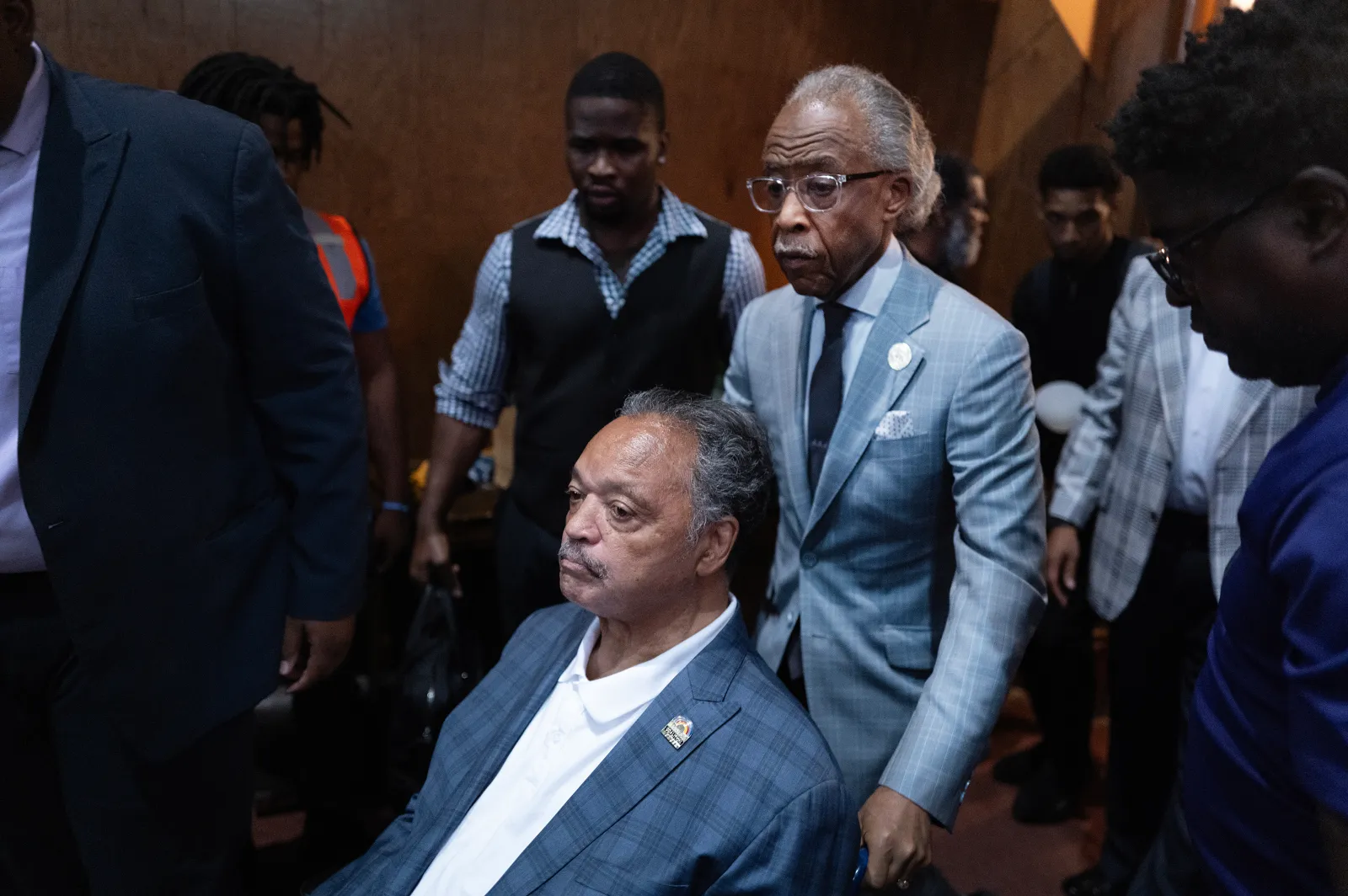
In 2023, Jackson announced he would step down as leader of Rainbow/PUSH due to age and health challenges, including Parkinson’s disease. His departure marked the end of an era for the organization he built into a national force. Leaders across the political spectrum praised his decades of advocacy, with Chicago Mayor Brandon Johnson calling him “an architect of the soul of Chicago” and Al Sharpton describing him as one of the most consequential figures in the history of American social justice.
Feb 17, 2026 at 10:03 AM EST
Inside Jesse Jackson’s high-profile advocacy and early political battles
The 2000s opened with Jesse Jackson still firmly positioned as one of the most visible civil‑rights leaders in American politics. In 1999, he ruled out a presidential run for 2000, choosing instead to focus on education, health‑care reform, and what he called the “explosive growth of the prison‑industrial complex.” That year he also criticized Texas Governor George W. Bush for failing to push hate‑crime legislation after the murder of James Byrd Jr. Jackson endorsed Al Gore in March 2000 and later addressed the Democratic National Convention, becoming a prominent surrogate during the contentious Florida recount. He joined rallies, filed civil‑rights complaints over discarded ballots, and urged federal scrutiny of voting irregularities affecting Black communities.
Jackson continued to clash with Florida officials after the election. He criticized Governor Jeb Bush’s appointments and voting‑roll purges, calling them racially discriminatory. Yet in 2005, Jackson and Bush found rare common ground in supporting the family of Terri Schiavo during their high‑profile legal battle. Jackson also sought to intervene internationally: after the September 11 attacks, he considered—but ultimately declined—a Taliban invitation to mediate for the release of detained Christian aid workers.
Throughout the decade, Jackson remained active in domestic advocacy. He was arrested in 2003 during a labor protest at Yale University and again in 2007 while demonstrating against a Chicago‑area gun shop accused of supplying weapons to gangs. He campaigned for John Kerry in 2004 and addressed the Democratic National Convention, though the Federal Election Commission later fined Jackson and the DNC for fundraising violations.
Jackson also inserted himself into several cultural flashpoints. He pledged tuition support for the woman at the center of the Duke lacrosse case, condemned Michael Richards’ racist tirade at the Laugh Factory, and joined calls to retire the N‑word from entertainment. His relationship with Barack Obama was complicated: he endorsed Obama early in the 2008 primaries but later criticized him over the Jena Six case, and a hot‑mic moment in 2008 captured Jackson making disparaging remarks about Obama’s rhetoric. Jackson apologized and ultimately celebrated Obama’s election, visibly emotional at the Grant Park victory rally.
By the end of the decade, Jackson remained a force within the Democratic Party. The Congressional Black Caucus honored him in 2009 for the 25th anniversary of his groundbreaking 1984 presidential run, and he continued to speak out on issues ranging from health‑care reform to racial justice—maintaining a national presence even as a new generation of political leaders emerged.
Feb 17, 2026 at 09:50 AM EST
What to know about Jesse Jackson’s political influence and public role in the 1990s
The 1990s marked a period of reinvention and sustained visibility for Jesse Jackson as he navigated politics, media, and national controversies. After the arrest of Washington, D.C., Mayor Marion Barry, Jackson briefly faced pressure to enter the mayoral race but ultimately declined. Instead, he pursued a newly created role as the District’s “shadow senator,” an unpaid position focused on lobbying for D.C. statehood. He held the post from 1991 to 1997, using it as a platform to push for expanded representation for the city’s residents.
Jackson remained a prominent national figure even as he stepped back from presidential politics. In 1991, he confirmed he would not run in the 1992 Democratic primaries, raising questions about the future of the Rainbow Coalition, which had been most influential during his presidential campaigns. His relationship with Bill Clinton began on uneven footing—Clinton was caught on a hot mic making disparaging remarks—but the two eventually aligned, with Jackson becoming an important bridge to Black voters during Clinton’s rise. Jackson also launched a CNN program, Both Sides with Jesse Jackson, one of the network’s few shows hosted by a liberal voice.
Throughout the decade, Jackson remained active in civil‑rights and community issues. He joined national commemorations like the 30th anniversary of the March on Washington, visited Tupac Shakur in the hospital after the rapper was shot, and backed Al Sharpton’s 1997 New York City mayoral bid. He also criticized Mayor Rudy Giuliani’s handling of police shootings, positioning himself as a vocal advocate for accountability.
Jackson played a visible role during President Clinton’s impeachment crisis, arguing that Clinton’s misconduct did not rise to the level of removal from office. He led a prayer vigil outside the U.S. Capitol the day before the House vote, underscoring his continued influence within Democratic circles.
Late in the decade, Jackson again drew national attention when he defended seven Black students in Decatur, Illinois, who were expelled after a fight at a football game. He argued the punishment was excessive and racially biased, thrusting the case into the national spotlight.
Feb 17, 2026 at 09:41 AM EST
King family honors Rev. Jesse Jackson’s legacy after his death
Arndrea Waters King and Martin Luther King III issued a tribute Monday honoring the life and legacy of the Rev. Jesse L. Jackson, calling him a towering figure whose work linked generations of the civil rights movement. In their statement, the couple described Jackson as a steadfast advocate who carried forward the unfinished mission championed by Dr. Martin Luther King Jr. and other movement leaders.
They praised Jackson’s willingness to speak boldly in difficult moments and his lifelong commitment to standing with marginalized communities. His decades of organizing, preaching and public leadership, they said, helped push the country toward greater justice and inspired countless people to believe in the possibility of meaningful change.
The Kings emphasized that Jackson’s influence extended far beyond his public speeches, shaping movements, mentoring younger activists and reminding the nation of the moral urgency of equality. They offered condolences to his family and to the many people touched by his ministry, urging supporters to continue the work he championed.
The statement closed with one of Jackson’s most enduring messages of resilience — a call to “keep hope alive” — and expressed confidence that his legacy will continue to guide those fighting for civil rights and human dignity.
Feb 17, 2026 at 09:37 AM EST
Jesse Jackson’s abortion stance shifted across his political career
Jesse Jackson’s position on abortion underwent one of the most notable ideological evolutions of any major Democratic figure of his era. Although he would later become aligned with the party’s pro‑choice wing, Jackson began his public life as a vocal opponent of abortion. Within weeks of the Supreme Court’s 1973 Roe v. Wade ruling, he launched a PUSH campaign condemning the decision, calling abortion a form of “murder” and warning that historic figures like Moses or Jesus might never have been born had the procedure existed in ancient times. His early rhetoric put him at odds with some allies, including T. R. M. Howard, a prominent Black physician and supporter who performed abortions.
Throughout the mid‑1970s, Jackson continued to champion anti‑abortion policies. He endorsed a constitutional amendment banning the procedure and supported the Hyde Amendment, which barred federal Medicaid funding for abortion. In a 1977 National Right to Life Committee publication, Jackson argued that the privacy rationale behind Roe echoed the legal justifications once used to defend slavery, framing abortion as part of a broader moral decline.
By the 1980s, however, Jackson’s views shifted dramatically. As he prepared for national campaigns and aligned more closely with mainstream Democratic positions, he embraced the principle that women should have the right to choose and that government should not interfere in personal reproductive decisions. By 1988, critics from the anti‑abortion movement accused him of fully adopting the Democratic Party’s pro‑choice platform, including support for federal funding.
Jackson continued to speak out on reproductive rights decades later. After the leak of the draft Supreme Court opinion overturning Roe v. Wade, he compared the moment to the infamous Dred Scott decision, arguing that both were preceded by efforts to portray the Court’s actions as apolitical. He warned that reversing Roe would ignite fierce political battles across the country—a prediction that gained new relevance when the Court formally overturned the ruling in June 2022.
Feb 17, 2026 at 09:23 AM EST
Jesse Jackson’s Michigan upset and the road to the convention
Jesse Jackson’s campaign reached its peak on March 26, 1988, when he stunned the political establishment by winning the Michigan primary in a landslide over Michael Dukakis. The victory made Jackson the Democratic front‑runner and forced party leaders to confront the possibility that he could become the nominee. Former DNC chairman Robert Strauss called the win evidence of “a kind of power we hadn’t expected.”
Jackson’s momentum carried into the March 28 debate at Fordham University, where he was the only candidate greeted with applause. He emphasized homelessness, poverty, and the need for federal intervention. But the campaign soon entered a more contentious phase. New York City Mayor Ed Koch, a Gore supporter, attacked Jackson and warned Jewish voters against backing him—remarks that drew national criticism and a later apology.
Dukakis regained control of the race with victories in New York, Colorado, and Wisconsin. Jackson’s support among white voters improved compared with 1984, but not enough to overcome Dukakis’s delegate lead. By late spring, Jackson’s own aides acknowledged he could not win the nomination.
Even so, Jackson finished the primary season with 6.9 million votes and victories in 11 contests—more than doubling his 1984 performance. He pressed Dukakis to adopt reforms such as same‑day voter registration and changes to winner‑take‑all delegate rules, and he argued that he deserved consideration for the vice‑presidential slot. Dukakis ultimately chose Senator Lloyd Bentsen, but Jackson pledged to “keep hope alive” and rallied his delegates behind the ticket.
Despite internal disputes that lingered into the summer, Jackson’s 1988 campaign reshaped Democratic politics. His broad coalition, improved white support, and historic primary wins led many observers to label 1988 “the Year of Jackson,” marking his run as one of the most consequential insurgent campaigns in modern party history.
Feb 17, 2026 at 09:10 AM EST
Breakthrough wins for Jesse Jackson during the 1988 presidential race
Jesse Jackson entered the 1988 presidential race with a sweeping, unapologetically progressive platform. He called for a single‑payer universal health‑care system, higher taxes on the wealthy, deep cuts to defense spending, and major new investments in education, housing, childcare, and welfare. He also backed ratification of the Equal Rights Amendment, protections for gay and lesbian federal employees, aggressive anti‑drug strategies, and the creation of an “American Investment Bank” to rebuild national infrastructure. Jackson urged a freeze on new nuclear weapons and advocated a more constructive relationship with the Soviet Union. The New York Times described him as a classic New Deal–Great Society liberal.
Jackson’s debate performances in early 1988 helped solidify his standing. While he finished fourth in the Iowa caucuses, he significantly improved on his 1984 showing. After a respectable performance in New Hampshire, analysts noted that he was beginning to broaden his appeal among white voters.
Super Tuesday marked a turning point. Jackson won five Southern states—Virginia, Georgia, Louisiana, Mississippi, and Alabama—establishing himself as a major contender in what party leaders increasingly viewed as a three‑way race with Michael Dukakis and Al Gore. He followed those victories with wins in Alaska, South Carolina, and Puerto Rico, demonstrating organizational strength and a diverse coalition of supporters.
Feb 17, 2026 at 08:57 AM EST
Jackson positions himself for a 1988 run
By early 1986, Jesse Jackson was once again at the center of national political speculation as signs mounted that he was preparing for a second presidential bid. He formally took a step toward that possibility in March 1987 by creating an exploratory committee, becoming one of the first Democrats to do so. Jackson then began investing time in Iowa—far more than he had during his 1984 campaign—relocating his office to a rural part of the state and drawing parallels between struggling farmers, small‑business owners, and unemployed Black Americans under Reagan‑era economic policies.
Jackson’s outreach extended across the South, including a notable July meeting with former Alabama governor George Wallace. Jackson praised Wallace’s more recent record on inclusive appointments, a striking moment given Wallace’s segregationist past. By September, Jackson appeared at a presidential candidates forum, aligning himself with the Congressional Black Caucus on education, employment, and defense. The crowd’s chants of “Run Jesse Run” underscored the growing expectation that he would enter the race.
On October 11, 1987, Jackson made it official, announcing his candidacy for the 1988 Democratic nomination. Early polling showed him leading in much of the South and topping the national Democratic field with 27 percent support, signaling a far stronger starting position than in 1984.
Feb 17, 2026 at 08:50 AM EST
Ben Crump pays tribute to Rev. Jesse Jackson after civil rights leader’s death
Civil rights attorney Ben Crump issued a heartfelt statement honoring the life and legacy of the Rev. Jesse L. Jackson, calling him a towering figure whose influence shaped generations of activists and leaders. Crump, who described Jackson as a mentor and close friend, said the longtime civil rights champion played a defining role in his own life and in the broader fight for justice.
In his tribute, Crump highlighted Jackson’s decades of activism — from marching with Dr. Martin Luther King Jr. to founding the Rainbow PUSH Coalition and launching groundbreaking presidential campaigns that mobilized millions of Black voters. He noted Jackson’s work on voting rights, economic justice, corporate accountability and international hostage negotiations, emphasizing that Jackson remained active on the front lines even as his health declined.
Crump said Jackson’s vision for a more inclusive America helped open doors for leaders of color and empowered countless people to believe in their own worth. He described Jackson’s legacy as inseparable from major civil rights gains over the past 50 years.
Feb 17, 2026 at 08:44 AM EST
Jesse Jackson pushes economic justice and anti-drug advocacy in the mid-1980s
As Ronald Reagan prepared for his second inauguration in January 1985, Jesse Jackson used the moment to spotlight the Americans he believed were being left behind. Leading several hundred supporters through downtown Washington to the Washington Monument, he urged the country to “keep alive the hopes of those who have fallen through the safety net” and pressed the administration to prioritize the poor. It was the first of several high‑visibility actions that year aimed at broadening the national conversation around economic inequality.
In April, Jackson traveled to Missouri to protest the foreclosure of an elderly farmer’s land, rallying farmers, labor organizers, clergy, and urban Black supporters outside the Clinton County Courthouse. He described the gathering as a “rainbow coalition for economic justice,” reinforcing his message that economic hardship cut across race and geography. Two months later, in Washington, D.C., Mayor Marion Barry introduced Jackson at Winston Elementary School, where Jackson warned that drugs posed the greatest threat to the rising generation.
Jackson’s anti‑drug message intensified in 1986. Delivering a commencement address at Medgar Evers College, he lamented what he saw as a moral and spiritual crisis among young people, citing drugs, alcohol, and violence as symptoms of deeper social neglect. Days later, the sudden death of college basketball star Len Bias from cocaine‑related cardiac arrest prompted Jackson and Rep. Charles Rangel to call on President Reagan to launch a national war on drugs and expand federal funding for school‑based prevention programs.
Jackson also remained active in local politics. During Chicago’s contentious 1987 mayoral race, he intervened with Democratic National Committee chairman Paul G. Kirk, warning that internal party maneuvering threatened to undermine Mayor Harold Washington’s reelection. Jackson and his allies accused some Chicago Democrats of being willing to back a Republican candidate rather than support the city’s first Black mayor, underscoring the racial and political tensions shaping the campaign.
Feb 17, 2026 at 08:41 AM EST
Trump issues statement on death of Rev. Jesse Jackson
President Donald Trump released a lengthy statement following the death of the Rev. Jesse Jackson, reflecting on their past interactions and highlighting areas where the two men’s work intersected over several decades.
In his post, Trump described Jackson as “a good man” with a commanding presence and a deep connection to the communities he served. He recalled providing office space for Jackson’s Rainbow Coalition in New York and noted moments when Jackson sought his support on policy issues, including criminal justice legislation and long‑term federal funding for Historically Black Colleges and Universities.
Feb 17, 2026 at 08:30 AM EST
The Rainbow Coalition speech and Jackson’s role at the 1984 Democratic convention

...
By the time Democrats gathered in San Francisco for their 1984 national convention, Jesse Jackson had become a transformative—if polarizing—figure within the party. Though he finished behind Walter Mondale and Gary Hart in the delegate count, Jackson arrived with significant leverage, arguing that his 21 percent share of the popular vote had not translated fairly into delegate representation. He pressed for influence over the ticket and the party platform, even as Mondale ruled him out as a running mate.
Jackson’s convention address on July 17 became the defining moment of his campaign. In what would be remembered as the “Rainbow Coalition” speech, he described America as a quilt stitched together from many communities—Black, white, Hispanic, Native American, Jewish, Arab, gay, straight, young, old, rural, and urban. It was the first major‑party convention speech to explicitly acknowledge gays and lesbians, and it included an apology referencing earlier remarks that had caused deep offense within the Jewish community.
Though many of Jackson’s platform proposals were voted down, his speech reaffirmed his commitment to party unity and moral clarity. He pledged support for the Mondale‑Ferraro ticket while insisting he would continue challenging the party to broaden its vision. By September, Jackson had become an asset to the Democratic campaign, introducing Mondale to key Black constituencies and helping energize voters nationwide.
Ronald Reagan ultimately won re‑election in a landslide, but Jackson’s campaign left a lasting imprint. It expanded Black political participation, reshaped Democratic coalition politics, and set the stage for his even stronger presidential run four years later.
Feb 17, 2026 at 08:26 AM EST
Debates, controversy, and breakthroughs on the campaign trail for Jesse Jackson
Jesse Jackson’s 1984 presidential campaign gained national attention not only for its historic nature but also for its confrontations, debate moments, and unexpected primary successes. Jackson entered the first Democratic debate in January 1984 with a strong command of television, but his performance drew criticism for factual missteps. Even so, he remained a compelling presence onstage, often injecting moral urgency into policy discussions.
A defining moment came during a February debate moderated by Barbara Walters, who questioned Jackson about past remarks widely viewed as antisemitic. Jackson’s response sparked the most intense exchange of the night, prompting rival Gary Hart to defend Jackson’s character. The controversy lingered, but it did not halt Jackson’s momentum.
By spring, Jackson’s campaign was challenging state election rules he argued were designed to suppress Black political power. His persistence paid off in April, when he won the South Carolina primary with more than a third of the vote—his first major victory. He followed with wins in the District of Columbia and Louisiana, and he drew strong support in Virginia caucuses, even as delegate math favored Walter Mondale.
Jackson’s early‑season performance energized Black voters nationwide. Registration drives in Georgia, Alabama, and Florida helped produce dramatic turnout increases, and Jackson ultimately captured roughly three‑quarters of the Black vote in the Democratic primaries. His campaign forced the party to confront questions of representation, fairness, and the future of its coalition.
Feb 17, 2026 at 08:12 AM EST
Jackson tested the boundaries of presidential politics
During the early 1980s, Jesse Jackson emerged as one of the most visible political voices in the United States, using his civil‑rights platform to test whether the country was ready for a Black presidential contender. In May 1983, he became the first African‑American man since Reconstruction to address a joint session of the Alabama Legislature, urging lawmakers to shift their focus from racial divides to economic inequality. The speech, delivered in the Deep South, signaled that Jackson was gauging national appetite for a historic run.
Momentum grew quickly. That summer, Jackson addressed thousands of Black Baptist ministers in Memphis, highlighting the stark underrepresentation of African Americans in public office. Their chants of “Run!” underscored the growing belief that Jackson could mount a viable national campaign. His outreach extended beyond Black audiences; he spoke to the National Congress of American Indians and toured heavily Hispanic regions of Texas to test his cross‑cultural appeal.
On November 3, 1983, Jackson formally announced his candidacy for the 1984 Democratic nomination, becoming only the second African American to run a nationwide campaign for the party. His entry divided Black political leaders—many supported his right to run but doubted he could win the nomination. Still, Jackson secured key endorsements, including from influential Black mayors, and quickly established himself as a candidate capable of reshaping the Democratic landscape.
Feb 17, 2026 at 08:09 AM EST
Rep. Hakeem Jeffries honors Jesse Jackson’s legacy
House Democratic Leader Hakeem Jeffries paid tribute to the Rev. Jesse L. Jackson Sr., calling him a towering figure in the civil rights movement and a steadfast advocate for marginalized communities. In a statement shared on social media, Jeffries described Jackson as “a legendary voice for the voiceless” whose decades of activism helped advance the nation’s ongoing struggle for equality.
Feb 17, 2026 at 07:59 AM EST
What to know about Jesse Jackson’s global diplomacy

...
By the 1980s, Jesse Jackson had expanded his activism far beyond U.S. borders, emerging as an unconventional but effective diplomatic figure. His first major international breakthrough came in 1983, when he traveled to Syria to negotiate the release of Navy Lt. Robert Goodman, an American pilot shot down over Lebanon. Jackson’s direct appeal to Syrian President Hafez al‑Assad secured Goodman’s freedom, prompting President Ronald Reagan—initially wary of the mission—to welcome both men at the White House. The moment elevated Jackson’s national profile and helped propel his 1984 presidential campaign.
That same year, Jackson traveled to Cuba and negotiated the release of 22 Americans held by Fidel Castro’s government. His willingness to engage adversarial leaders became a hallmark of his international work. On the eve of the 1991 Persian Gulf War, he went to Iraq to plead for the release of foreign nationals being used as “human shields,” ultimately securing freedom for several British citizens and 20 Americans.
Jackson continued to take on diplomatic roles throughout the 1990s. In 1997 he visited Kenya as President Bill Clinton’s special envoy for democracy, urging fair elections. Two years later, during the Kosovo War, he traveled to Belgrade—without formal authorization from the Clinton administration—and persuaded Yugoslav President Slobodan Milošević to release three captured U.S. soldiers.
His global activism extended into the 2000s. Jackson addressed more than a million anti‑war demonstrators in London in 2003, met with political and community leaders in Northern Ireland in 2004 to support the peace process, and traveled to Venezuela in 2005 to meet President Hugo Chávez after controversial remarks by televangelist Pat Robertson. Jackson condemned the comments and emphasized that Venezuela posed no threat to the United States. He later attended Chávez’s funeral in 2013.
Jackson also lent his voice to civic engagement efforts abroad, joining the United Kingdom’s Operation Black Vote campaign in 2005 to encourage political participation among ethnic minorities. In 2009 he spoke across Malaysia and Thailand for the International Peace Foundation, focusing on building a culture of peace in an increasingly interconnected world.
Feb 17, 2026 at 07:46 AM EST
Inside the rise of Operation PUSH and Jesse Jackson’s economic justice movement
Jesse Jackson launched People United to Save Humanity—better known as Operation PUSH—on December 25, 1971, marking a new phase in his break from the Southern Christian Leadership Conference. The organization, later renamed People United to Serve Humanity, aimed to use political pressure and public advocacy to expand economic opportunities for Black Americans and low‑income communities. Early supporters included civil‑rights veteran T. R. M. Howard, who joined the board and chaired the finance committee, helping Jackson build credibility with Black business leaders. While Jackson envisioned PUSH as a vehicle for broad economic justice, some SCLC officials argued it would ultimately benefit middle‑class Black entrepreneurs more than the poor.
Throughout the 1970s and 1980s, Jackson used PUSH to push corporations and political parties to compete for Black support. In 1978 he urged the Republican National Committee to actively court Black voters, arguing that both parties needed to offer meaningful alternatives. PUSH also became known for high‑profile corporate boycotts, including a 1983 campaign targeting Anheuser‑Busch over its lack of minority participation in its distribution network. Years later, the company’s decision to award a Chicago distributorship to Jackson’s sons drew scrutiny, though the family denied any link to the earlier boycott.
Jackson’s political ambitions grew alongside PUSH’s influence. In 1984 he founded the Rainbow Coalition and stepped down as PUSH president to run for the Democratic presidential nomination, though he remained board chair. By the late 1980s, PUSH was running job‑readiness programs, housing initiatives, and voter‑registration drives, funded largely through private donations. Financial troubles in 1987 threatened the organization’s future and became a talking point for Jackson’s political opponents during his 1988 presidential campaign. In 1996, Operation PUSH and the Rainbow Coalition formally merged, uniting Jackson’s economic and political networks under one umbrella.
Feb 17, 2026 at 07:44 AM EST
NYC Mayor Zohran Mamdani pays tribute: ‘May we honor him not just in words, but in struggle’
New York City Mayor Zohran Mamdani described Jackson as “a giant of the civil rights movement who never stopped demanding that America live up to its promise.”
Feb 17, 2026 at 07:33 AM EST
Jesse Jackson and Donald Trump’s unique relationship
Jesse Jackson and Donald Trump have shared one of the more unexpected relationships in modern American politics—one that shifted dramatically over time.
In 1999, when Trump briefly explored a presidential bid on the Reform Party ticket, Jackson offered positive remarks about him, praising his business record and willingness to engage with minority communities. Those comments later resurfaced as Trump sought to highlight past praise from prominent Black leaders and counter racism accusations.
But the tone changed sharply in the years that followed. As Trump entered politics as a Republican and later won the presidency in 2016, Jackson became a vocal critic. He condemned Trump’s positions on immigration, voting rights and race, arguing that the administration’s policies harmed the very communities Jackson had spent decades advocating for.
Continue reading: Jesse Jackson and Donald Trump’s Unique Relationship
Feb 17, 2026 at 07:20 AM EST
How Jesse Jackson rose as a national civil-rights leader after working with Martin Luther King Jr.
Jesse Jackson’s rise as a national civil‑rights figure began during his early work with Martin Luther King Jr., who quickly recognized Jackson’s talent for organizing and commanding public attention. Jackson joined the 1965 Selma to Montgomery marches, and his energy on the ground led King to assign him to build the Southern Christian Leadership Conference’s Chicago presence. By 1966, Jackson was tapped to lead the local branch of Operation Breadbasket, the SCLC’s economic justice program, and within a year he was promoted to national director.
Under Jackson’s leadership, Operation Breadbasket expanded its strategy of using consumer boycotts to pressure white‑owned businesses to hire Black workers and invest in Black communities. He built alliances with influential Black entrepreneurs, including T. R. M. Howard, and turned Breadbasket’s weekly South Side meetings into major civic gatherings that blended political discussion with religious services and music.
King’s assassination in 1968 thrust Jackson further into the national spotlight, though it also deepened tensions within the SCLC. Jackson publicly described himself as the last person to speak with King—an account disputed by some aides—and his growing visibility led to friction with Ralph Abernathy, King’s successor. Jackson continued working on the Poor People’s Campaign but increasingly clashed with SCLC leadership over strategy, direction, and control.
By 1971, the conflict reached a breaking point. Abernathy ordered Operation Breadbasket’s national office moved to Atlanta, but Jackson refused and instead organized the Black Expo in Chicago, a major showcase of Black economic and political power. Questions over finances and authority soon led to Jackson’s suspension, prompting him, his staff, and most of Breadbasket’s board to resign from the SCLC. The split marked the end of Jackson’s role within the traditional civil‑rights establishment and set the stage for the independent activism that would define his later career.
Feb 17, 2026 at 07:06 AM EST
How Jesse Jackson’s early life shaped his path to civil rights leadership

...
Jesse Jackson’s early years in Greenville, South Carolina, set the foundation for one of the most influential civil‑rights careers of the 20th century. Born Jesse Louis Burns on October 8, 1941, he entered the world under circumstances that drew scrutiny in a deeply segregated society. His mother, Helen Burns, was a teenage high‑school student, and his biological father, Noah Louis Robinson, was a married neighbor and prominent figure in the local Black community. A year later, Helen married Charles Henry Jackson, who adopted Jesse and gave him the surname he carried into public life. Jackson maintained relationships with both men, later saying he considered them both his fathers.
Growing up under Jim Crow laws, Jackson experienced the daily humiliations of segregation—being told where to sit, where to drink water, and where he did not belong. Classmates taunted him over his birth, a stigma he later credited with fueling his determination to excel. At Greenville’s segregated Sterling High School, he emerged as a standout student and athlete, serving as class president and lettering in three sports.
After graduating in 1959, Jackson initially accepted a football scholarship to the University of Illinois, a predominantly white institution. He transferred after one year to North Carolina A&T, a historically Black university, citing racial barriers that limited his opportunities both on the field and in public speaking competitions. At A&T, he flourished—playing quarterback, leading the student body, and joining local protests against segregated public spaces. He earned a sociology degree in 1964 and began theological studies in Chicago before leaving to join the civil‑rights movement full‑time.
Jackson was ordained in 1968 and, decades later, received his Master of Divinity from Chicago Theological Seminary, which recognized his academic work and lifelong contributions. His early experiences—marked by racial injustice, personal resilience, and leadership—became the driving force behind his activism and public life.
Feb 17, 2026 at 06:24 AM EST
When did Jesse Jackson run for president?
Jesse Jackson launched two bids for the Democratic presidential nomination in the 1980s.
Though Jackson never won the nomination, he had a big impact on national politics, bringing Black and working-class progressive supporters together under what he called a "Rainbow Coalition".
Jackson's first run in 1984 made him only the second Black American, after Shirley Chisholm in 1972, to launch a major party nationwide campaign for the White House.
Initially dismissed by party leaders as a fringe candidate, Jackson built his Rainbow Coalition that helped to deliver him several primaries and caucuses, finishing third overall.
The unexpected performance was a clear demonstration that a Black candidate could compete seriously on the national stage in U.S. politics.
Jackson ran again in 1988, this time armed with the experience of four years earlier and a more organized and expansive campaign.

...
He went on to win a larger share of the vote, carried multiple states, and emerged as a leading contender deep into the primary season.
Jackson's message emphasized economic justice, voting rights, and expanded participation in the political process, and his campaign drew support from minority voters and progressive white Democrats alike.
At the Democratic National Convention, Jackson delivered a widely noted speech that framed the party as a multiracial, multiethnic coalition.
He finished second to Michael Dukakis.
Although he fell short of the nomination, Jackson’s two campaigns reshaped Democratic primary politics and helped lay the groundwork for future candidates, expanding who was seen as viable in a presidential race.
Feb 17, 2026 at 06:13 AM EST
Al Sharpton pays tribute to “my mentor” Jesse Jackson
The civil rights activist Rev. Al Sharpton paid tribute to Rev. Jesse Jackson, calling him "my mentor" and "a giant".
"My mentor, Rev. Jesse Jackson, has passed. I just prayed with his family by phone," Sharpton said in a post on X.
"He was a consequential and transformative leader who changed this nation and the world. He shaped public policy and changed laws. He kept the dream alive and taught young children from broken homes, like me, that we don’t have broken spirits.
"He told us we were somebody and made us believe. I will always cherish him taking me under his wing, and I will forever try to do my part to keep hope alive.
"A giant has gone home. Sending prayers, so many prayers, love, and heartfelt condolences to the Jackson family and to every person around the world whose life he touched and who loved him."
Feb 17, 2026 at 06:07 AM EST
Watch: Donald Trump at Jesse Jackson’s Rainbow PUSH Coalition in NYC, 1999
Feb 17, 2026 at 06:03 AM EST
Racist rejection of Jesse Jackson’s football talent set him on path to stand beside MLK

...
Jesse Louis Jackson was a standout quarterback at Sterling High School in Greenville, South Carolina.
But the racism in 1940s America was a wall for his talent.
Jackson had accepted a football scholarship to the University of Illinois, but was reportedly told that Black people could not play quarterback. So he transferred to North Carolina A&T in Greensboro, a historically Black university.
There, Jackson became the first‑string quarterback, an honor student in sociology and economics, and student body president.
He arrived on campus in 1960, months after students there launched sit‑ins at a whites‑only diner, and he soon immersed himself in the growing Civil Rights Movement.
By 1965, Jackson had joined the voting‑rights march led by the Rev. Martin Luther King Jr. from Selma to Montgomery, Alabama.
King later sent Jackson to Chicago to launch Operation Breadbasket, a Southern Christian Leadership Conference initiative aimed at pressuring companies to hire Black workers.
Jackson described his years working with King as “a phenomenal four years of work.”
He was with King on April 4, 1968, when the civil rights leader was assassinated at the Lorraine Motel in Memphis, Tennessee, and said King died in his arms.
Feb 17, 2026 at 05:53 AM EST
Watch: Jesse Jackson’s iconic 1984 speech to the DNC
Feb 17, 2026 at 05:48 AM EST
When is Jesse Jackson’s funeral?
No details have yet been released on the funeral, though the family has said that "public observances will be held in Chicago" to remember Jesse Jackson and his legacy.
"Final arrangements for Reverend Jackson's celebration of life services, including all public events, will be released by the Rainbow PUSH Coalition at www.rainbowpush.org or JesseJacksonLegacy.com," the statement announcing his death said.
Feb 17, 2026 at 05:36 AM EST
Pictures show Donald Trump, Jesse Jackson together during boxing’s 1980s heyday

...

...

...
Feb 17, 2026 at 05:29 AM EST
Jesse Jackson’s health struggles didn’t stop his activism
In his final months, as he received 24-hour care, Jesse Jackson lost his ability to speak, communicating with family and visitors by holding their hands and squeezing.
It was a painful moment of decline for the Jackson family, who had seen their patriarch use his eloquence to advance the causes he held dearly.
“I get very emotional knowing that these speeches belong to the ages now,” his son, Jesse Jackson Jr., told the AP in October.
Jackson revealed in 2017 that he had been diagnosed with Parkinson's Disease, a progressive neurological disorder that can severely impact an individual's ability to move, speak, and think.
Then last November, as his health declined sharply, Jackson was admitted to the hospital for progressive supranuclear palsy, a rare, progressive neurodegenerative brain disorder with similar effects to Parkinson's, though its impacts are felt faster.
Despite these profound health challenges, Jackson continued protesting against racial injustice into the era of Black Lives Matter.
In 2024, he appeared in a wheelchair at the Democratic National Convention in Chicago and at a City Council meeting to show support for a resolution backing a ceasefire in the Israel-Hamas war.
“Even if we win,” he told marchers in Minneapolis before the officer whose knee kept George Floyd from breathing was convicted of murder, “it’s relief, not victory. They’re still killing our people. Stop the violence, save the children. Keep hope alive.”
Feb 17, 2026 at 05:11 AM EST
Jesse Jackson’s views on Donald Trump
Jesse Jackson, in his later life, held a firmly dim view of President Donald Trump.
“Trump wants to pull us back into white supremacy," Jackson told the New Republic in 2023.
Jackson had actually praised Trump in the 1990s for supporting minority entrepreneurs.
But he became a sharp critic during Trump’s political rise, warning that his rhetoric “seeded these clouds” of division and fear.
In 2016, Jackson told BBC Radio 4 that Trump was a symptom of a "mean-spirited divide" emerging in the U.S.
“He is a factor in that, but it’s not just Trump, it’s the followers of Trump who really believe that somehow they have lost… the blacks and browns and Muslims, we’ve globalised capital by globalising human rights," Jackson said.
“We’ve been used as scapegoats for deeper and deeper economic and cultural fears. But we’re not the cause of them.”
Read more from Newsweek's Joe Edwards.
Feb 17, 2026 at 05:02 AM EST
Newsweek covers show Jesse Jackson during his 1980s rise


View 0 Comments
Submit Correction
View Editorial & AI Guidelines