Newsweek

By Newsweek Editors
0
Share
Newsweek is a Trust Project member
See more of our trusted coverage when you search.Prefer Newsweek on Googleto see more of our trusted coverage when you search.
After House Speaker Mike Johnson blocked a floor vote for months, Representatives Ro Khanna and Thomas Massie forced passage of the Epstein Files Transparency Act through a discharge petition—requiring 218 signatures from a Republican-controlled House. The final signature came when Representative Adelita Grijalva, delayed from taking her seat for seven weeks after winning her election, was sworn in. The bill passed 427-1. President Donald Trump, facing the inevitable, signed it on November 19, setting the December 19 date for the DOJ to release all unclassified Epstein files.
What arrived on deadline day: thousands of heavily redacted documents, 550 pages completely blacked out, photos of Bill Clinton with redacted women, and Deputy Attorney General Todd Blanche announcing the rest would trickle out over months. After seven batches of files were released on Friday and Saturday, an eighth batch was published early Tuesday which included some 400 videos, evidence spreadsheets, part clippings and audio files. Media obsessives following the case for bombshells have found mostly reruns. Survivors of Epstein’s abuse are calling it a "slap in the face." Khanna and Massie have threatened contempt charges against Attorney General Pam Bondi for violating the law. The Epstein files: now in installment-plan form.
Bill Clinton ⬇
"This isn't about Bill Clinton. Never has, never will be," his spokesperson protested, the DOJ said Clinton isn't under investigation and even White House Chief of Staff Susie Wiles said there was nothing incriminating about him in the files. But dozens of photos suggest a different story: Clinton topless in a hot tub with a redacted woman, poolside with Ghislaine Maxwell, arm-in-arm with redacted females on Epstein's private jet, the "Lolita Express". A thousand denials aren’t worth what these photos show.
Read More on Opinion
Donald Trump ⬆
Spent months calling Epstein a "Democrat hoax," tried blocking the transparency bill, signed it when passage became inevitable. The drip-drip-drip release schedule now works in his favor: each photo dump features Clinton while Trump barely appears. By the time all files emerge in 2026, the news cycle will have moved on. Trump knows that procrastination can be its own form of exoneration.
Pam Bondi ⬆
In February she told Fox News the Epstein client list was "sitting on my desk right now." In July, the DOJ said no such list existed. On December 19 she released a fraction of what the law required, with no specific explanation for each redaction. Khanna and Massie are mad, but she successfully turned the most anticipated document dump of the year into a nothingburger. Mission accomplished.
Todd Blanche ⬇
The Deputy AG has achieved the unenviable: he’s now the DOJ's public face of the Epstein files and will be for the foreseeable future. He's promised "several hundred thousand" more documents over "the next couple of weeks"—which then became months. Asked if he's worried about impeachment threats from Massie and Khanna: "Not even a little bit. Bring it on." Hours later, the DOJ quietly unredacted the 119-page grand jury transcript. His confidence expired faster than the transparency deadline.
Maria Farmer ⬆
Her 1996 FBI complaint about Epstein—ignored for nearly three decades—is finally public. "Thank you for believing me. I feel redeemed. This is one of the best days of my life," she said. It took 29 years and an act of Congress, but the first whistleblower was right all along.
David Brooks ⬇
Last month The New York Times columnist dismissed Epstein obsession as QAnon conspiracy-mongering: "The Epstein Story? Count Me Out." Days later, photos emerged of Brooks smiling at a 2011 dinner that Epstein attended—three years after Epstein's sex crime conviction. The paper said: "As a journalist, David Brooks regularly attends events." Apparently so does Jeffrey Epstein.
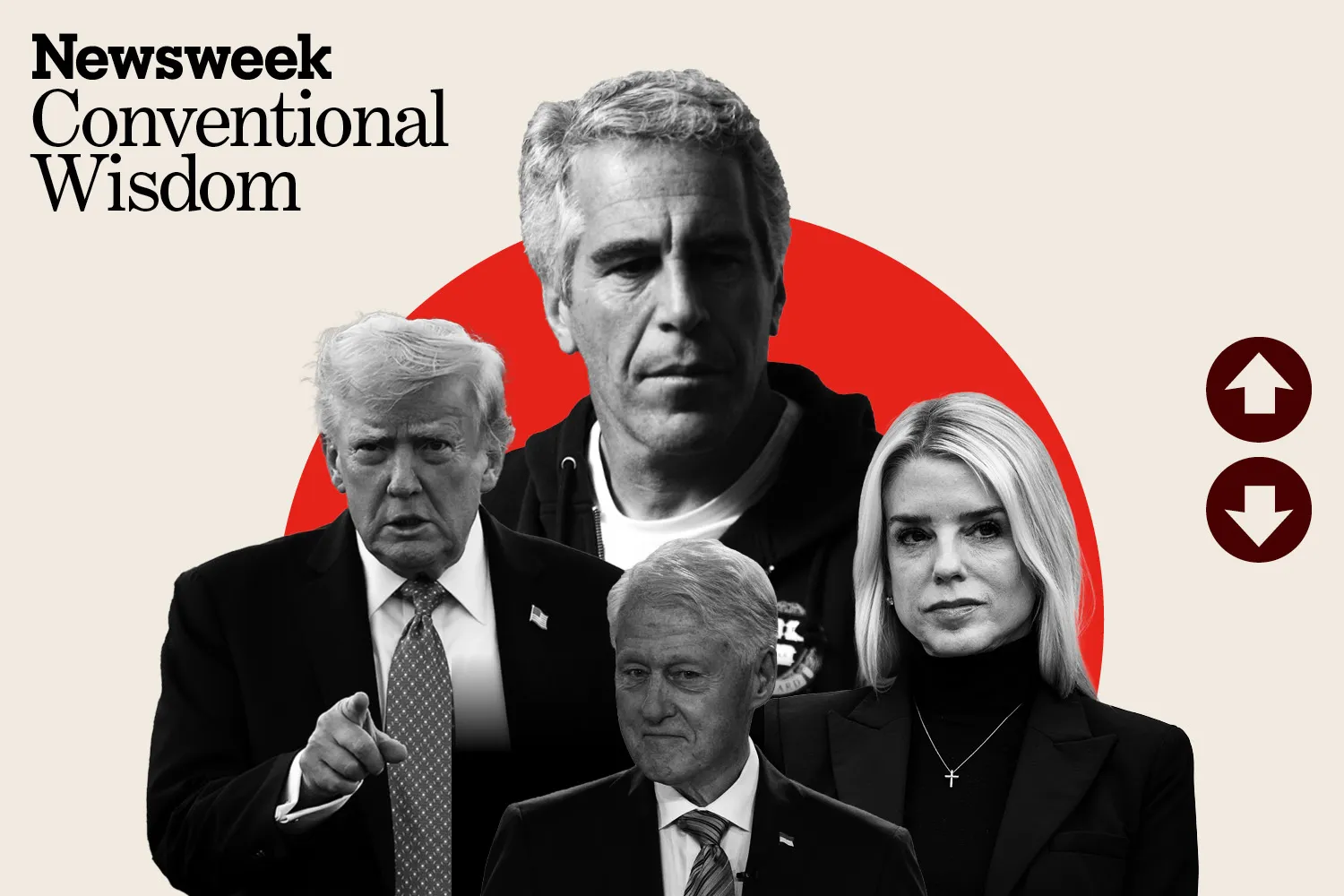
Originally a staple of Newsweek's print edition, Conventional Wisdom used arrows to track whose stock was rising or falling in the political circus. We're reviving it in the digital age because the problem it lampooned—hyperbole and partisan certainty masquerading as insight—has only intensified.
CW assigns arrows—up, down, or sideways—to the figures and forces shaping current events. The arrows don't predict the future or claim special insight. They capture the prevailing winds of the moment, uncluttered by tribal howling. In an era when partisan media reinforces rather than questions assumptions, CW operates from the center—skeptical of left and right alike, committed to puncturing inflated reputations and recognizing overlooked truths.
View 0 Comments
Submit Correction
View Editorial & AI Guidelines