...

By Soo Kim
Reporter
0
Share
Newsweek is a Trust Project member
See more of our trusted coverage when you search.Prefer Newsweek on Googleto see more of our trusted coverage when you search.
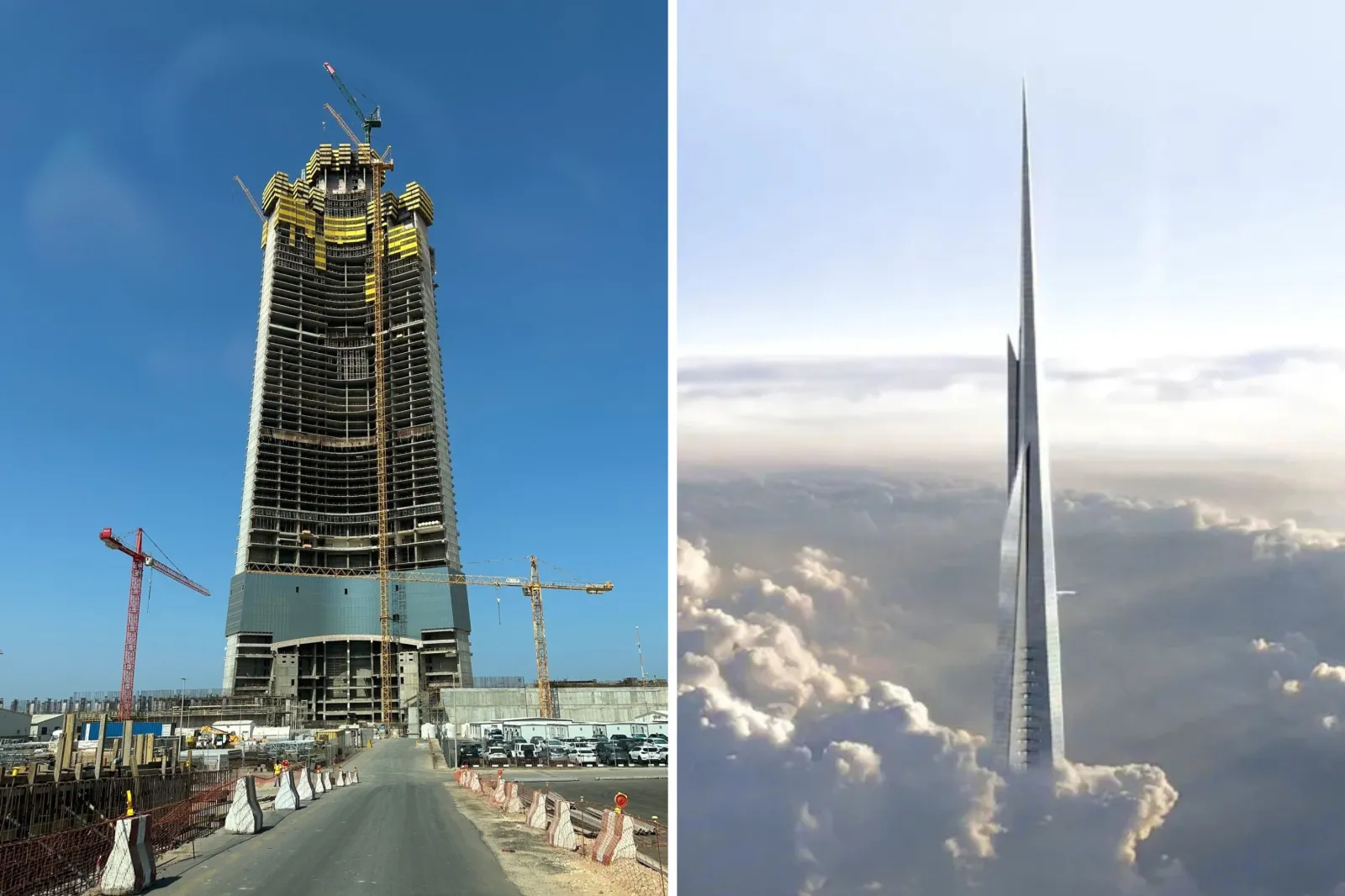
The world's tallest building—the Jeddah Tower in Saudi Arabia—will be soaring to new heights this month, as it is set to soon gain its 100th floor with construction seeing “great progress” and “moving very well,” one of the skyscraper's architects told Newsweek.
Designed by architects Adrian Smith and Gordon Gill, the Jeddah Tower will reach unprecedented heights, soaring past a kilometer—or about 3,281 feet—above the ground, Gill told Newsweek.
Once topped off, it can officially seize the title of world's tallest building from the Burj Khalifa in Dubai, which stands at 2,717 feet high and was also designed by Smith.
Read More on Travel
Noting that construction of the Jeddah Tower has currently reached its 95th floor, Gill told Newsweek: “It’s headed towards 100 stories here in a couple of weeks…so, they've made great progress…they’re moving very well.
"As the building is going up, the floor plates obviously are getting a little smaller. So, the pace is picking up on the delivery of floor-by-floor construction, so it's looking good.”
“So, they are moving toward the 100th floor here in a couple of weeks,” the architect added. After this, construction will move on towards the observation deck level, before adding the spire that will form the top of the tower.
...
While there is “no specific release on the [exact] number of floors,” Gill said, the tower "will have more than 130 floors" and be over 3,281 feet high, the firm told Newsweek back in August.
The skyscraper’s latest projected completion date of August 2028 remains unchanged as of today, Gill added, noting that “I haven’t heard anything different other than 2028.”
Asked what makes the Jeddah Tower stand out from previous buildings that had been declared the world’s tallest, Gill said it comes down to its simplicity.
The architect explained: “I think with this particular building, there is a kind of simplicity to it, and the power of it comes from that simplicity. It's a very clear, very simple diagram. I often liken it to a folded airplane that a child might make to stand on end…I think its aesthetic is very simple and striking.”
Gill described the silhouette of the Jeddah Tower as basically a “tripod with three spots that are accelerating at different rates, so they don't all come to one single point, they stop at different points.”
While there is “a lot of engineering behind” the creation of this type of building, having to consider the wind and other factors, Gill noted that “the building itself is extremely efficient. I think what makes it stand out differently is that it's achieving greater heights with greater efficiency.”
Gill explains that the majority of embodied carbon–the greenhouse gas emissions created by the construction before a building becomes operational–we’re seeing is “primarily in the infrastructure and the structure of these buildings.
“So, if we can simplify or reduce that infrastructure and save on concrete and steel and still accelerate at greater heights, we're becoming more and more efficient every day. So, I think that's a great achievement for our projects.”
Gill sees the Jeddah Tower—which will form part of the greater Jeddah Economic City large-scale urban development that is also presently being constructed—as “a kind of new growth, as it's part of a huge master plan that's currently being developed, and we're seeing that now kind of take shape and take form.”
He concldued: “So, in time, this will be a city all onto its own, and we're very excited about that. It's a great catalyst for Jeddah and for the kingdom of Saudi Arabia.”
Do you have an architecture or design-related story to share? Let us know via life@newsweek.com, and your story could be featured on Newsweek.
View 0 Comments
Submit Correction
View Editorial & AI Guidelines