10
Loading video...


By Gabe Whisnant and Leonardo Feldman
Share
Newsweek is a Trust Project member
See more of our trusted coverage when you search.Prefer Newsweek on Googleto see more of our trusted coverage when you search.
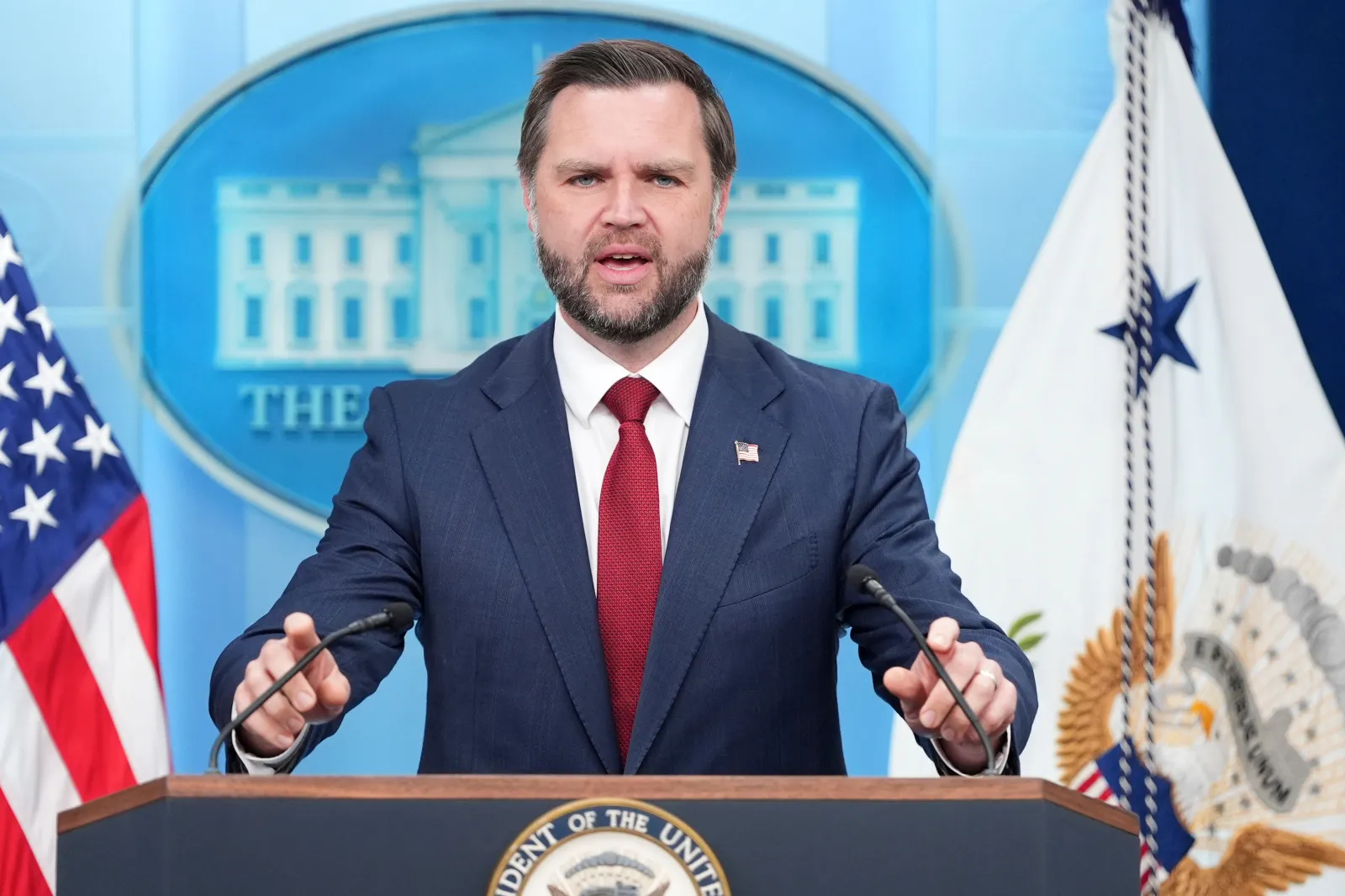
Vice President JD Vance on Thursday pushed back against growing public opposition to data centers, arguing that much of the backlash stems from fears that large AI facilities will strain local power grids and raise household electricity bills.
Speaking during a White House press briefing, Vance said he had seen polling showing resistance to new projects and acknowledged that "a very large chunk" of the opposition comes from residents who believe "my neighborhood's going to get worse" and "my power bills are going to go up."
Vance's comments come as polls suggest skepticism about data centers extends to many of President Donald Trump's supporters. An Economist/YouGov survey conducted August 21-24 found that 47 percent of 2024 Trump voters opposed having a new data center built in their community, compared with 35 percent who supported one. A majority, 52 percent, also said a local data center would likely drive up power bills.
Read More on Politics
...
Opposition to data centers extends beyond Trump's political base. A Gallup survey conducted in March found that 7 in 10 Americans opposed building a data center in their local area. Meanwhile, a July Politico poll found 41 percent would oppose a facility within three miles of their home, up from 28 percent in January.
The scale of projected demand underscores the immense pressure facing utilities. After consuming roughly 4.4 percent of U.S. electricity in 2023, data center power demand is projected by the Department of Energy to surge to between 6.7 percent and 12 percent by 2028—reaching as high as 580 terawatt-hours annually. Looking further ahead, the Electric Power Research Institute warns that data centers could devour up to 20 percent of the nation's electricity by 2035, with the heaviest concentration hitting states like Virginia.
Related Story
Jobs Surge Puts Donald Trump and Kevin Warsh on Collision Course
The backlash has increasingly translated into political action. New York earlier this year approved a one-year moratorium on certain large-scale data center projects while regulators study their impact on electricity demand, utility costs and local communities.
"As data center development threatens to hike up utility bills, deplete our natural resources, and create uncertainty for New Yorkers, it's my responsibility to take action and lead," New York Democratic Governor Kathy Hochul said in July.
Lawmakers in states including Pennsylvania, Delaware, Michigan and Vermont have also considered proposals to pause or restrict new developments, while local governments in major data center hubs have tightened zoning rules or delayed approvals amid concerns over energy use, water consumption and strain on existing infrastructure.
Donald Trump Makes Economic Case for Data Centers
On Friday, Trump pushed back on criticism of data centers, arguing they bring economic growth while minimizing strain on local infrastructure. The president told reporters in the Oval Office that if he were running a state or town, he would want "as many data centers as I can because they throw up tremendous amounts of money."
Trump contended that modern facilities increasingly operate without relying on local power grids, saying new projects approved by his administration "all create their own energy" by building dedicated power plants. He claimed some would even generate surplus electricity that could be fed back into the grid, helping lower energy costs.
The president also argued that communities hosting data centers stand to gain from lower taxes, higher property values and greater economic activity. "If you want success, you have to go with the data center," he said, while acknowledging that projects should be carefully sited and reviewed for issues including noise and environmental impacts.
Warning that opposition could drive investment elsewhere, Trump said communities that reject data centers may eventually regret the decision, arguing that areas that welcome the facilities can become "wealthy and rich and lower taxes" while attracting long-term economic development. He added that many other locations in the U.S. and abroad are eager to host the projects if local leaders turn them away.
What Is Trump's Ratepayer Protection Pledge?
Vance argued that the answer is not to halt data center construction but to build more power alongside it. He said Trump had insisted on "ratepayer protection" and that "if you're going to build a data center, you have to feed power back into the grid as opposed to taking power out."
His comments echoed the Trump administration's "Ratepayer Protection Pledge," a voluntary March agreement signed by Amazon, Google, Meta, Microsoft, OpenAI, Oracle and xAI aimed at shielding consumers from the energy demands of the AI boom. Under the pledge, the companies agreed to pay for the new power generation and transmission infrastructure needed to support their data centers rather than passing those costs on to households.
Because the agreement is voluntary and does not carry statutory enforcement mechanisms, Republican lawmakers have since introduced the Ratepayer Protection Act, which would require large energy users such as hyperscale data centers to bear the full cost of grid upgrades needed to serve their facilities.
Energy Secretary Chris Wright added that the policy would allow the U.S. to expand AI development while protecting consumers from higher electricity costs. “This allows America to maintain our lead in artificial intelligence by driving rapid investment in our country, rapid investment in new power infrastructure,” he said.
Ari Peskoe, director of Harvard Law School's Electricity Law Initiative, questioned how much practical protection the pledge offers consumers. Calling the initiative "a press release," Peskoe told Newsweek via email that neither the White House nor another federal entity is enforcing compliance. He also argued that existing rules often fall short, saying that "federally regulated markets and transmission rates socialize billions in data center costs."
Some Republicans who support data center development have also stressed the importance of protecting local communities and utility customers from the costs associated with the AI boom.
Representative Pete Stauber of Minnesota told Newsweek this week he has four conditions for supporting projects: "The local community's got to have input. It can't increase rates, or taxes, and they have to use their own water and energy."
Representative Ralph Norman of South Carolina said communities should closely examine proposals before approving them. "Each community is going to have to take ownership, learn about it, how much water usage, how much electricity usage," Norman told Newsweek. "I don't think they ought to be subsidizing them."
Other Republicans have strongly backed the projects. Representative Joe Wilson of South Carolina said concerns about data centers have at times been fueled by misinformation and argued the facilities can provide substantial local benefits through tax revenue and economic development. Wilson told Newsweek he was confident energy concerns could ultimately be addressed through new generating capacity, including small nuclear reactors.
Vance Says AI Race With China Requires More Power
Framing the issue as part of a broader economic agenda, Vance said Trump is trying to make the United States "a nation of builders again" and warned against policies that slow new infrastructure.
"We've got to build more power plants," he said. "We cannot be a country that says we're not going to build anything anymore."
Trump on Monday doubled down on his support for data centers, warning that communities that reject the projects risk becoming "backwards and poor," even as a growing number of Republicans have backed restrictions, moratoriums and other measures aimed at slowing their expansion and giving local communities a greater role in the approval process.
Trump has argued that data centers bring jobs, investment and tax revenue, and has cast the facilities as critical to the United States' competition with China. Representative Tim Burchett, a Tennessee Republican, told MeidasTouch in response to Trump’s post on Monday: “I guess I’m backwards and poor.”
The vice president also tied the debate to competition with China, arguing that American power production has failed to keep pace with demand. He said the backlash against data centers is "downstream of the fact that the United States doesn't build enough power," and warned that expanding energy and AI infrastructure is critical if the U.S. hopes to maintain an edge in artificial intelligence.
Looking ahead, Peskoe said regulators are increasingly focused on mitigating the impacts of large data centers. "The industry and regulators are spending an inordinate amount of time on just protecting the public from the consequences of massive data centers," he said.
JD Vance’s Joe Biden Remark Draws Criticism on X
During the same White House briefing, Vance was asked why he would represent the administration in New York at events marking the 25th anniversary of the September 11 attacks while Trump attends a commemoration at the Pentagon.
Vance described attending the New York event as an “amazing honor” before joking that he was looking forward to spending time with former President Joe Biden. “I’m sure we’ll have many, many intense intellectual conversations,” he said. “We’ll have a great time.”
The comment drew criticism from several users on X, who argued that a joke at Biden’s expense was inappropriate in the context of the anniversary.
The account Republicans Against Trump characterized the exchange as a Biden joke, while another user, Barbara Othmer, wrote that it showed "how mean Vance really is," described it as a “cheap shot,” and questioned the tone of the remark on a day of remembrance.
Contact Newsweek editors on this story: Samantha Beech and Sam Wilson.
Submit Correction
View Editorial & AI Guidelines