...

By Ryan Chan
China News Reporter
0
Share
Newsweek is a Trust Project member
See more of our trusted coverage when you search.Prefer Newsweek on Googleto see more of our trusted coverage when you search.
Japanese fighter jets have intercepted multiple Russian military aircraft, including nuclear-capable bombers, approaching the country's airspace, according to official reports.
Russia's Defense Ministry said the bomber-led flight was conducted over the neutral waters of the Sea of Japan, also known as the East Sea in South Korea, noting that its aircraft operated in strict accordance with international rules for the use of airspace.
Confirming the incident on Friday, the Joint Staff Office of Japan's Defense Ministry said it would maintain vigilance and take "all necessary measures" against airspace violations in accordance with international law and the Self-Defense Forces Law.
Read More on World
...
Why It Matters
Russia maintains a military presence in the country's Far East region, which lies opposite the Japanese archipelago, despite its war with Ukraine. Japan, a key United States ally, regularly intercepts Russian forces near its territorial waters and airspace.
Tensions between Moscow and Tokyo remain, as Japan has claimed sovereignty over four islands of the Kuril archipelago, located northeast of Japan's Hokkaido and south of Russia's Kamchatka Peninsula, which are currently under Russian administration.
The continued Russian military deployment in the Pacific region could be viewed as a countermeasure against the U.S.-Japan alliance, under which Japan hosts about 60,000 U.S. troops, along with equipment such as missile systems, raising Moscow's concerns.
What To Know
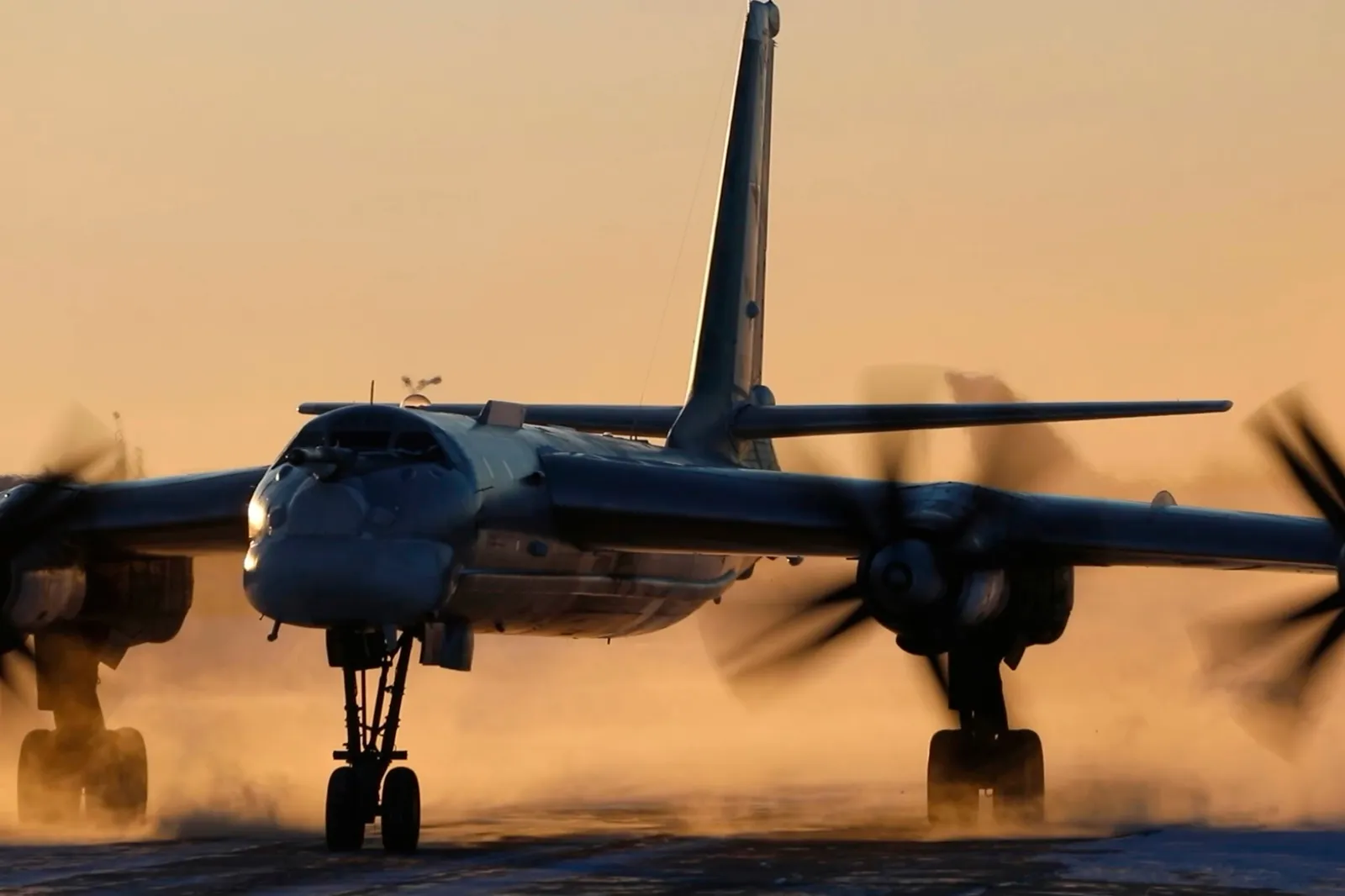
The Russian Ministry of Defense said Wednesday that Tu-95MS strategic bombers, without disclosing the exact number of aircraft, conducted a planned mission lasting more than 11 hours over the Sea of Japan, escorted by Su-35S and Su-30SM fighter jets.
According to Japan's Joint Staff Office, three groups of Russian aircraft were tracked over different parts of the Sea of Japan on Wednesday. Each group consisted of at least two Tu-95MS bombers, and two of the groups also included two fighter aircraft each.
No Russian aircraft entered Japan's sovereign airspace, which extends up to 13.8 miles from the coastline, according to a map provided by Japan's Joint Staff Office.
Japan's Joint Staff Office reported the Air Self-Defense Force deployed fighter jets and took appropriate action amid the possibility of airspace violations over the Sea of Japan.
In a post on the social media platform X, Japanese Defense Minister Shinjiro Koizumi said the Russian bombers are capable of carrying nuclear weapons, noting that Russia also deployed bombers for a joint air patrol with China near Japan in December.
"This cannot be seen as anything but a show of force against our country," he wrote, warning that Russia's military movements, along with its strategic coordination with China, have raised "strong defense concerns" in both Japan and the Indo-Pacific region.
According to the Nuclear Information Project of the Federation of American Scientists, each Tu-95MS bomber can carry between six and 14 nuclear-armed cruise missiles, and Russia has used this type of aircraft to launch conventional strikes against Ukraine.
What People Are Saying
Japanese Defense Minister Shinjiro Koizumi said of the Russian mission: "In response, the Air Self-Defense Force scrambled fighter jets from the Central Air Defense Force and others, and strictly implemented air defense identification zone measures. To all the members of the Air Self-Defense Force who professionally protect our country's airspace day and night, thank you!"
Japan's Joint Staff Office said: "The Ministry of Defense and the Self-Defense Forces will continue to maintain the utmost readiness 24 hours a day, 365 days a year, to protect our country's territory and the peaceful daily lives of our citizens."
What Happens Next
Russia is expected to continue its military activity near Japan to signal its presence. It remains to be seen how Japan will bolster its defense posture with the U.S. in response.
View 0 Comments
Submit Correction
View Editorial & AI Guidelines