...

By Ellie Cook
Senior Defense Reporter
0
Share
Newsweek is a Trust Project member
See more of our trusted coverage when you search.Prefer Newsweek on Googleto see more of our trusted coverage when you search.
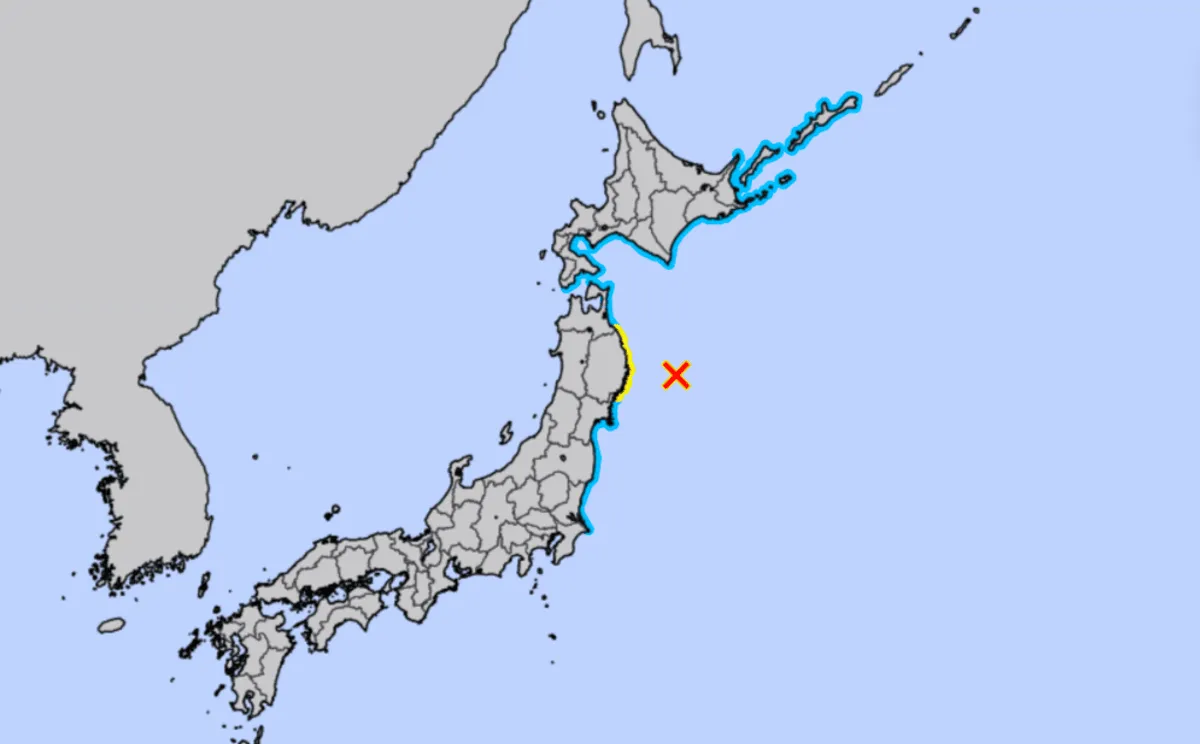
Japanese authorities issued a tsunami alert for the northeast of the country on Sunday after a magnitude 6.7 earthquake was recorded in the Pacific Ocean, close to the country.
The Context
Japan sits on the Pacific's earthquake belt, often dubbed the ocean's "ring of fire." Around 90 percent of all the world's earthquakes happen along the 25,000-mile horseshoe.
Read More on World
Earthquakes or undersea volcanic eruptions can trigger tsunamis. These waves can be small and only impact a localized area, or cause widespread destruction.
Japan's "complex coastline is vulnerable to tsunamis," Tokyo's Foreign Ministry has said. The vast majority of tsunamis occur in the Pacific Ocean, although they can happen in any large body of water.
...
What To Know
Tsunamis of up to 1 meter, around 3.2 feet, could reach land in Japan's Iwate Prefecture, the Japan Meteorological Agency said. Areas to the north and south of the region may see a slight rise in sea levels.
The earthquake struck shortly after 5 p.m. local time on Sunday (3 a.m. ET) at a depth of roughly 10 kilometers, or about 6 miles, the weather agency said.
The earthquake measured 4 on the country's own seismic scale, Japan's NHK broadcaster reported. Known as Shindo, measures how much shaking an earthquake causes on a scale of 0 to 7.
An earthquake measured at 4 on the Shindo scale will likely cause lights to swing violently and some objects to overturn, while drivers in vehicles will likely feel the impact.
Some bullet train services were temporarily stopped and a power outage was detected in an unspecified area, Japan's Kyodo News Agency reported. A tsunami wave reaching 10 centimeters was recorded in the coastal city of Ofunato and a "minor" wave reached Miyako, a city just north of Ofunato, according to the news agency.
Close to 20,000 people were killed in March 2011 in Japan after a powerful earthquake triggered a huge tsunami in the country's northeast, sometimes referred to as the Great East Japan earthquake.
The 40-meter-high tsunami took out the power supply and cooling of three nuclear reactors at Japan's Fukushima nuclear power plant in one of the world's worst-ever nuclear disasters. Thousands of people were evacuated from the area.
Scientists said at the time the earthquake was powerful enough to shift the Earth's axis. It was the largest magnitude earthquake ever recorded in Japan.
Japanese authorities said around 122,000 buildings were entirely destroyed and another 283,000 significantly damaged. Just short of 750,000 buildings sustained some level of damage.
The earthquake and tsunami racked up roughly $235 billion in damages, the World Bank estimated shortly after the disaster.
Update 11/9/2025 at 5:25 a.m. ET: This article has been updated with additional information.
View 0 Comments
Submit Correction
View Editorial & AI Guidelines