...


By Micah McCartney and John Feng
0
Share
Newsweek is a Trust Project member
See more of our trusted coverage when you search.Prefer Newsweek on Googleto see more of our trusted coverage when you search.
Japan is accelerating the construction of a training base for U.S. and Japanese fighter jets on a southwestern island as it steps up efforts to counter the growing threat from China.
Why It Matters
United States defense planners view Japan, a U.S. treaty ally, as strategically vital to its military posture on the front lines of the Western Pacific.
Read More on World
China's People's Liberation Army is pushing up against the First Island Chain, a string of islands the Pentagon views as key to containing its East Asian rival in the event of a conflict. Japan's Defense Ministry has dubbed China its "greatest strategic challenge."
Tokyo has vowed to ramp up defense spending to grow its role in the U.S.-led defense network, and the work at Mageshima is but one node in a years-long effort by Japan to bolster its military presence in its far-west islands, including those closest to China-claimed Taiwan, a possible flashpoint.


...
What To Know
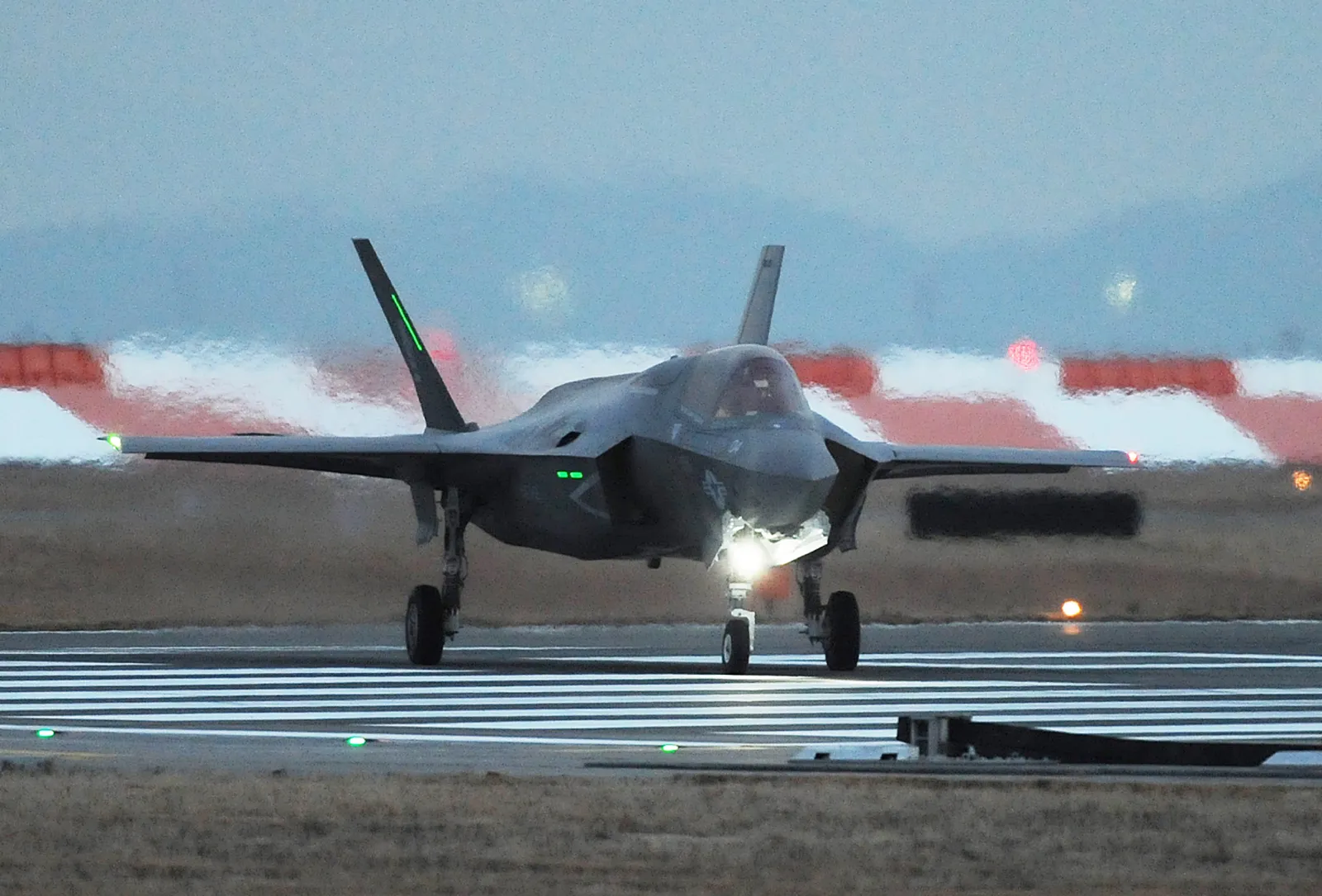
The Japanese government purchased Mageshima, an uninhabited islet in Kagoshima prefecture, for $146 million in 2019. By the start of the next decade, it is to serve as the main flight operations training center for F-35Bs, the short takeoff and vertical landing variant of the Lockheed Martin stealth jet flown by the U.S. Marine Corps and its Japanese counterpart.
Mageshima is located in the narrow Osumi Strait, one of the few waterways used by the Chinese navy to gain access to the Philippine Sea and the wider Pacific Ocean. Satellite imagery reviewed by Newsweek showed that base construction on the island has continued rapidly since it began in January 2023.
The work has not gone unnoticed in Beijing. Last week, China's state broadcaster CCTV released a special report highlighting the pace of Japan's rearmament campaign, aired amid an ongoing diplomatic spat between the two governments over recent comments by Prime Minister Sanae Takaichi.
A report published on Sunday by the Chinese state-run tabloid Global Times said the construction on Mageshima had "accelerated markedly."
"At present, major military facilities—including a 2,000-meter (6,560-foot) runway, ammunition depots, fuel infrastructure such as storage tanks, and a temporary pier capable of accommodating large warships—have already taken shape," the newspaper cited unnamed analysts as saying.
The number of workers involved in construction, now in its third year, surpassed 6,000 in October for the first time—1,000 more than in December 2024, according to Japan's TBS News.
U.S. carrier-based fighter jets previously conducted takeoff and landing drills at the Atsugi Naval Air Facility near Tokyo, but the site was moved more than 700 miles south to Iwo To Island in the 1990s due to noise complaints.
The travel distance increased further for U.S. Marine aircraft after they relocated from Atsugi to Iwakuni. Washington pressed Tokyo to establish a more accessible training base, and Megashima was eventually selected.
Song Zhongping, a Chinese military affairs expert, told the Global Times that the base could serve not only as a training facility for pilots but also as part of Japan’s preparations for "military expansion." He also observed Mageshima’s strategic proximity to the Ryukyu Islands.
Last month, Japanese Defense Minister Shinjiro Koizumi confirmed plans to deploy anti-air missiles on Yonaguni, a Ryukyu islet just 60 miles from Taiwan’s east coast. Beijing condemned the move as “extremely dangerous,” saying it would further escalate military rivalry.
Koizumi said the deployment was essential to national security efforts.
These developments come amid heightened tensions between Tokyo and Beijing following Prime Minister Takaichi’s November 7 remarks that Japanese forces could intervene in the Taiwan Strait to help U.S. forces break a potential Chinese blockade of the island during a crisis.
Takaichi intimated a military blockade would present a “survival-threatening situation” for Japan, a rare justification for military action under the country’s pacifist postwar constitution. While previous Japanese leaders had linked the situation around Taiwan to Japanese security, Takaichi’s was the most explicit articulation yet of conditions for a possible intervention.
Chinese officials and state-linked commentators have launched a sustained campaign of condemnation, demanding that she retract the statement and accusing Japan of reviving the militaristic adventurism of the 1930s and 1940s.
China claims Taiwan as its territory, though the Communist Party-led government in Beijing has never ruled there. Chinese leaders continue to vow unification—by force if necessary.
What People Are Saying
Mao Ning, Chinese Foreign Ministry spokesperson, said during the ministry's November 21 press conference: "In recent years, Japan has kept easing the restrictions and seeking military buildup...If Japan seeks to go back to the path of militarism, violate its commitment to peaceful development and disrupt the postwar international order, the Chinese people will not allow it, and the international community will not allow it."
Japan's Defense Ministry previously said of the Mageshima base: "It will hold great significance for Japan’s peace and security. In the event of a large-scale disaster, rescue operations in the region could also be conducted more effectively."
What Happens Next
The Mageshima base is slated for completion in March 2030.
View 0 Comments
Submit Correction
View Editorial & AI Guidelines