
...

By Gabe Whisnant
News Editor
0
Share
Newsweek is a Trust Project member
See more of our trusted coverage when you search.Prefer Newsweek on Googleto see more of our trusted coverage when you search.
The Supreme Court on Tuesday ruled for the Trump administration in a closely watched immigration case involving the government’s authority over green card holders accused of crimes.
The 6-3 decision broadens the power of border officials and could make it easier for authorities to place lawful permanent residents on immigration parole based on suspected wrongdoing. The ruling affects green card holders returning to the U.S. and may expand the government’s ability to pursue deportation proceedings before a criminal conviction is secured.
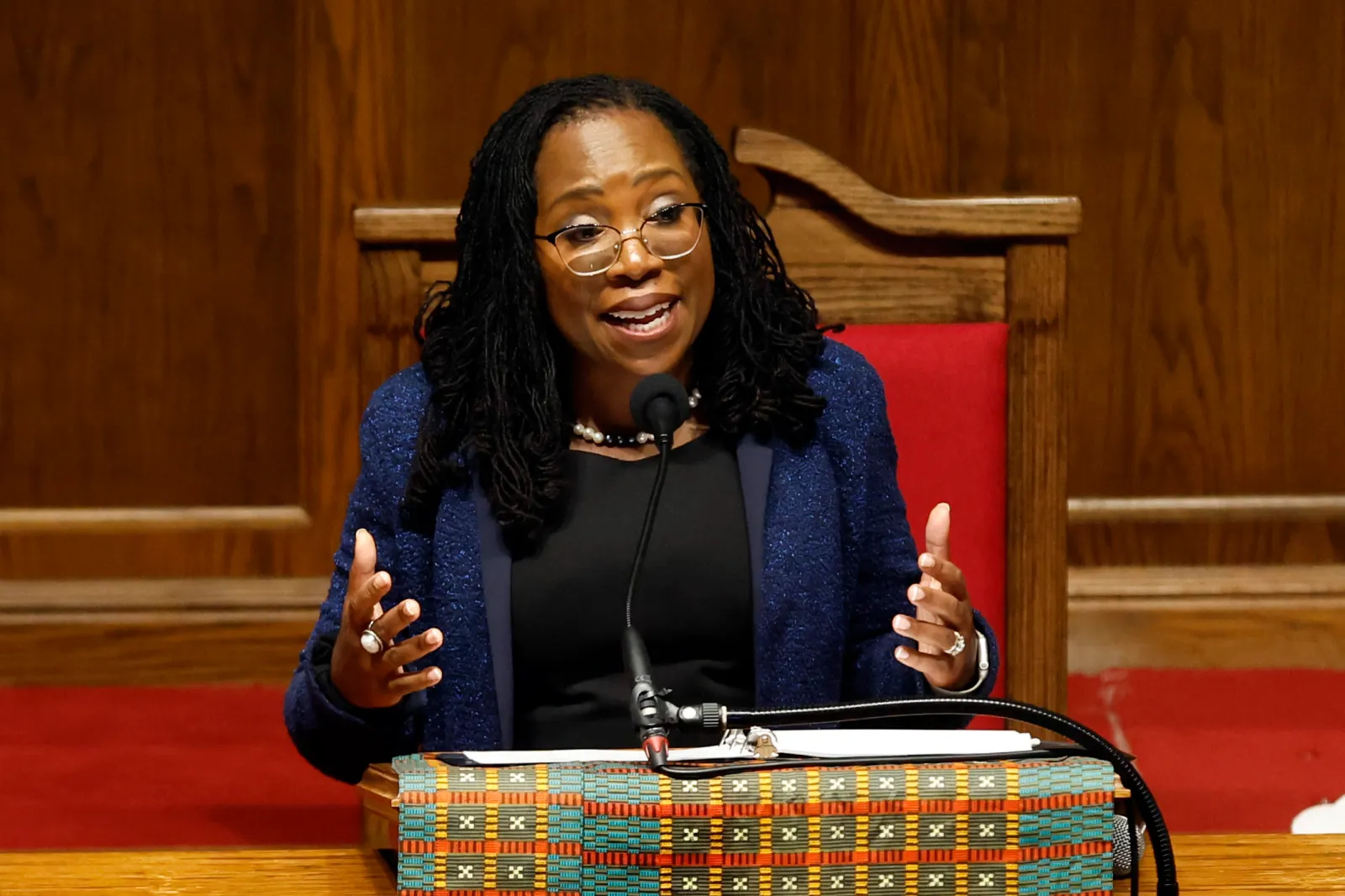
In a sharp dissent, Justice Ketanji Brown Jackson warned the court had effectively given immigration agents a “massive blank check,” while the majority said officers were not required to prove alleged criminal conduct before taking such action.
Read More on Politics
She continued, "With today’s decision, the Court allows the Government to return an LPR (lawful permanent resident) to the status of 'seeking an admission' upon his entry at the border, so long as the Government is able to show later that he was eventually convicted. That sequencing undermines the plain terms and basic operation of the relevant statutory scheme, which guarantees that LPRs will not be 'regarded as seeking an admission' at the border unless certain exceptions apply."
James Percival, the general counsel for the Department of Homeland Security, called the ruling a "big win" in a an emailed response to Newsweek.
“Today, the Supreme Court affirmed an important tool DHS has long used to prevent criminals from entering our country. Big win!" Percival said.
...
The ruling in Blanche v. Lau marks a sweeping victory for the Trump administration’s immigration agenda, which had actively urged the high court to take an expansive view of executive power. Green card holders are now forced to prove they are legally entitled to remain in the U.S., rather than requiring the government to prove they should be removed.
Why the Supreme Court Ruled Against Muk Choi Lau
The case centers on Muk Choi Lau, a lawful permanent resident who was placed on immigration parole by border officials in 2012 when returning to the U.S. from a short trip abroad. At the time of his reentry, Lau was facing an unresolved state charge of trademark counterfeiting.
Lau argued that the government overstepped its bounds by using the parole status to swiftly trigger deportation proceedings after he pleaded guilty to the counterfeiting charge and received probation. A lower appellate court agreed with Lau, ruling that the government needed "clear and convincing evidence" of a disqualifying crime at the moment of reentry, not just a pending accusation.
The Supreme Court’s conservative majority rejected that limitation. Writing for the majority, Justice Clarence Thomas held that federal border officials must make "quick judgments on the spot," and that suspicion of a crime is enough to press the pause button via parole while charges play out.
"The Second Circuit derived its clear-and-convincing-evidence requirement not from the statutory text, but from inapposite Board of Immigration Appeals precedent… We decline to read into the INA (Immigration and Nationality Act) an additional clear-and-convincing-evidence burden on border officers entrusted with making 'quick judgments on the spot' when that burden is nowhere in the statute," Thomas wrote for the 6-3 majority.
Ketanji Brown Jackson Warns of 'Cold Comfort' for Paroled Green Card Holders
Jackson, joined in her dissent by Justices Sonia Sotomayor and Elena Kagan, fiercely disputed that logic, arguing that treating a long-term permanent resident as an arriving stranger based on a mere accusation creates a broad loophole for executive overreach past the statutory boundaries Congress has set.
"To be sure, if the paroled LPR ends up being acquitted, the Government’s eventual effort to remove him on this basis will fail (insofar as the charge of removability was based only on the qualifying offense). But that is likely cold comfort to the LPR, who by then might have spent years in legal limbo (with only the protection of a temporary green card) or worse, in detention," Jackson wrote.
She also called the ruling, "A loophole vast enough to swallow protections."
Newsweek has reached out to the Department of Justice and the Department of Homeland Security via email on Tuesday afternoon for comment.
The court is also weighing cases tied to President Donald Trump’s efforts to end birthright citizenship, revive a restrictive asylum policy, and terminate temporary legal protections for migrants fleeing war and natural disasters in their home countries.
View 0 Comments
Submit Correction
View Editorial & AI Guidelines