
...

By Ian Randall
Deputy Science Editor
0
Share
Newsweek is a Trust Project member
See more of our trusted coverage when you search.Prefer Newsweek on Googleto see more of our trusted coverage when you search.
Human egg cells have the ability to "power down" their internal recycling plants to protect themselves from harmful DNA damage as they age.
This is the conclusion of an international team of researchers whose study helps reveal how eggs can manage to avoid common wear-and-tear for decades before pregnancy.
Women are born with some 1–2 million immature eggs—or "oocytes"—but this stock is diminished to a few hundred by the time of menopause.
Read More
Sperm: Embryologist Reveals the Difference Between ‘Good’ and ‘Bad’ Swimmers3 min read

Parents Can Choose Genetic Makeup of Their Children With New IVF Option4 min read

New Fertility Drug Boosts Chances of Pregnancy3 min read

"By looking at more than a hundred freshly donated eggs, the largest dataset of its kingdom, we found a surprisingly minimalist strategy that helps the cells stay pristine for many years," said paper author and molecular biologist Elvan Böke of the Centre for Genomic Regulation in Barcelona, Spain.
"We speculate that this reduced activity state helps oocytes conserve energy and preserve essential components needed for early embryo development."
The findings, the researchers say, may help improve in vitro fertilization (IVF) outcomes by changing the guidance given to fertility patients around which supplements to take.
...
In their study, Böke and colleagues collected more than 100 eggs from 21 healthy donors, all aged between 19 and 34, from a fertility clinic in Barcelona.
Of the eggs sampled, 70 were ready for fertilization, while 30 were still-developing oocytes.
What distinguishes this study from the majority of its predecessors is that it was conducted on healthy human eggs collected directly from women—in fact, it is the largest-scale study to use this approach to date.
In contrast, most prior research examined eggs that had been ripened artificially in vitro—a process which can often lead to eggs that behave unusually and are associated with poorer IVF outcomes.
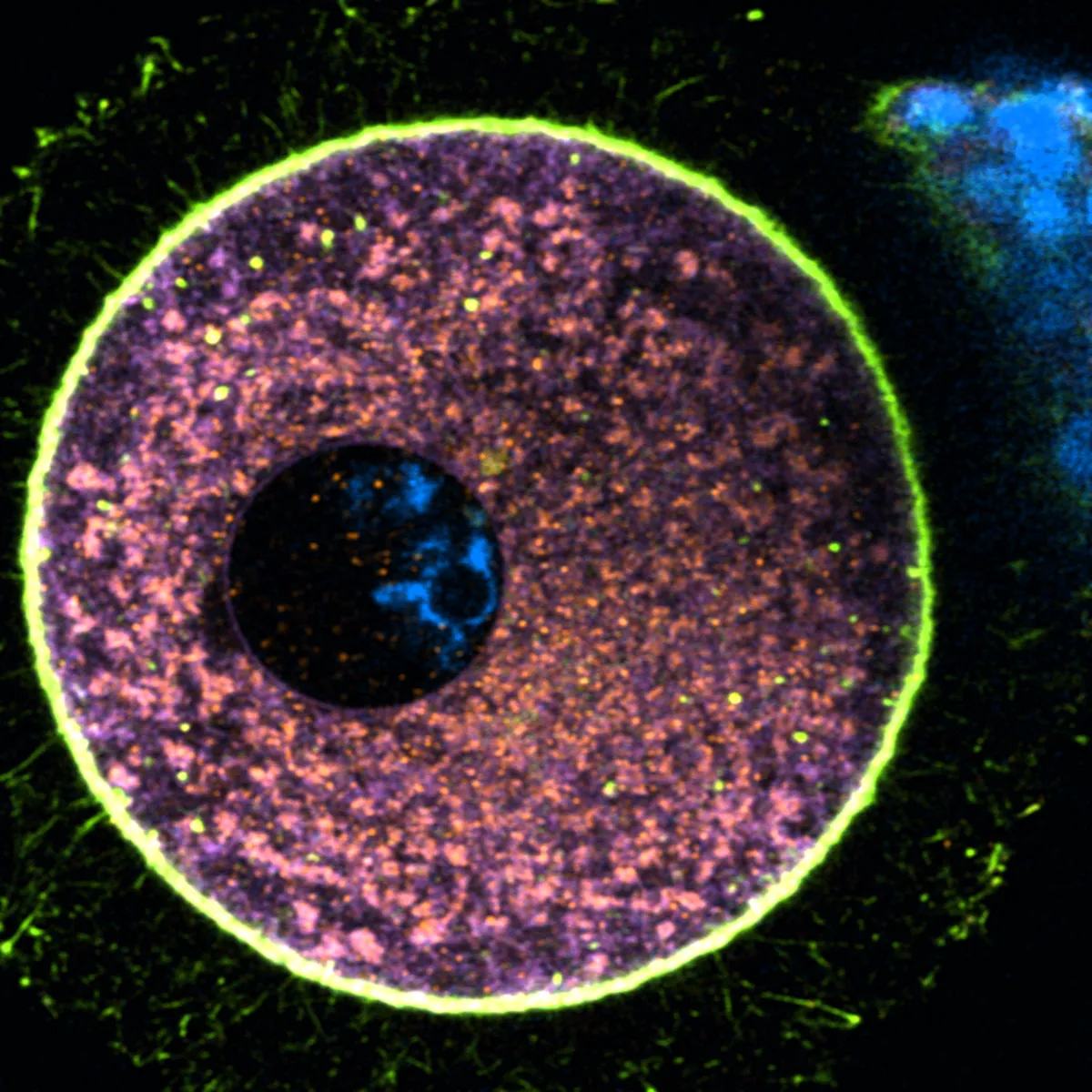
The team used fluorescent probes to track lysosomal, mitochondrial and proteasomal activity in the cells.
Lysosomes and proteasomes are the primary waste disposal and recycling centers of cells. However, their operation required the production and consumption of energy (supplied via the mitochondria).
This, in turn, can produce reactive oxygen species (ROS)—harmful molecules that have the ability to damage both cellular membranes and DNA.
The team found that all three activity levels started out some 50 percent lower than in the eggs' surrounding support cells—and, moreover, such fell further as the eggs matured.
In fact, real-time imaging revealed eggs jettisoning lysosomes into the surrounding fluid, while their mitochondria and proteasomes simultaneously migrate to the outer rim of the cells.
This is "a type of spring clearing we didn't know human eggs were capable of," said paper author and molecular biologist Gabriele Zaffagnini of the University of Cologne, Germany, in a statement.
While the team did not measure the production of ROS in the cells, they believe that by putting their recycling facilities in "low power mode," the eggs are able to minimize the creation of the harmful molecules while still doing enough internal housekeeping to survive.
The findings complement those of a previous study by the team which found that human oocytes suppress a fundamental process in cellular energy production in order to minimize the production of harmful ROS.
Together, the researchers explained, the studies suggest that human eggs have multiple ways to "power down" and reduce the risk of accidental damage over time.
...
With this study complete, the researchers are now looking to perform a similar analysis on eggs from both older donors and those involved in failed IVF cycles to explore whether aging or disease impacts eggs' ability to throttle down their cellular waste disposal units.
The team are also working to investigate other fundamental aspects of oocyte biology.
"I often use the analogy of a car engine to explain our approach: if you don't know how an engine works or what its parts do, you can't fix it when something goes wrong," Böke told Newsweek.
She said: "The same is true for human oocytes. Despite their central role in reproduction, we still lack a deep understanding of basic oocyte biology.
"So, in our lab, we first study how a healthy oocyte should function for a given biological pathway—and then examine how that pathway changes with age."
The findings of the researchers' investigations could lead to new approaches to help boost the success rate of IVF procedures—approximately half of which, at present, are not successful.
"Fertility patients are routinely advised to take random supplements to improve egg metabolism, but evidence for any benefit for pregnancy outcomes is patchy," said Böke.
She concluded: "By looking at freshly-donated eggs, we've found evidence to suggest the opposite approach—maintaining the egg's naturally quiet metabolism could be a better idea for preserving quality."
Do you have a tip on a health story that Newsweek should be covering? Do you have a question about IVF? Let us know via health@newsweek.com.
Reference
M. A., & Böke, E. (2022). Oocytes maintain ROS-free mitochondrial metabolism by suppressing complex I. Nature, 607(7920), 756–761. https://doi.org/10.1038/s41586-022-04979-5
Zaffagnini, G., Solé, M., Duran, J. M., Polyzos, N. P., & Böke, E. (2025). The proteostatic landscape of healthy human oocytes. The EMBO Journal. https://doi.org/10.1038/s44318-025-00493-2
View 0 Comments
Submit Correction
View Editorial & AI Guidelines