10
Loading video...

By Tom O'Connor
Deputy Editor, National Security and Foreign Policy
0
Share
Newsweek is a Trust Project member
See more of our trusted coverage when you search.Prefer Newsweek on Googleto see more of our trusted coverage when you search.
What most worries Ofir Akunis, Israel’s Consul General in New York, is not the uncertainty surrounding the war with Iran, nor the other bouts of turmoil and conflict ravaging the Middle East—it’s a drift in American politics he warns could one day spell the end of a historic alliance.
Citing recent electoral victories by progressive Democratic Party candidates critical of Israel and U.S. intervention abroad, Akunis argued that “the reality is that some people here, for sure, prefer the ayatollahs rather than the American administration.”
“You can hate your president, you can love your president, you can ignore him, you can want to change the administration,” Akunis told Newsweek. “All of this is within the frame of the democratic game. But to prefer your enemies rather than your political opponents, this is something new.”
Read More
This Map Shows Iran, Israel and Saudi Arabia’s Allies in a New Middle East11 min read

Iran War Puts Saudi Arabia at Odds With Growing Israel-UAE Axis11 min read

Where the New Middle East Order Stands Today7 min read


...
While the diplomat said it was his “hope that the United States of America will always be with us,” he said Israel will need to prepare to be more independent given the trends he was witnessing.
Already, Akunis said, Israel has a proven record of indigenous security achievements, including the formidable Iron Dome and other domestically produced defense systems that have blunted the worst of the rocket, missile and drone waves that have bombarded the nation since the Palestinian Hamas movement’s October 2023 assault, which plunged the region into crisis.
But an enhanced sense of independence does not necessarily mean going it alone.
“Beside our allyship with the United States,” Akunis said, “we will continue building coalitions with other countries.”

...
U.S. Relations Wane
The schism is highlighted by Israeli Prime Minister Benjamin Netanyahu’s rejection of the Board of Peace’s 15-point roadmap implementing President Donald Trump’s Gaza peace plan. The proposal, announced on July 30 as a follow-on to last year’s framework, called for Hamas and other armed groups to disarm, Israeli forces to withdraw in phases and security to shift to an International Stabilization Force, a new Palestinian police force and a technocratic Palestinian administration. Trump hailed it as a “monumental step,” but Netanyahu said the Israel Defense Forces would not withdraw until Hamas is “genuinely disarmed.”
It followed Trump’s sidelining of Israel in Iran peace talks. Both U.S. and Israeli media have reported growing frustration among Israeli officials over their limited involvement in negotiations with Tehran, with some accounts describing them as largely excluded from key discussions. It marked a sharp departure from the close coordination that has traditionally characterized U.S.-Israel policy on Iran, an issue Netanyahu has long framed as Israel’s foremost security challenge. Subsequent reporting also pointed to tensions between Trump and the prime minister over efforts to pursue a diplomatic off-ramp to the conflict.
The drift has also been underscored by rising-profile Democrats who cast support for Israel as a liability. With Netanyahu to visit New York for September’s United Nations General Assembly, New York City Mayor Zohran Mamdani said he was considering enforcing an International Criminal Court arrest warrant against him. But in late July, he said his administration lacked legal authority to execute it and urged the federal government to join the court and do so. He added the Israeli leader was not welcome in his city. Israel and the U.S. do not recognize the ICC, and Israel rejects allegations that Netanyahu and former Defense Minister Yoav Gallant committed war crimes in Gaza.

...
Fresh from primary victories in New York, Democratic congressional nominees Darializa Avila Chevalier and Claire Valdez campaigned on sharply pro-Palestinian platforms. Avila Chevalier promoted spending on “babies, not bombs,” while Valdez said the issue of Palestine was “one of the great moral questions of our time.” In Michigan, Democratic U.S. Senate nominee Abdul El-Sayed made opposition to U.S. military aid to Israel central to his campaign, telling The Adam Mockler Show podcast Washington should not be “in the business of unconditional foreign military aid” and that U.S. tax dollars should be spent on domestic needs.
New Friends and Foes
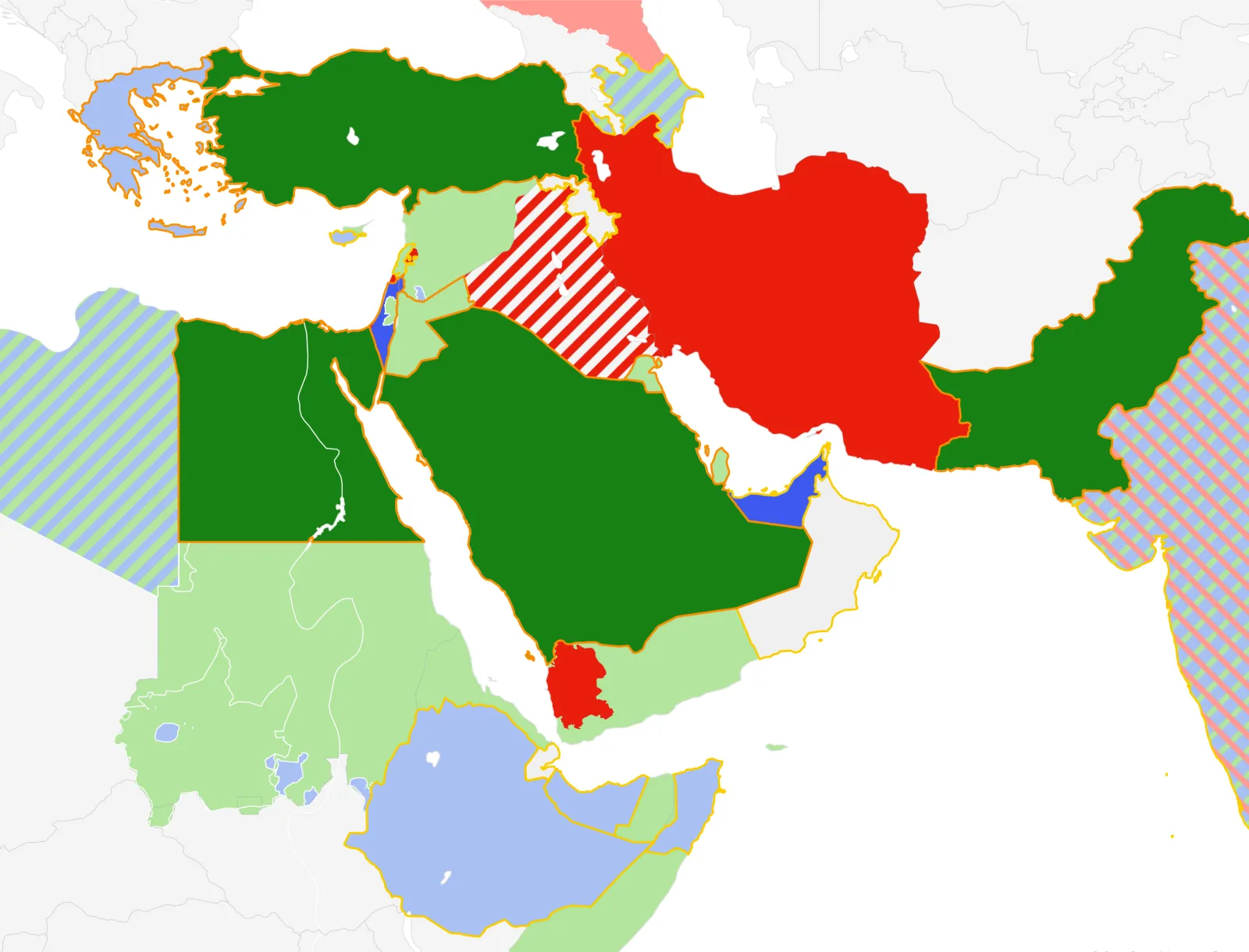
Among the countries with which Israel has ramped up relations in recent years are India, Greece and Cyprus. Those ties form part of what Netanyahu referred to as a “hexagon of alliances” ahead of a visit by Indian counterpart Narendra Modi in February, days before the U.S. and Israel launched the joint war against Iran.
Another key success in Israel’s outreach has been the United Arab Emirates, which, along with fellow Gulf Cooperation Council member Bahrain, normalized ties through the Abraham Accords initiative in 2020, later followed by Sudan and Morocco. Akunis said the list was not limited to these nations. With Israeli Foreign Minister Gideon Saar having recently returned from South America, Akunis said: “Now, there is a positive change toward Israel in, let’s say, Colombia, and that’s very good—by the way, other places as well.”

...
“Every country that will want to cooperate, that will want to trade, that will want to be our ally, they are more than welcome,” Akunis added. “We are for it, for all the countries around the world. As I said, it takes two to tango.”
But it’s not just Iran and its own coalition—the predominantly Shiite Muslim Axis of Resistance that includes the Lebanese Hezbollah, the Islamic Resistance in Iraq and Yemen’s Ansar Allah, widely known as the Houthi movement—that Israel sees on its threat radar. An emerging “quartet” comprising the leading Sunni Muslim powers of Saudi Arabia, Turkey, Egypt and Pakistan is also viewed with deep suspicion by Israeli officials. Pakistan, the only nuclear-armed Muslim country, and Saudi Arabia signed a defense pact last September. Turkey, a member of the U.S.-led NATO alliance, was also included in a new mutual defense deal signed by the trio this month. Shortly after the announcement of the agreement, Netanyahu and Modi held a call discussing their partnership and developments in the Middle East.
Ankara’s inclusion spells particular concern given the increasingly hostile exchange of rhetoric between Netanyahu and Turkish President Recep Tayyip Erdogan, who Akunis described as “extreme” and “insane,” referencing Erdogan’s shift against Israel nearly two decades ago and his support for activist flotillas attempting to break the blockade of Gaza. “So maybe one day, maybe I don’t know, in the near future, something will happen in Turkey as well,” Akunis said, “And we can find ourselves in a much better situation, like it was until this crazy man actually changed his mind toward the State of Israel and encouraged terror attacks.”
'You Need To Be Tough With Them'
Whether Turkey may prove the next foe after Iran, Akunis stated that “the ayatollahs are still in Iran. So, we need to solve this problem, and then we’ll talk about the next challenge.” Iran’s resilience has complicated U.S. and Israeli goals, with some Israeli officials, including Akunis, having considered the possibility that the Islamic Republic may not collapse after all under the weight of the joint intervention.
But even as Tehran seeks to dictate the terms of an eventual peace settlement, Akunis urged restraint before predicting an enemy victory six months into the war and just over a year after the 12-day war, during which Israel and the U.S. conducted strikes against Iran. “You need patience,” Akunis said. “It’s almost 50 years of the ayatollahs’ regime in Iran. So, we are talking about one year since last June.” He also expressed continued confidence in Trump, who has met with Netanyahu more than any foreign leader, their latest encounter in July marking their first since the beginning of their war against Iran. At the same time, Akunis offered a piece of advice to the U.S. leader after he gave the Islamic Republic a “last chance,” calling off large-scale strikes to consider a new deal involving Iran and Oman that would reportedly grant Tehran a partial say over the vital Strait of Hormuz oil and gas trade choke point now at the center of the conflict.
“You need to be tough with them,” Akunis said. “Because if we, all of us, the Western society, will reflect weakness, they will attack. Why do I think so? Because they are saying it.”
Related Story
This Map Shows Iran, Israel and Saudi Arabia’s Allies in a New Middle East
But it’s those in the West who direct their outrage not toward Iran but Israel that he blames most. “Those people do not say even one word about the ayatollahs, not even one word about their slogan ‘Death to America,’ and not even one word about the Iran massacre [of protesters]. What is it? Gaza, Gaza, Gaza, Gaza,” Akunis said. “OK, I can give you an answer about Gaza. Gaza can be like the Emirates, or Bahrain, or Singapore of the Middle East. No Hamas? Gaza can be prosperous. By the way, like in Lebanon. No Hezbollah? Lebanon can be prosperous.”
In fact, he said, “we have plans,” including the restoration of a historic “direct line between Beirut and Cairo through Haifa, through Tel Aviv, through Gaza to Egypt,” a distance he compared to the Boston-Washington train corridor and argued could be achieved in the Middle East as well if not for hostility toward Israel.
“Now, if they prefer the terror organizations, OK, I’m sorry for them; it’s very difficult that we will see the day that they will prefer our values or the American values or the Western world values,” Akunis said. “I don’t think that they need to prefer the Western world values, but they must stop encouraging the terror organizations and cheering them, and to prefer them over their own life.”
He compared U.S. activists and politicians pushing such rhetoric to populations in Gaza and southern Lebanon who he said also “prefer the terrorists rather than themselves, not only Israel.”
“So, if we will not see a massive change in the near future, the future of the Western world, and United States of America as the leader of the Western world and the free world, the next decade will be very bad.”
View 0 Comments
Submit Correction
View Editorial & AI Guidelines