...

By Newsweek Editors
0
Share
Newsweek is a Trust Project member
See more of our trusted coverage when you search.Prefer Newsweek on Googleto see more of our trusted coverage when you search.
In the U.S.-Iran war, everyone seems high on their own supply of copium.
The internet slang is a portmanteau of “cope” and “opium”, a shorthand for the self‑deluding narratives people use to rationalize or deny difficult realities.
And there are plenty of those to go around in the Middle East right now.
Read More on Analysis
Both Tehran and Washington are pushing their own comforting versions of reality. From Iran’s AI‑generated slopaganda to the White House’s war‑as‑gaming videos, each side is spinning a story of glory.
But as the war drags into its second month, the gap between narrative and reality is widening.
Khamenei’s Posthumous Last Stand
From the outset, Iran’s regime and its supporters have spun a narrative of defiance and triumph, often untethered from reality.
With generative AI tools, pro‑regime propagandists can manufacture alternate realities at scale, and a flood of AI‑made videos on social media depicts an Iran that is handily winning the war.
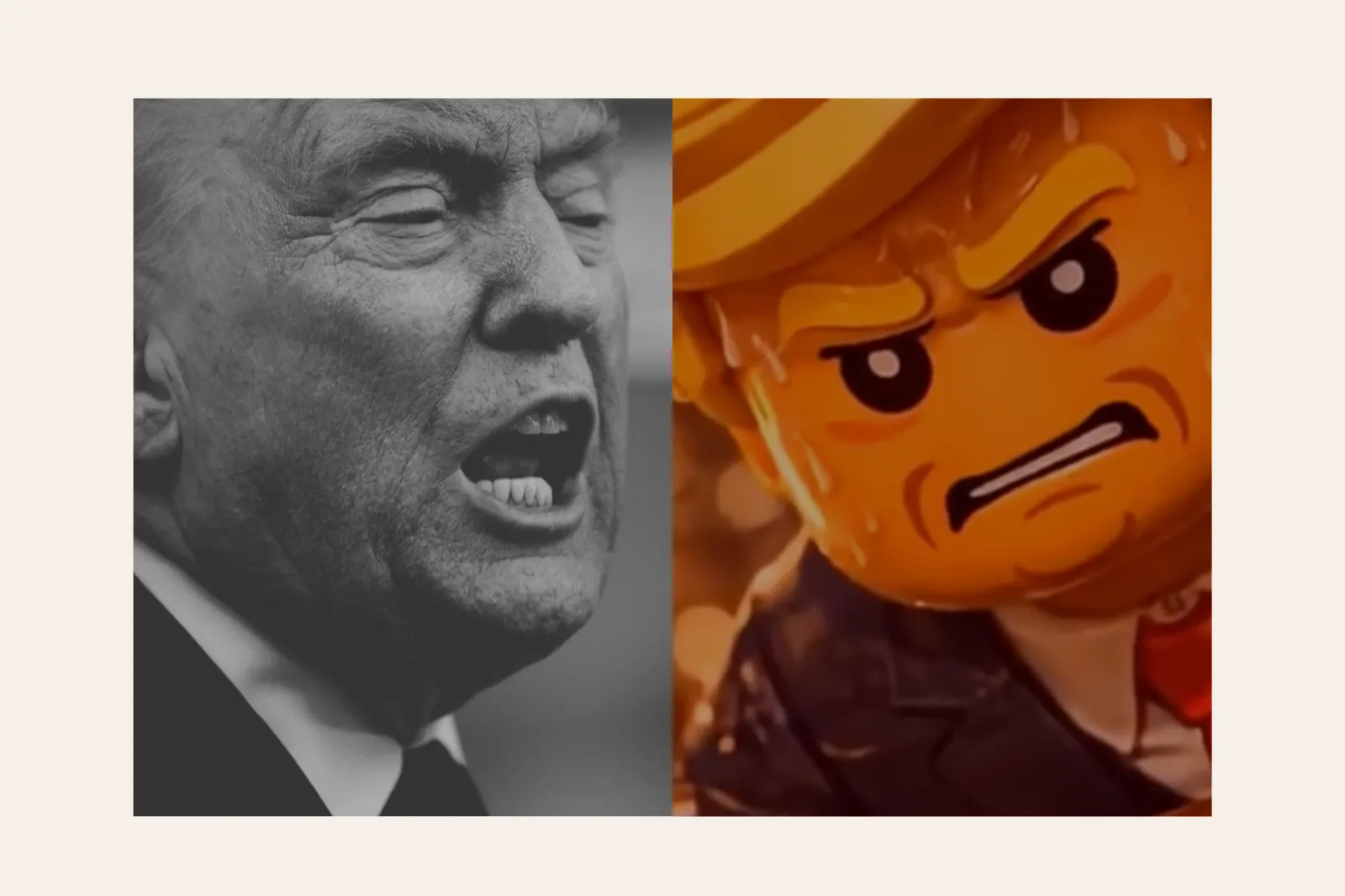
These clips often use humor and pop‑culture aesthetics—even LEGO‑style animations—to show Iran’s late supreme leader outsmarting and humiliating his American adversaries.
In one recurring format, a grinning Ayatollah Ali Khamenei is shown controlling traffic through the Strait of Hormuz, or dispensing Iranian oil, selectively helping friendly powers while thwarting Donald Trump.
Other videos depict barrages of Iranian ballistic missiles raining down on Tehran’s enemies.
One clip shows Ebrahim Zolfaqari, spokesman for the unified command of Iran’s armed forces, skateboarding with a selfie‑stick and sipping on fruit juice while missiles launch behind him to the soundtrack of Fleetwood Mac’s Dreams, a parody of a viral video from 2020 from the U.S.
The subtext is clear: Iran is winning, defying American military might and dominating the Strait of Hormuz.
It’s pure copium.
The regime has certainly proven more resilient than some observers expected, and Tehran continues to fire a diminishing number of drones and missiles at the U.S., Israel, and Gulf monarchies.
But Khamenei isn't coming back, killed in the war’s opening salvo on February 28 and replaced by a wounded son whose true grip on power is in question. And Iran’s military has taken heavy, irrevocable losses ever since.
U.S. and Israeli forces destroyed or severely damaged vast numbers of command centers, air bases, and naval facilities in the first weeks of Operation Epic Fury.
Iran’s control over the Strait of Hormuz is limited to its ability to disrupt tanker traffic with drones and missiles, deterring commercial shipping unwilling to take the risk.
It does not open or close access. Tehran has no such power. But it can increase the costs and risks for those who try to transit through it, which it is doing to some effect. That will wane as its capabilities are inevitably reduced further.
Whether Tehran can mine the strait—and to what extent—also remains an open question.
But its conventional naval power looks severely degraded, while Western allies retain strong minesweeping capabilities that could be deployed to keep global trade flowing.
Meanwhile, the U.S. is sending thousands more troops to the region, with one option under discussion a potential ground operation that could include seizing Kharg Island, the oil terminal that serves as the regime’s economic heart and financial lifeline.
Trump has signaled a willingness to dramatically escalate, threatening devastating damage to Iran’s remaining economic infrastructure if the regime does not come to heel.
The U.S. will “conclude our lovely ‘stay’ in Iran by blowing up and completely obliterating all of their Electric Generating Plants, Oil Wells and Kharg Island (and possibly all desalinization plants!)” unless there is a deal, Trump said.
In short, Iran’s propaganda—portraying Khamenei as a victorious commander and Iran as a dominant power over the U.S.—is total fiction.
The reality is a battered military, a dead leader, and a shrinking ability to project force against an adversary willing and able to use overwhelming power.
Washington’s Copium
But the White House is huffing its own brand of copium.
From the start, the Trump administration framed the war as a quick, decisive campaign that would last only weeks. Trump has leaned heavily into that narrative, repeatedly suggesting the conflict is already essentially over.
Yet the timelines keep shifting. A month in, “a few weeks” has become a familiar refrain, and the endgame remains unclear.
Still, official administration accounts have posted slick videos blending real strike footage of U.S. military hardware with memes and pop‑culture references, including popular video games and movies.
CENTCOM even celebrated hitting its “10,000th target” in Iran, as if the war has a scoreboard.
These chest‑thumping displays are real enough. The U.S. has struck thousands of Iranian targets, and the footage is genuine, even if packaged with gimmicks designed to thrill armchair G.I. Joes.
Iran simply cannot come close to matching the hard realities of unparalleled American power.
But impressive tactical wins with big statistics attached do not equal strategic victories. It’s copium to think otherwise. This is much more than a numbers game.
Despite suffering heavy losses, the Iranian regime remains entrenched, having spent the past five decades rooting itself deeply in every corner of society.
The U.S. is on an escalatory path, allies are reluctant to join the war, and the costs are mounting, both financial and political.
American voters are already feeling the impact. Gas prices have risen sharply, with broader inflationary blowback looming if the conflict drags on.
A late‑March AP‑NORC poll found 59 percent of Americans said U.S. military action against Iran had “gone too far,” while 45 percent were “extremely” or “very concerned” about being able to afford gas in the coming months, up from 30 percent earlier.
The findings highlight how quickly public tolerance erodes when a promised short war looks open‑ended in reality.
Some Republicans are also questioning how this all ends, and there are signs of splintering within Trump’s own MAGA movement over how the Iran war fits into “America First.”
“We just wanted them to tell us what’s the plan, and we didn’t get any answers,” said House Armed Services Committee Chair Rep. Mike Rogers, an Alabama Republican, about a classified Iran briefing from the Pentagon.
“I understand they can’t give us, they shouldn’t give us, specific operational details. But generally, we should be able to get more texture than we’re receiving from them.”
Iran, meanwhile, is still hitting back. It continues to strike Israel and attack American allies in the Gulf, raising questions about whether those states will want to keep hosting U.S. bases once the war ends. The White House will have to do a lot of reassurance diplomacy when the bombs stop falling.
A major blow came when Iranian missiles struck Prince Sultan Air Base in Saudi Arabia over the weekend, damaging—and possibly disabling—a U.S. E‑3 Sentry AWACS aircraft, one of only 16 in service.
The loss would likely reduce U.S. battlefield awareness and was one of the rare Iranian strikes to land a significant blow to Americans.
Iran has also damaged refueling aircraft and struck U.S. personnel. The Pentagon has downplayed casualties, but CENTCOM says 13 service members have died and 303 are wounded so far.
Those are hard numbers to justify to an electorate unconvinced—or at least not fully sold—on the war.
This is where the copium kicks in. How can you question a war when the Pentagon’s numbers are so big and the White House videos so slick?
Reality Catches Up
Both sides are clinging to comforting thoughts.
Iran’s regime pretends it is winning a war it is clearly losing and will never recover from.
The U.S. administration insists it is on the brink of victory, despite mounting costs, rising casualties, and no clear endgame, leaving voters primed to punish governing Republicans at the midterms.
Reality is catching up. The war is escalating, casualties are rising, and public support is eroding.
But just one more toke of the copium makes everything seem fine again.
Hey gang, Carlo Versano here. I hope you enjoyed this article. As Newsweek's Director of Politics and Culture and editor of the 1600 newsletter, I'm keen to hear what you think. Now, Newsweek is offering a new service to allow you to communicate directly with me in the form of a text message chat. You can sign up and get a direct line to me, as well as the reporters who work for me. You can shape our coverage.
As a Newsweek member, we're offering this service to you for free. You can sign up below, or read more about how it works here. Let's talk!
View 0 Comments
Submit Correction
View Editorial & AI Guidelines