Newsweek/Getty

By Newsweek Editors
0
Share
Newsweek is a Trust Project member
See more of our trusted coverage when you search.Prefer Newsweek on Googleto see more of our trusted coverage when you search.
Nearly two weeks into Operation Epic Fury, the United States and Israel have killed Iran's Supreme Leader, degraded its nuclear program, and triggered the first closure of the Strait of Hormuz in history—taking 20 percent of the world's oil supply offline in a single week. Brent crude crossed $100 a barrel for the first time in four years, prompting the IEA's largest-ever emergency reserve release: 400 million barrels, coordinated across 32 nations. Iran has struck back at every Gulf neighbor and sent its navy into the Indian Ocean. The war's disruptions have spread well beyond the Middle East—from the World Cup qualifying draw to the Australian Gold Coast to the floor of the Indian Ocean.
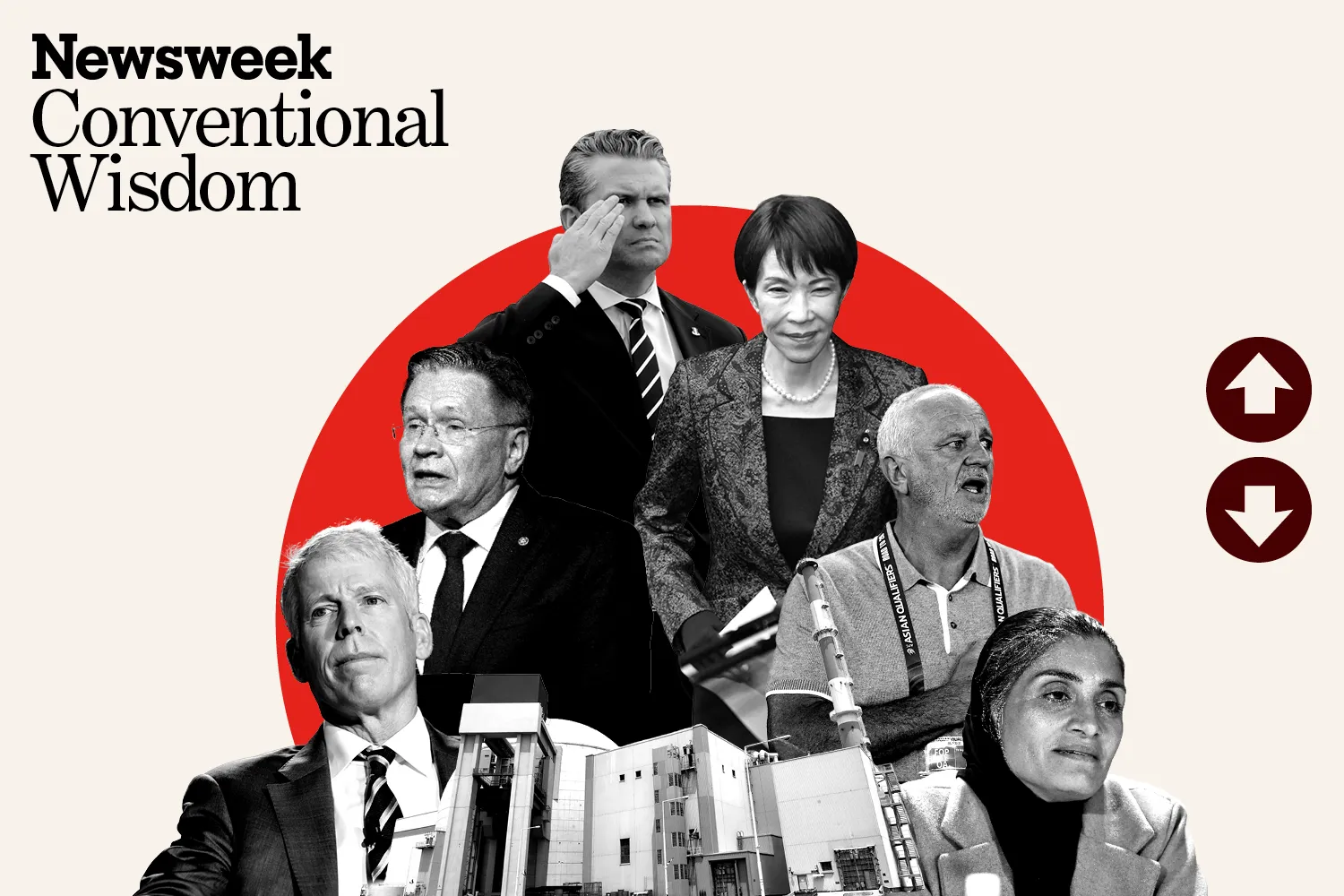
Chris Wright ⬇
On Tuesday, the U.S. Energy Secretary told his fellow G7 energy minsters that an oil reserve release was premature—then reversed himself within two hours after Trump personally overruled him, ultimately announcing the largest emergency oil release in the IEA's 52-year history. Days earlier, a post from his official X account had dropped global oil more than 15 percent with a false claim that the US Navy had escorted a tanker through Hormuz, deleted and denied within 30 minutes. The Energy Secretary of the world's largest oil producer moved markets twice in one week—neither time on purpose.
Read More on Opinion
Sanae Takaichi ⬇
Japan's Iron Lady staked her reputation on hawkishness toward China, triggering a diplomatic crisis last November by declaring a hypothetical Chinese attack on Taiwan a "survival-threatening situation"—the precise legal trigger for Self-Defense Forces support of US operations. Now, with an actual war cutting off 70 percent of Japan's oil through Hormuz, she has ruled that Iran doesn't clear the same bar. Her summit with Trump is in seven days.
Alexei Likhachev ⬇
Russia's Rosatom CEO spent three decades building Iran's Bushehr Nuclear Power Plant—taking over a project bombed during the Iran-Iraq War, finishing it in 2011, starting two new reactors due this year. He now has 639 workers trapped on site, has lost all contact with Iran's nuclear leadership, and is publicly begging the countries bombing Iran not to hit a plant he built—while Putin pledges unwavering support from Moscow. The flagship symbol of Russia's Iran alliance is a nuclear plant it built, can't staff, can't finish, and can't defend.
Marziyeh Jafari ⬇
Iran's women's soccer coach declared her team eager to return home, then personally chased two escaping players down a Queensland hotel stairwell to a locked door. When a wavering player who'd taken asylum asked teammates for advice, Jafari's group told her to call the Iranian embassy—burning the safe house location and forcing Australian police to move the remaining six to safety. She made it home. Five of her players and one team staff member stayed in Brisbane.
Graham Arnold ⬇
The Iraqi national soccer team’s Australian coach has been stranded in Dubai since Day 1, his players trapped inside a country under bombardment, his World Cup playoff—Mexico, against a South American opponent—suspended indefinitely. He coaches a team he cannot reach, for a match he cannot play, in a war he had nothing to do with.
Commander Bafford E. Lewellen ⬇
On August 14, 1945, the commander of USS Torsk torpedoed the last enemy warship of World War II off the Japanese coast—a U.S. record that held for 80 years, long enough for the Torsk itself to become a tourist attraction in Baltimore's Inner Harbor. Last week, a U.S. fast-attack submarine fired a single Mark 48 torpedo at the Iranian frigate IRIS Dena south of Sri Lanka, sinking it with more than a 100 of its crew. Defense Secretary Pete Hegseth announced the kill at a Pentagon briefing with evident pride—apparently the first person in 80 years to consider "no one has fired a torpedo in anger since World War II" a problem worth solving.
Originally a staple of Newsweek's print edition, Conventional Wisdom used arrows to track whose stock was rising or falling in the political circus. We're reviving it in the digital age because the problem it lampooned—hyperbole and partisan certainty masquerading as insight—has only intensified.
CW assigns arrows—up, down, or sideways—to the figures and forces shaping current events. The arrows don't predict the future or claim special insight. They capture the prevailing winds of the moment, uncluttered by tribal howling. In an era when partisan media reinforces rather than questions assumptions, CW operates from the center—skeptical of left and right alike, committed to puncturing inflated reputations and recognizing overlooked truths.
Do you agree with our editors on which way the political winds are blowing? Send us a message here.
Hey gang, Carlo Versano here. I hope you enjoyed this article. As Newsweek's Director of Politics and Culture and editor of the 1600 newsletter, I'm keen to hear what you think. Now, Newsweek is offering a new service to allow you to communicate directly with me in the form of a text message chat. You can sign up and get a direct line to me, as well as the reporters who work for me. You can shape our coverage.
As a Newsweek member, we're offering this service to you for free. You can sign up below, or read more about how it works here. Let's talk!
View 0 Comments
Submit Correction
View Editorial & AI Guidelines