...

By Saul Hudson
0
Share
Newsweek is a Trust Project member
See more of our trusted coverage when you search.Prefer Newsweek on Googleto see more of our trusted coverage when you search.
In war, civilians rely on information almost as much as food or shelter. They need to know whether a road is safe, where hospitals are operating, whether an evacuation warning is real or a rumor spreading through frightened neighborhoods.
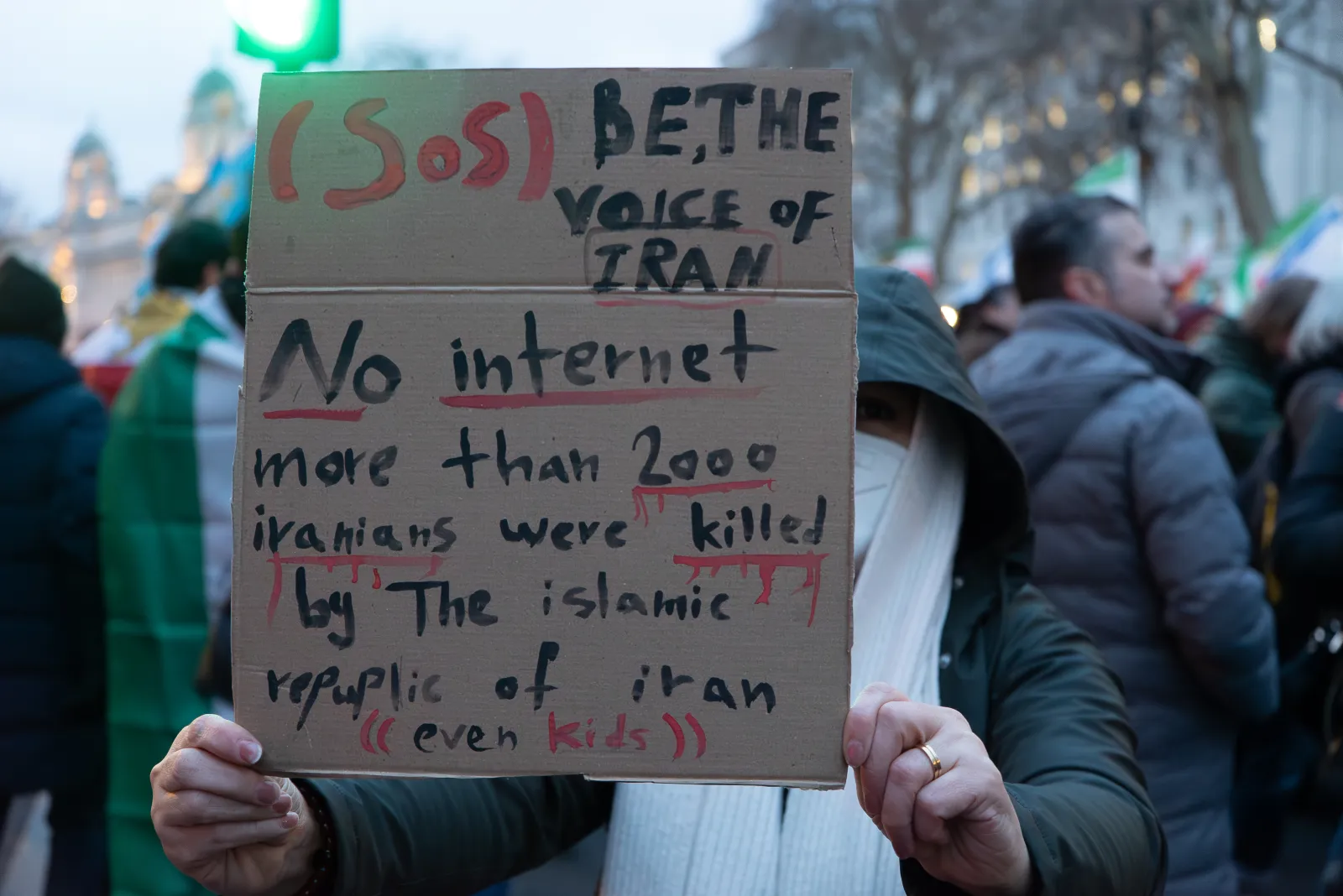
In Iran today, much of that information has disappeared.
Connectivity inside the country has fallen to roughly 1 percent of normal levels, according to internet monitoring groups such as NetBlocks. Yet the network itself has not fully gone dark. Instead, access appears to be filtered through centralized gateways using tools such as Deep Packet Inspection, allowing authorities to control who can communicate with the outside world.
Read More on Essays
Government officials and state-aligned media outlets continue posting polished videos and statements online. But ordinary Iranians—doctors trying to document casualties, families searching for missing relatives, journalists attempting to upload photographs—largely cannot.
...
This is not a typical internet outage. It is a targeted effort to suppress civilian communication while leaving the state’s messaging apparatus intact.
Iran did not invent this. In fact, the tactic reflects a broader pattern in modern crises in which governments under threat increasingly treat control over communications infrastructure as a strategic tool, tightening access in ways that limit civilian speech while preserving their own ability to shape the public narrative.
I saw earlier versions of this dynamic during my years covering conflicts for Reuters, including along the Iran-Iraq border and in other regions where governments severed communications at critical moments. When the lines go quiet, there is an opportunity to blur the truth. Rumors spread quickly, and the most powerful actor in the room can define the story before others have a chance to respond. Official narratives harden.
Propaganda has always accompanied war. Every government engaged in conflict, including the United States and Israel, as well as Iran, attempts to influence how events are understood. What has changed is the technical precision with which authorities can now manage information flows. Instead of silencing everyone, governments can selectively restrict access, muting opponents while keeping their own megaphone fully operational.
Examples of similar tactics have appeared elsewhere in recent years. Pakistan experienced widespread mobile blackouts during its 2024 elections. In Bangladesh last year, authorities imposed an 11-day nationwide blackout during protests over government job quotas—then selectively restored broadband first to banks and the export sector, while the general population remained offline for days longer.
Earlier precedents appeared during the Arab Spring, when governments in Egypt, Libya and Syria restricted internet access in an effort to slow coordination among protesters. Offensive militaries also use the tactic. During the most acute phases of Israeli operations in Gaza, connectivity collapsed repeatedly in a pattern documented by Access Now.
The goal is usually the same: maintain control over the narrative while limiting the ability of citizens to contradict it in real time.
The consequences extend far beyond political messaging.
The United Nations High Commissioner for Human Rights has warned that Iran’s current internet restrictions have left millions unable to access basic safety information during active hostilities. Civilians under fire need to know which roads remain open, where medical care is available, and whether evacuation routes are genuine or dangerous rumors. When communication channels disappear, those decisions become far more difficult—and far more dangerous.
In today’s conflicts, connectivity has become a critical component of civilian protection.
Under international humanitarian law, parties to a conflict are obligated to take feasible precautions to protect civilians. When authorities deliberately restrict a population’s ability to communicate during active fighting—while maintaining their own channels—it is not merely a technical policy choice. It directly affects whether civilians can find safety, locate aid or warn others about danger.
But the international community has often treated internet shutdowns primarily as digital governance issues rather than humanitarian ones.
That framing is increasingly outdated.
Humanitarian organizations understandably focus first on food, medicine and shelter during emergencies. Communication resilience has often been viewed as a secondary concern to address later. But in a world where aid distribution, evacuation alerts and emergency coordination increasingly depend on digital networks, the ability to communicate is no longer optional. It is foundational.
An aid convoy that cannot receive real-time updates about safe routes may never reach its destination. A field hospital that cannot signal its location may struggle to receive supplies. A family that cannot verify evacuation warnings may be forced to choose between staying in danger or moving toward it.
When connectivity disappears, the systems designed to protect civilians begin to unravel.
There are technical attempts to address the problem. Mesh networking tools allow phones to pass messages between one another without relying on the internet. Obfuscated network bridges can disguise internet traffic to bypass censorship systems. Satellite terminals can connect users directly to global networks.
But none of these solutions is universally reliable, especially under sustained government pressure. Some also carry serious risks for those attempting to use them.
Protecting civilian communication during crises ultimately requires preparation before conflict begins: pre-positioned communications infrastructure, stronger legal frameworks recognizing deliberate blackouts as potential humanitarian violations and sustained international attention to the issue. Because once a network goes down in the middle of a conflict, the window for building those protections has already closed.
Inside Iran today, one side continues speaking to the world at full volume. The other has been quietly disconnected.
If the international community is serious about protecting civilians during war—not only after tragedies occur but in the moments when information could save lives—it must begin treating communication networks as infrastructure worth defending.
The bombs and missiles make headlines. The shooting gets the headlines. The silence is where real damage is also done.
Saul Hudson, a former Reuters war correspondent and media executive, is the CEO of Angle42, supporting technology companies and mission-driven organizations with strategic communications.
In a polarized era, the center is dismissed as bland. At Newsweek, ours is different: The Courageous Center—it's not "both sides," it's sharp, challenging and alive with ideas. We follow facts, not factions. If that sounds like the kind of journalism you want to see thrive, we need you.
When you become a Newsweek Member, you support a mission to keep the center strong and vibrant. Members enjoy: Ad-free browsing, exclusive content and editor conversations. Help keep the center courageous. Join today.


View 0 Comments
Submit Correction
View Editorial & AI Guidelines