...

By Shane Croucher
Senior Editor
0
Share
Newsweek is a Trust Project member
See more of our trusted coverage when you search.Prefer Newsweek on Googleto see more of our trusted coverage when you search.
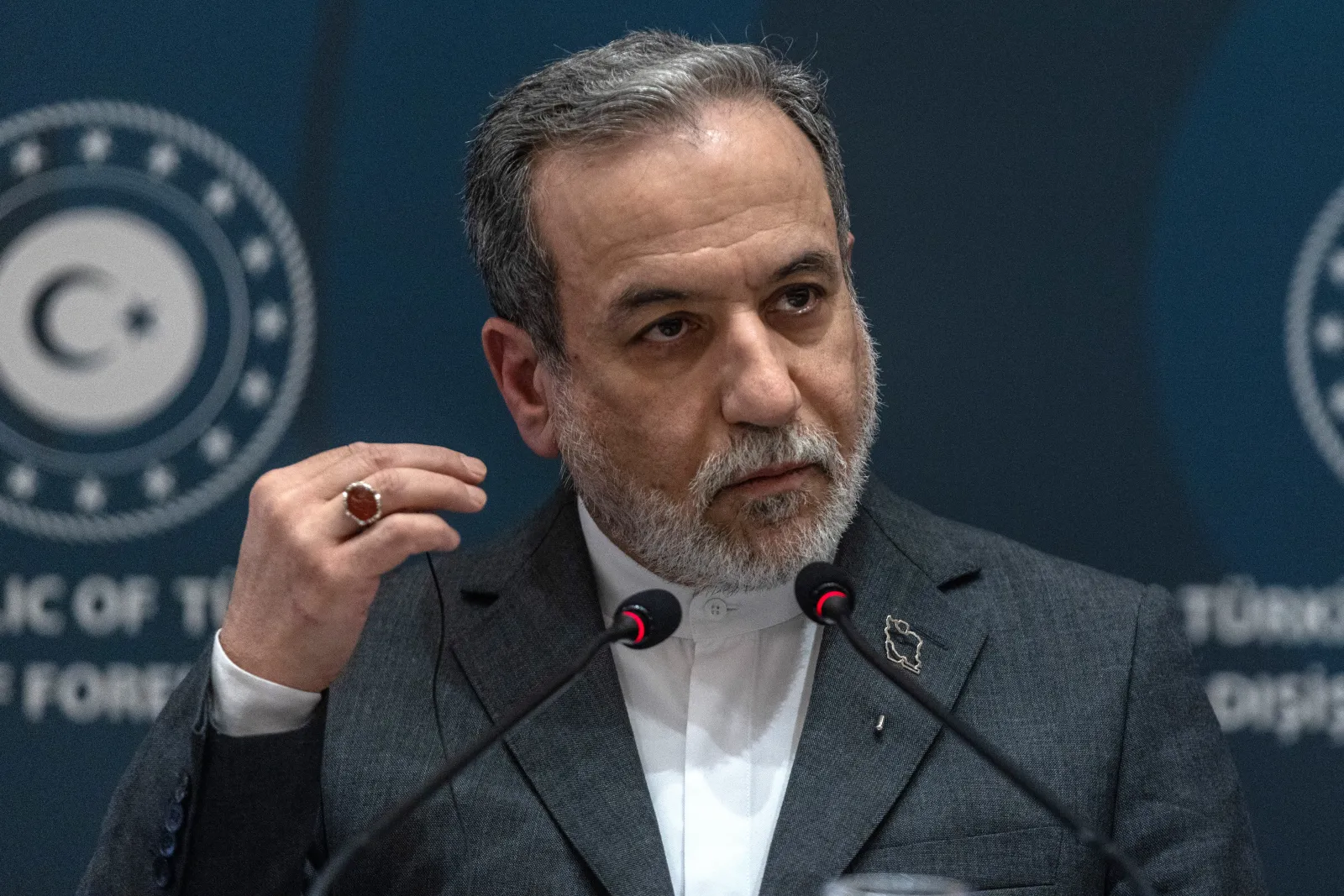
Iranian Foreign Minister Abbas Araghchi said Tehran is "completely serious" about the negotiations with the Trump administration as it seeks to avoid airstrikes, but blamed the U.S. for a "very large wall of distrust" between the two sides.
President Donald Trump has assembled what he described as an "armada" of warships and other military resources in the Middle East to threaten Iran, urging Tehran to negotiate on a range of issues and to avoid strikes.
Trump had first put Iran on notice of military action over the Islamic regime's brutal crackdown on mass protests in the country that were sparked by economic strife, which killed tens of thousands of people.
Read More on World
He has since broadened his goals from saving the lives of protesters to seriously limiting Iran's nuclear capabilities, restricting its missiles, and cutting off its support for militant groups in the region, such as Hezbollah and the Houthis.
"We are completely serious in the negotiations that have begun," Araghchi said in remarks to ambassadors in Tehran on Monday, originally in Farsi.
"We are seeking genuine negotiations aimed at reaching a result—provided that the other side is also serious and prepared for result-oriented talks.
"Unfortunately, there is a very large wall of distrust, stemming from the behavior of the United States in past years, and even over the past year. Previously, we were engaged in negotiations when those events occurred and an act of aggression was carried out against us.
"We hope that the necessary trust will be created so that the negotiations can move toward achieving results."
...
Trump, during his first term in 2018, withdrew the Obama-era deal with Iran that dropped economic sanctions in exchange for monitoring of its nuclear program.
The U.S. president had also authorized action to kill the top Iranian general Qasem Soleimani in a 2020 strike.
And in 2025, Trump joined Israel in its brief war with Iran by bombing Iranian nuclear facilities.
Iran and the U.S. had held indirect talks in Oman last Friday. Araghchi was present for Iran, and the U.S. was represented by Special Envoy Steve Witkoff and Trump's son-in-law, Jared Kushner.
For the first time, America also brought its top military commander in the Middle East to the table at the talks in Muscat, the Omani capital.
The presence of U.S. Navy Admiral Brad Cooper, head of the military’s Central Command (CENTCOM), in his dress uniform, served as a reminder that the aircraft carrier USS Abraham Lincoln and other warships were now off the coast of Iran in the Arabian Sea.
Trump said the U.S. had "very good" talks on Iran and said more were planned for early this week. But he kept up the pressure, warning that if the country didn’t make a deal over its nuclear program, "the consequences are very steep."
"Iran looks like they want to make a deal very badly—as they should," Trump told reporters aboard Air Force One as he headed to his Florida golf club late Friday. He suggested Iran was willing to "do more" than in previous talks but did not give details.
Asked how long he was willing to wait for a deal, Trump said: "We have plenty of time. If you remember Venezuela, we waited around for a while. We’re in no rush."
The Trump administration built up a huge military presence in the Caribbean Sea in the months before a U.S. raid captured then-Venezuelan President Nicolás Maduro in January.
Iran denies seeking to build a nuclear bomb and says its nuclear program is for civilian energy purposes. But it has stockpiles of uranium enriched to a level beyond what is needed for nuclear energy.
This article includes reporting by The Associated Press.
In a polarized era, the center is dismissed as bland. At Newsweek, ours is different: The Courageous Center—it's not "both sides," it's sharp, challenging and alive with ideas. We follow facts, not factions. If that sounds like the kind of journalism you want to see thrive, we need you.
When you become a Newsweek Member, you support a mission to keep the center strong and vibrant. Members enjoy: Ad-free browsing, exclusive content and editor conversations. Help keep the center courageous. Join today.


View 0 Comments
Submit Correction
View Editorial & AI Guidelines