...

By John Feng
China Editor
0
Share
Newsweek is a Trust Project member
See more of our trusted coverage when you search.Prefer Newsweek on Googleto see more of our trusted coverage when you search.
It was business as usual this week for Iran’s oil industry despite daily airstrikes by the United States and Israel including the recent targeted bombing of the country’s main export hub.
Newsweek reported this week that suspected Iranian tankers were seen loading fuel at the Kharg Island oil terminal off Iran’s southern coast, days after President Donald Trump ordered U.S. forces to hit military sites on the island last Friday.
Further evidence on Tuesday showed that Iran’s energy trade largely had been uninterrupted. A number of oil tankers could be seen pierside at the export hub’s eastern jetty in satellite imagery captured by the European Space Agency’s Copernicus Earth observation program.
Read More on World
The photograph taken by the ESA’s Sentinel-2 satellites was not detailed enough to identify any missile damage from last week’s bombing, which deliberately avoided Iran’s oil infrastructure, according to Trump and the U.S. Central Command.

...
Iran’s crude oil trade is the lifeblood of its heavily sanctioned economy and Kharg Island handled most of the outbound volume last year, according to the monitoring service TankerTrackers.com. Millions of barrels are exported each day.
Iran’s Islamic Revolutionary Guard Corps has effectively shut the Strait of Hormuz to the majority of non-Iranian vessel traffic by striking at random in the Persian Gulf using drones and missiles. Oil and natural gas deliveries from the gulf have been suspended and major economies including the U.S. have released emergency oil stockpiles to keep prices from soaring far past $100 a barrel.
The U.S. bombing of Kharg Island was a warning to Tehran over the continued closure of the strait, which saw commercial vessel traffic fall to just two transits on Monday from an average of 138 per day before the Iran war began on February 28, according to the latest advisory published on Wednesday by the U.S.-run Joint Maritime Information Center.
Only 89 ships, including 16 oil tankers, crossed the Strait of Hormuz between March 1 and March 15, according to analysis by London-based Lloyd’s List Intelligence. More than one-fifth of the traffic was linked to Iran.
This week, Treasury Secretary Scott Bessent said the U.S. was permitting tankers laden with sanctioned Iranian fuel to exit the strait unchallenged in order to keep global oil prices down. “The Iranian ships have been getting out already, and we’ve let that happen to supply the rest of the world,” Bessent told CNBC on Monday.
More than 90 percent of Iran’s oil exports go to China, whose annual supply comprises about 10 percent of Iranian crude, according to commodities analytics company Kpler.
Abbas Araghchi, Iran’s foreign minister, told CBS News on Sunday that Tehran was open to negotiating safe passage for the ships of certain countries. Bulk carriers and a handful of oil tankers affiliated with China, India, Pakistan, Turkey and Greece have made it through the Strait of Hormuz without attack, but it wasn’t clear whether specific arrangements had been made for their transit.
...
For the majority of international shipping lines and their insurers, the strait is still off limits, given the risk of Iranian attacks. Of the 89 transits tracked by Lloyd’s List this week, 11 were by China-linked vessels, but none was operated by mainstream Chinese owners, it said.
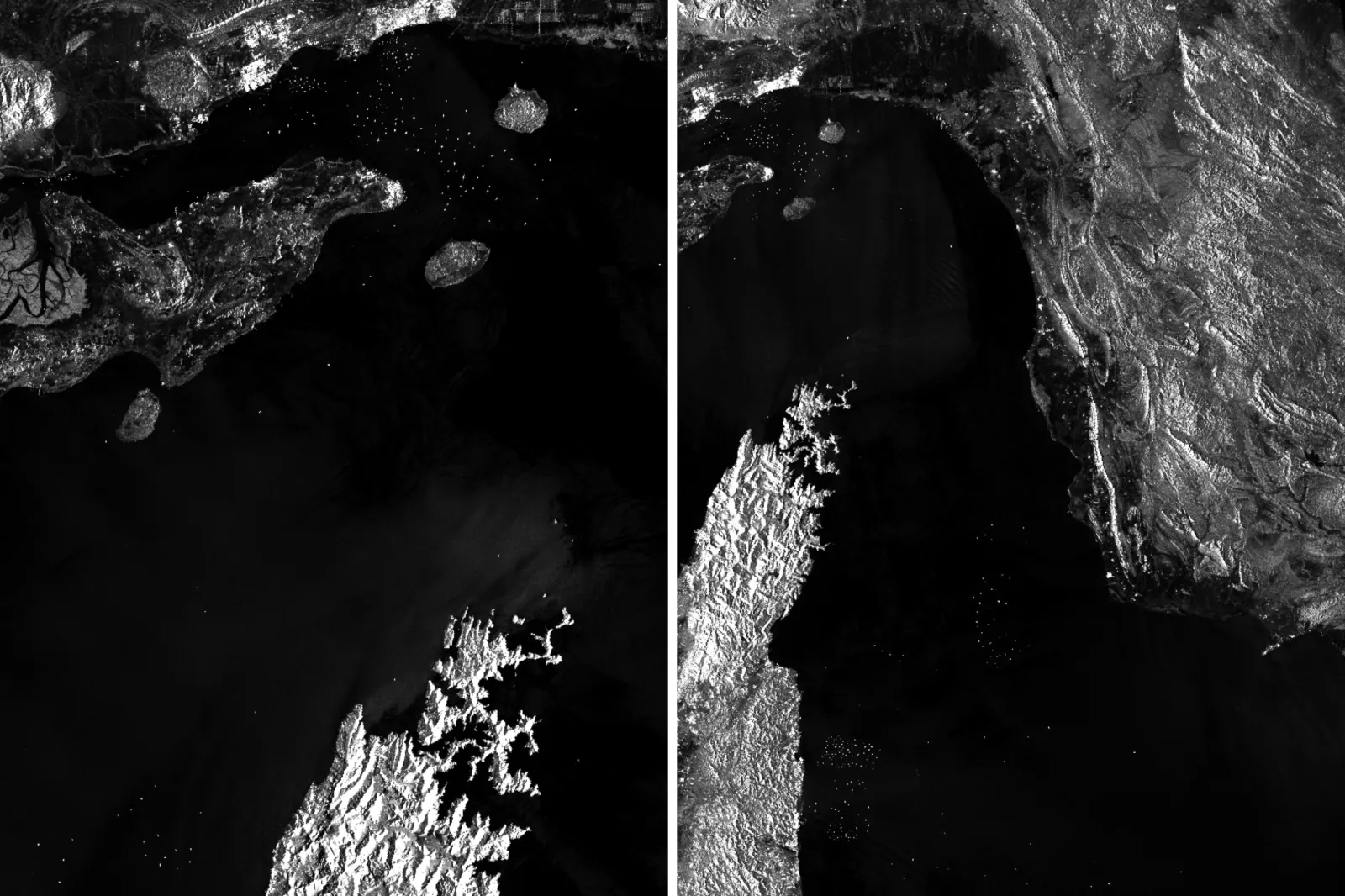
Synthetic aperture radar imagery captured by the ESA’s Sentinel-1 satellites on March 16 and 18 showed the strait largely empty of large vessels for the third week of the war, a sign of persistent fears—and the effectiveness of the IRGC’s tactics.
Lloyd’s List said it found “no discernible pattern of targeting” in the Iranian attacks on civilian vessels in and around the strait. Around 20 ships have been struck, but the incidents appear “to be random and calibrated towards disruption rather than targeting specific profiles and national affiliation,” it said.
Trump has called for an international coalition, including China, to help keep the strait open under fire. He made the proposal not because the U.S. military needs help, but to gauge how each government would respond, he said.
View 0 Comments
Submit Correction
View Editorial & AI Guidelines