10
Loading video...

By Alex Harrington
Sports Contributing Writer
0
Share
Newsweek is a Trust Project member
See more of our trusted coverage when you search.Prefer Newsweek on Googleto see more of our trusted coverage when you search.
The compact gimbal camera market just got a serious shakeup. The Luna Ultra represents the most significant result yet of Insta360's six-year Leica partnership, a collaboration that has quietly grown alongside the company's reputation for 360-degree action cameras. It's a dual-lens, 8K gimbal camera with a detachable wireless OLED monitor, a 1-inch primary sensor, and enough professional features to make a lot of dedicated vlogging setups look overcomplicated. At $769.99 for the standard bundle or $979.99 for the creator package, it's a serious piece of kit aimed squarely at serious creators.
And in the United States, it's currently the only option in its class. DJI's Osmo Pocket 4P isn't available stateside due to ongoing FCC restrictions, which means anyone shopping for a dual-lens pocket gimbal camera in the American market has exactly one answer. Insta360 knows this, of course - co-founder Max Richter has said openly that "we're not going to compete on price," which at least tells you where the company's head is at.
So does the Luna Ultra actually deliver? After extensive real-world testing across the British Grand Prix, a Maserati shoot in Italy, four car reviews, low-light tests around a beautiful British lake, and dog tracking runs... the answer is yes - with just a few caveats.
Read More on Tech
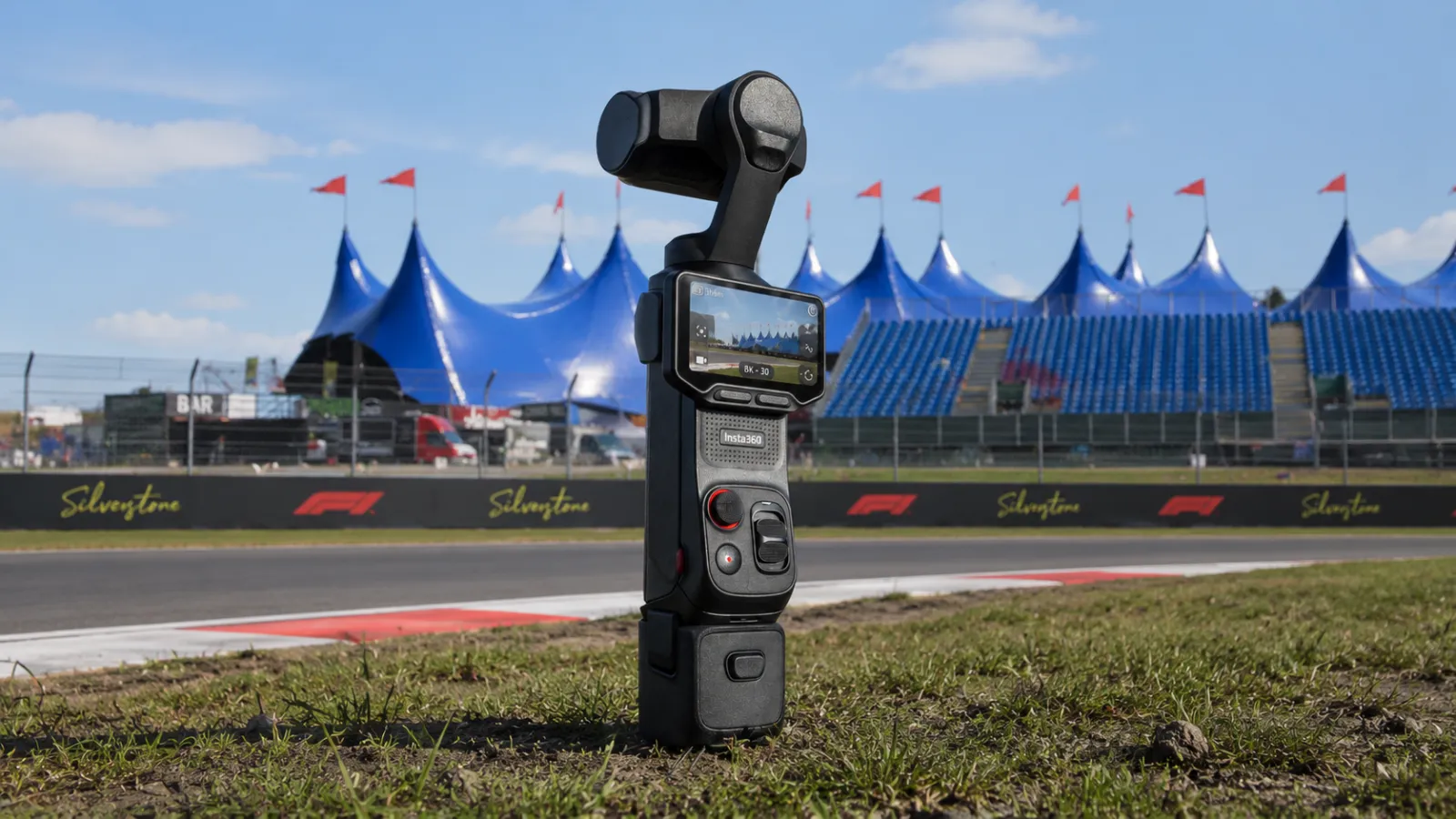
What Makes the Luna Ultra Different From Every Other Pocket Camera
The headline feature most people expected to love is the telephoto lens. The Luna Ultra pairs a 20mm f/1.8 primary lens on a 1-inch sensor with a 60mm f/2.0 telephoto on a 1/1.3-inch sensor, giving you five effective focal lengths, 6x lossless zoom, and up to 12x digital zoom. Per Insta360's official specs, the lossless ceiling sits at 120mm equivalent - the kind of reach that makes vehicle-to-vehicle shooting, which used to require a full camera car rig, easily achievable with a pocket-sized setup.
Tracking performance on the 3x telephoto lens remains solid even when subjects are moving at highway speeds. At 6x digital zoom, the footage stays usable. At 12x, it's better than you'd expect from a 1-inch sensor camera doing extreme digital magnification, largely because the underlying resolution - this thing shoots 8K at 30fps with Dolby Vision - gives the system enough headroom to maintain acceptable quality. Whether you'll actually shoot in 8K is another matter. The files are large, the storage hit is real, and the visible sharpness gain over 4K is minimal unless you're pixel-peeping at 100%. Stick to 4K. I do for Newsweek productions.
But the telephoto lens, impressive as it is, turned out not to be the feature that made the biggest impression in testing. That would be the detachable 2-inch OLED monitor.
The screen pulls away from the camera body and operates as a fully functional wireless remote - pan, tilt, zoom, menu navigation, full camera control - at distances up to 20 meters. It has its own 210mAh battery and a built-in microphone, which means it doubles as a lavalier-style audio capture device when you're standing in front of the lens. For solo creators, this eliminates an entire category of problem: you no longer need a phone, a separate monitor, or an assistant to verify framing before hitting record. You just detach the screen, walk into the shot, and check yourself.
James Trew at Engadget called the Luna Ultra's arrival the beginning of "the gimbal camera wars," and it's easy to see why when you look at what that detachable panel actually enables. A quartet of microphones - three built into the main camera unit and a fourth housed in the detachable grip - delivers clear sound even when shooting at high speeds. In dog tracking tests with wind noise that would normally require a dedicated external microphone with a proper dead cat, the internal audio remained surprisingly usable. That's not a small thing to be grateful for. While I'm on the subject, too, the automatic tracking far outperforms the same feature on the DJI Osmo Pocket 4.
The 10-bit I-Log color profile, Insta360's first, is ASUS-certified and integrates with Final Cut Pro and Adobe Premiere Pro. Alongside the three Leica color profiles - Natural, Vivid, and Chrome - plus additional cinematic and film-emulation looks developed with Leica's color science team, the Luna Ultra gives creators a huge range of in-camera and post-production options. Shooting log and applying the transform LUT produces a noticeably more organic result than the processed look you get from default settings, and the extra latitude for exposure correction in post is worth the slightly elongated workflow.
Low-light performance deserves its own paragraph. Insta360's PureVideo mode - available for recording up to 4K60 - combined with a triple AI chip does something that has no right to work as well as it does. In a side-by-side test against my own personal Sony FX30 shooting at f/2.0 in near-darkness, the Luna Ultra held its own long enough that the result genuinely required explanation. The Sony eventually pulled ahead in the most extreme conditions, as it should - an FX30 with a fast prime is a different category of tool - but the gap was smaller than it should have been - it almost made me a little annoyed at the price difference.
These features and the quality level really makes it a product that's difficult to say no to, regardless of what project you're working on.
Battery Life, the Grip, and the Things That Still Need Work
Battery life numbers first. The main 1,550mAh cell runs for roughly two hours and 50 minutes shooting 4K30. Add the optional battery grip and that extends to three hours and 45 minutes. Drop down to 1080p with the grip attached and the Luna Ultra will run for five straight hours - enough to outlast most shooting days and definitely enough to outlast most sporting events. It lasted a whole day of racing at Silverstone, to put into perspective (you can see the footage in the B-roll at the top of this page).
Fast charging gets the main battery to 80% in around 23 minutes.
The optional battery grip and tripod adapter both include fold-out feet so the camera stands independently without additional accessories. It's a minor detail, but it's the kind of thing that matters when you're setting up a solo shot.
Now the drawbacks - yes, it does have some. The biggest missing feature is a viewfinder assist when shooting in log. Right now, you're staring at a flat, low-contrast image on the monitor while composing, which makes judging exposure by eye harder than it needs to be. There's no waveform, no LUT testing, and no exposure value indicator in the corner. These are all firmware-fixable problems, and Insta360 has confirmed multiple major firmware updates are planned - a log view assist and exposure indicator are on the roadmap as well as a better quality zoom capture soon - but at launch, manual exposure in log requires more experience and patience than it should.
The detachable screen's wireless range is rated at 20 meters, which is sufficient for most solo setups. The battery in that screen is small by necessity, so plan on re-docking it to the camera body when you stop to charge. It's a minor workflow interruption, but worth knowing before you rely on it for a long shoot. It runs down much faster than you expect it to.
There's no open-gate/full-frame recording, which limits your ability to shoot wider and reframe for different aspect ratios in post. For creators producing content across YouTube, Instagram, and vertical formats simultaneously, that's a big omission. Slow motion tops out at 4K120 - genuinely capable, but the GoPro's 960fps burst mode now exists, so the frame rate ceiling feels less impressive than it would have a year ago.
Thermal throttling during sustained high-resolution recording has been flagged by other reviewers, but mine didn't suffer from anything as it worked hard underneath the hot Italian sun. But, if this is an issue, it is something future firmware could partially address through better thermal management logic.
The Creator Bundle at $979.99 includes the Mic Pro microphone, a wide-angle adapter, and a mist filter - the last of which subtly diffuses the image and takes some of the clinical digital edge off the footage. Worth having. The standard bundle at $769.99 is the right starting point if you're primarily a run-and-gun creator who doesn't need the additional audio hardware out of the box.
Honestly, I can't fault this product. It's a real disruptor that Insta360 has thrown everything at. It is packed full of features, and firmware updates could extend it to even more use cases. What is scary is that this is the company's first try at something like this. How have they done such a good job straight out the gate?
It may have a body that's slightly larger than the most pocket-friendly competitors, and occasional color-matching inconsistencies between the two lenses in certain lighting. But none of it is disqualifying. And honestly, it's nice of them that they've given competitors a small chance.
For US-based content creators, the competition is unusually simple: the DJI alternative isn't available here, the Luna Ultra does things that no single-lens pocket camera can match, and the firmware trajectory looks promising. The detachable monitor alone changes how solo shooting works. The low-light capability, the telephoto reach, and the Leica color science is genuinely good. A few things need firmware polish. The rest already works. That's a solid foundation for what Insta360 is clearly treating as a long-term platform, not a one-off product.
View 0 Comments
Submit Correction
View Editorial & AI Guidelines