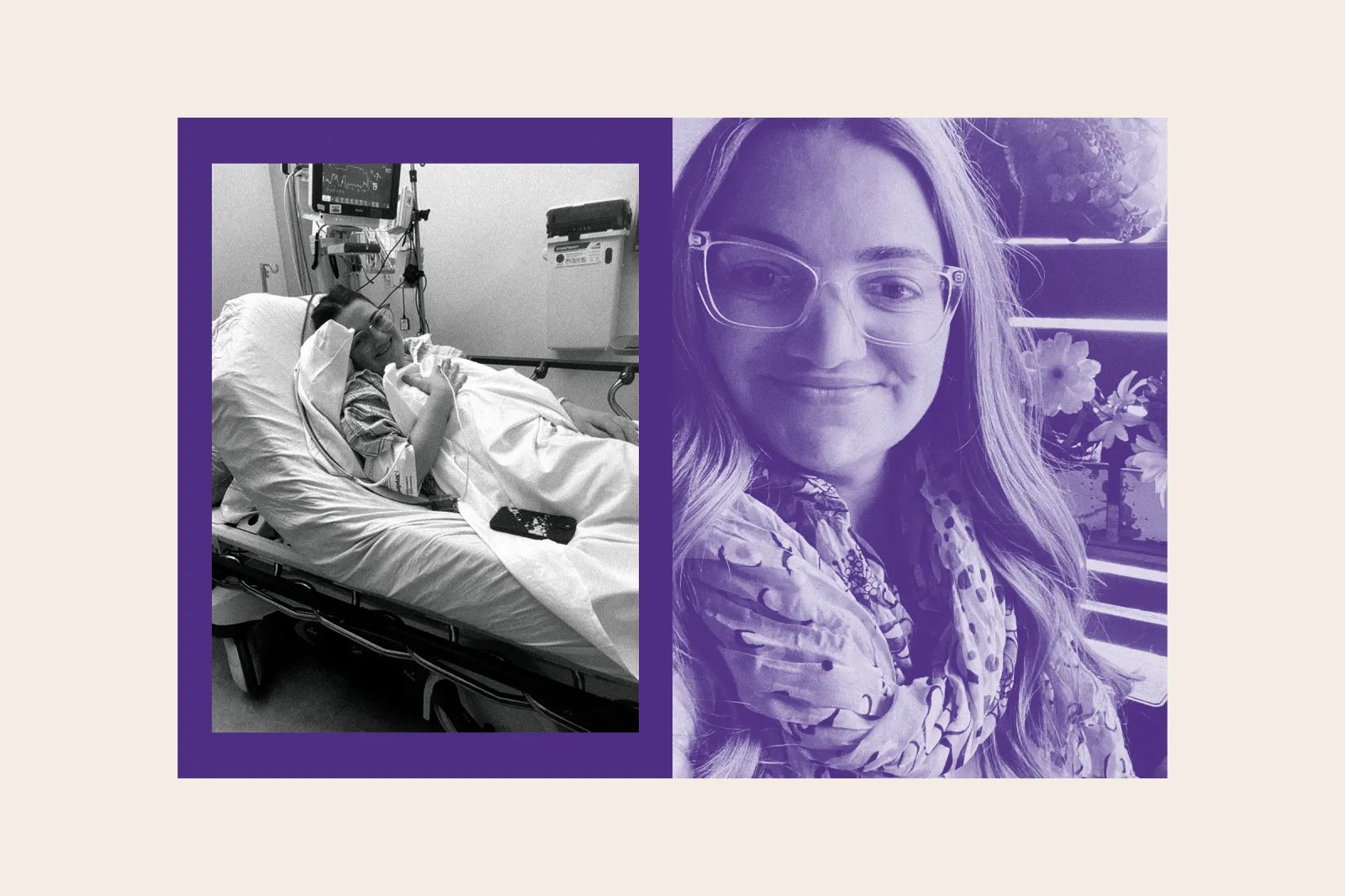
Photo-illustration by Newsweek/Getty/Courtesy of Kimberly Rex

By Kimberly Rex
0
Share
Newsweek is a Trust Project member
See more of our trusted coverage when you search.Prefer Newsweek on Googleto see more of our trusted coverage when you search.
I was 20 years old the first time my implantable cardioverter-defibrillator (ICD) delivered a shock to my heart. It felt like something inside me wound up, up, up and sucker-punched me from the inside out. In the hours following, I had my first panic attack. The air around me got heavy. The weight of it pressed me down into the leather seats of the car as we drove to the hospital, pushing me until I sank away. I rocked back and forth, shook my leg, and scrunched my face to try to stay afloat.
The device was meant to save my life. Born with a defective heart, I had my second open-heart surgery at 16. Afterwards, I had bouts of unsustained ventricular tachycardia, a potentially fatal kind of arrhythmia, or irregular heartbeat, in the lower chambers of the heart. The doctors said the bouts may not ever progress to a dangerous length but if they did, a defibrillator would send an electric shock to my heart, restore a regular rhythm, and save my life. There wasn’t much of a choice in the matter. A few weeks later, the device was implanted just above my left breast.

...
Read More on My Turn
A Teacher Sexually Harassed Me. One Coach’s Decision Changed Everything7 min read

I Was a Healthy Doctor. I Never Expected to End Up in a Wheelchair5 min read

I Was Intubated After Giving Birth. What Followed Was a Living Nightmare9 min read

For almost five years, the ICD sat idle inside me. I hardly thought about it. Until that windy day in March when it sent roughly 30 joules of energy to my heart for the first time. After, my doctor explained how the arrhythmia that triggered the device started in the upper chambers of my heart. It wasn’t life-threatening; the device just couldn’t tell the difference. So I tried to go back to normal. I tried to pretend I was a regular college student worried about finals, but little by little, I began to fray. Every pang inside me put me on alert. Any twinge convinced me that the defibrillator was about to shock me again.
And then it did. On Christmas Eve while I gathered gifts, and on a random weeknight while I sat at the family computer. Each time, I fell apart a little bit more. Eventually, the anxiety and depression wormed their way into everything, taking away my ability to function.
I found a therapist, which helped. I learned strategies to calm my mind, but after every shock, I’d go to the hospital, damaged and unraveling. Once, my mother argued with a blasé electrophysiologist who scoffed at my fears. There was talk of a psychiatric hold. Instead, my warm and kind cardiologist sent me home on an antidepressant.

...
But there were still so many bad days. Days when I stayed frozen in my grandfather’s recliner. I hoped that if I didn’t move, if I just stayed still and held my body tight and taut, my heart might stay calm. There were days when all I could do was cry, the tears wetting my cheeks and seeping down my neck. Days when I couldn’t think and couldn't breathe, how I feared that any moment my heartbeat would run away from me, and a shock would reverberate inside my chest. I was convinced the next shock would be caused by a ventricular arrhythmia and that a fatal diagnosis would follow.
There were good days too, and I was lucky to have support around me. My mother and sisters held me together. I graduated and started teaching but the panic remained, and my ICD continued to go off. As I walked up the pathway to my front door, on the street outside the beach house I’d rented with friends, and in the bed of a guy I was seeing.
Slowly, though, the combination of medicine and therapy began to work, and I climbed my way out of the hole. My doctors found a cardiac medication regimen that kept my arrhythmias under enough control to stop the device from going off, and I’d learned to listen to my heart and know whether a shock was actually coming. By the time I met my husband, my anxiety attacks remained but were less frequent. Now, I’m a happy and functioning wife, mother and writer. Maybe, though, I should have had a therapist from the very beginning. Maybe someone, a doctor perhaps, should’ve told my parents that if my defibrillator did ever send a shock, I might not take it well. In their defense, the use of ICDs was not longstanding when I got mine. But a few studies were published before my implantation highlighting the prevalence of anxiety and depression in ICD patients. On that March day of my first shock, when my mother called my cardiologist, she warned my mother that I’d likely break down soon. So they knew something about the connection between mental health and ICDs. Maybe they just didn’t know enough. Besides, mental health was not as large of a focus then.

...
Today, though, we know better. Today, numerous scientific studies exist, which show how common my story is for patients with ICDs, how women with the device are more susceptible to anxiety, and how the emergence of mental health conditions is sometimes contingent on the incidence of shocks. In multiple studies done last year, the researchers concluded that mental health care should be included in the treatment of ICD patients. Those receiving an ICD should have mental health screenings before implantation and follow-up care after.
What a difference it might have made if I were already prepared for how a shock would feel. How much easier could it have been if I had the help of a professional, knowledgeable mental health provider before and after my implantation. I might have lost far less time to anxiety. Perhaps my depression wouldn’t have stopped me from taking leaps in my education and career. In the end, it’s OK for me. I’m where I’m meant to be with the family I always wanted. I recently had surgery to replace my ICD, a part of routine maintenance, and recovered without much trouble or turmoil. Mentally, I’m OK now. Future ICD patients, however, shouldn’t have to struggle the way I did. We certainly know better now, and we can certainly do far better too.
Kimberly Rex is a mom and a freelance writer whose work has appeared in The New York Times*,* The Washington Post*,* Business Insider and elsewhere.
All views expressed in this article are the author’s alone.
Do you have a personal essay you want to share with Newsweek? Send your story to MyTurn@newsweek.com.
View 0 Comments
Submit Correction
View Editorial & AI Guidelines