
...

By Tom O'Connor
Deputy Editor, National Security and Foreign Policy
0
Share
Newsweek is a Trust Project member
See more of our trusted coverage when you search.Prefer Newsweek on Googleto see more of our trusted coverage when you search.
An Israeli military official has revealed to Newsweek efforts by the Israel Defense Forces (IDF) to counter a new weapon complicating the war against the Iran-aligned Hezbollah movement in Lebanon.
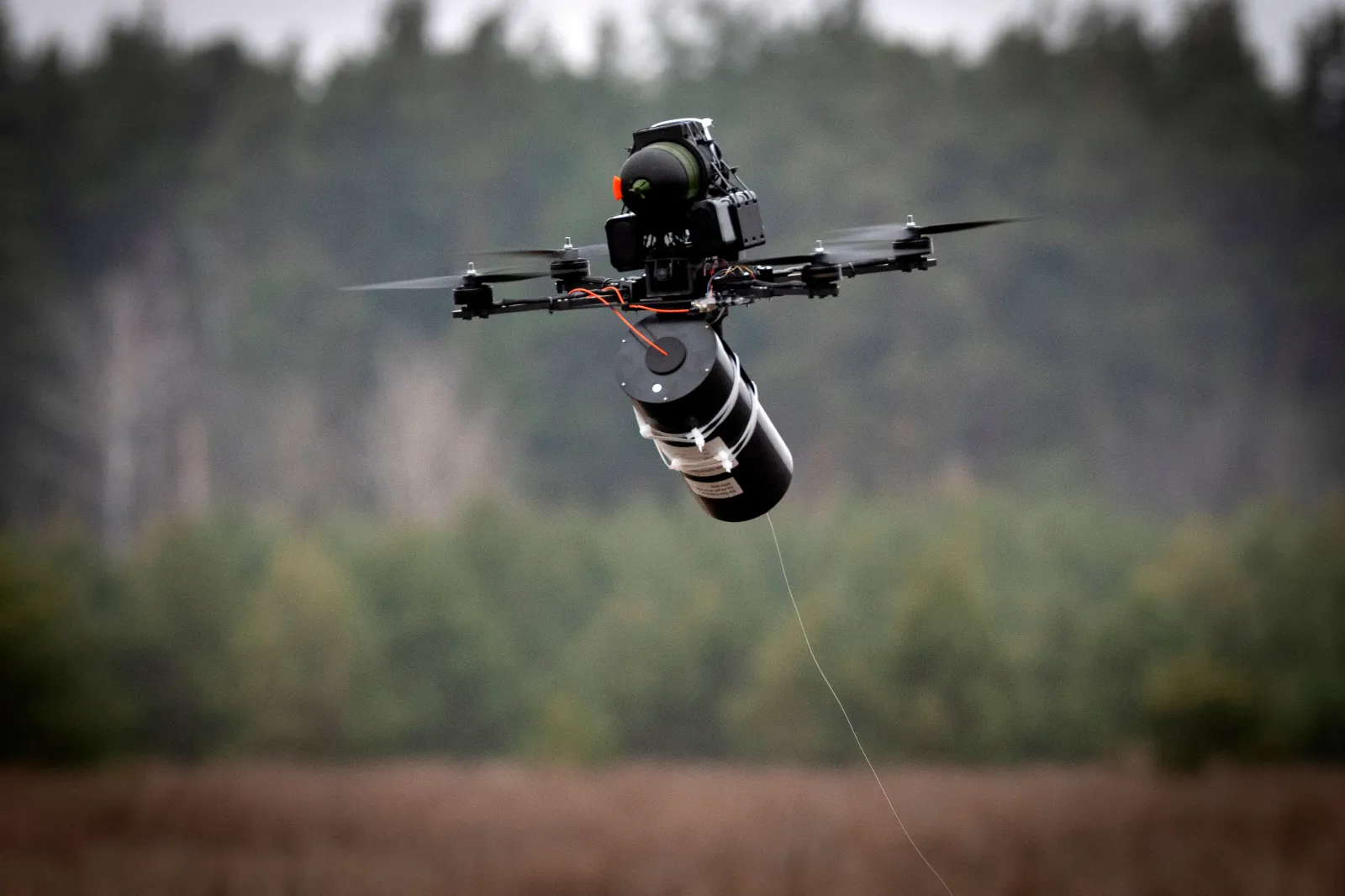
Since resuming attacks in March in response to the U.S.-Israeli war launched against Iran, Hezbollah has debuted the use of fiber-optic first-person view (FPV) drones.
The small, cheap and easy-to-operate systems bear virtually no electronic signal, thus making them difficult to both detect and intercept by traditional platforms, all while allowing pilots to operate from a relatively safe distance.
Read More on News
Israeli Captain Adi Stoler, who heads the IDF International Press Desk, called it "one of the most cowardly ways to fight an army."
At the same time, she told Newsweek, the "specific tactical issue" associated with the use of fiber-optic FPV drones over the past six months marks "basically the first time that Hezbollah actually stood a chance against Israeli soldiers."
...
Now, the race is on to reclaim the momentum in the lethal cat-and-mouse game between Israel and one of its craftiest and most dangerous foes in the midst of a regionwide battle taking place across the Middle East.
"The Israeli mind, the Jewish mind, whatever you [would like to] call it is working on a solution to fight it, and the security industries and the Israeli Air Force and the Israeli Army in general is working on trying to find a solution," Stoler said. "We haven't got to that spot yet, but I'm pretty sure that we're on our way to that point."
How the IDF Is Fighting Back
The nature of these drones renders existing platforms such as the Iron Dome ill-suited for the task of thwarting what has emerged as the latest innovation from Hezbollah as it seeks to make up for the IDF's technological superiority.
Pending breakthroughs in research being conducted for new platforms, Stoler identified two current methods in the IDF's arsenal geared toward addressing the threat.
The first involved efforts designed to tackle the devices kinetically rather than electronically. Israel has responded to the Hezbollah drone threat through the procurement of the SMASH Hopper remote weapons system designed by Israeli firm Smart Shooter and set to be delivered later this year, as well as Israel Weapons Industries' Arbel system that enhances precision small arms fire against moving targets.

...
Stoler mentioned an even lower-tech option: shotguns, which she said have been distributed to soldiers in southern Lebanon. The IDF has also utilized fragmenting bullets, which she described as involving "one bullet being shot from a shotgun that is split into two bullets once it reaches to the air," allowing the operator to hit "two targets at one time."
The second approach was even more rudimentary, involving the use of netting to capture drones attempting to strike Israeli positions and personnel. An IDF official stated in May that Israeli forces had been supplied "approximately 158,000 square meters of netting," a span "equivalent to the area of approximately 20 soccer fields."
Roughly 188,000 square meters were said to be on the way.
...
International Partnerships for Defensive Measures
The advent of this emerging form of warfare has also prompted shifts in the way the IDF approaches operations in southern Lebanon. Now, there is "at least one soldier in each squad that is responsible for looking at the sky and making sure that no drone is being launched towards them, and is on the way to them," Stoler said.
As the IDF explores new options, Stoler said steps being taken by other countries facing the same issue were being looked at as well. After all, she noted, "those fiber optic drones are a problem that not only the Israeli Army is facing, but also armies all over the world," pointing to how they first appeared in the Russia-Ukraine war, where they were debuted in scale in August 2024 by Moscow to repel an incursion in the Kursk region, and are now used by both sides.
While she declined to name the specific countries with which Israel was examining partnerships, Stoler said it's "the same as always when it comes to the learning process of a war, whether it's a kinetic war, an aerial war, naval, maritime, each country is learning from the other side, and of course, a lot of countries are also learning from the Israeli Army."
"So, I'm pretty sure that a lot of countries are, you could say, relying on the security industries of Israel, since it has proven many times that they are able to find very clever types of systems against those types of threats," Stoler said. "But we're looking at other countries as a part of our learning process, and if we have good relationships and military connections with other countries, then we are likely to find a solution together."
"Each side has its qualities that they're bringing to the table," she added.

...
'Both Sides Are Learning'
But it's not just the IDF that's pressing to stay ahead. Hezbollah has a history of adapting to conflict that far predates the use of its fiber-optic FPV drones.
Prior examples include Hezbollah's introduction of Kornet anti-tank guided missiles (ATGMs) to strike Merkava tanks during their last major war in 2006.
When Israeli forces sought to overcome this vulnerability through the development of the Trophy active protective system—a radar-based system that detect incoming projectiles in real time and react with a rapid detonation of charges to engage the threat—Hezbollah then went on to field a custom twin-launcher setup known as "Tharallah" in a bid to overwhelm the cutting-edge defense.
Hezbollah obtained another tool from that conflict by way of Iran, which reportedly reverse engineered captured Israeli Spike ATGM system components to create the Almas-1 model. Introduced in the current war that began with the Palestinian Hamas movement's October 2023 attack against Israel, Almas-1 offered Hezbollah "fire and forget" capabilities using the same fiber-optic technology now fitted to the group's drone fleet.
"Both sides are learning from the other side, the same as always in wars," Stoler said. "You can see that also with Hamas and Israel. You can see that also, of course, with Iran and Israel, and of course with Israel and Hezbollah. Each time they're trying to find a solution on how to harm Israel's civilians and Israeli soldiers."
"It's very much a part of their learning process that we're doing simultaneously," she added. "As we're finding a solution to something, they're finding a new method of doing damage, and vice versa. We're also doing that, not against the civilians, of course, but both sides are learning the battlefield and learning from their enemy in the battlefield."
Newsweek has reached out to a representative of Hezbollah for comment.

...
The Cost-Benefit Equation
For now, the frequency of threats has somewhat diminished in line, down from multiple incidents a day to about one per week or two weeks, according to Stoler, the result of ceasefire arrangements that began in April and continue as Israeli and Lebanese officials engage in direct talks.
Yet Hezbollah has rejected any deal that did not include the full withdrawal of Israeli forces from southern Lebanese territory they have occupied since an October 2024 invasion, with a spokesperson telling Newsweek in June, "Our hands are on our weapons. As long as there is occupation, there is resistance."
Israeli Prime Minister Benjamin Netanyahu has conditioned any lasting peace on the disarmament of the group, though skepticism persists regarding the Lebanese government's ability and willingness to undergo the process amid worries of sectarian conflict.

...
Israeli Defense Minister Israel Katz reaffirmed Thursday that the IDF will “not withdraw from the security zone in Lebanon as long as Hezbollah is not disarmed and the threat of Hezbollah in all of Lebanon is not removed."
Meanwhile, as the quest continues for more comprehensive solutions to the latest challenge posed by Hezbollah's use of fiber-optic FPV drones, Stoler spoke of the added complication of ensuring that the response to such a cheap yet effective tool in enemy hands does not ultimately result in even greater costs.
It's one of the core issues the United States now faces in its confrontation with Iran.
U.S. munitions priced in the millions of dollars are running precariously low as the Islamic Republic rapidly refits its stockpile of more economical weapons, including Shahed-series suicide drones—some costing as little as $7,000 per unit—that have also emerged as a leading tool in Russia's arsenal against Ukraine in yet another tie-in of the two conflicts.
...
Fiber-optic FPV drones are even cheaper and easier to use, with reports and analysts indicating operators had accumulated prior expertise by playing video games. And while they may not necessarily pack the same explosive punch, their simplicity poses a problem in its own right.
"That's also one of the problems that we're dealing with, is that we need to find a solution that won't be so expensive to us since the threat is so cheap," Stoler said.
"We will if we have to, if there's an actual threat to the soldiers," she added. "But you can understand that using an interceptor that costs hundreds of thousands of dollars against a drone that costs $500, it kind of damages the equation, makes us lose even more."
Contact Newsweek editor on this story: Edward Pearcey.
View 0 Comments
Submit Correction
View Editorial & AI Guidelines