10
Loading video...


By Alyce Collins and Jessica Vargas
0
Share
Newsweek is a Trust Project member
See more of our trusted coverage when you search.Prefer Newsweek on Googleto see more of our trusted coverage when you search.
It is hard to adequately describe my surprise when I saw those two lines on the pregnancy test in August 2025. I already had two children, aged 16 and 12 at the time, and I was not planning on having any more.
I met my (now) ex-boyfriend online, and though he lived in Israel and I in Washington State, we planned to make long-distance work and go through this journey together.
Having already experienced two healthy pregnancies, I never imagined this one would be so different. The beginning of my pregnancy wasn’t easy. I had four large fibroids that caused significant pain and bleeding early on. Along with that, I had terrible morning sickness. Even though I was 37 at the time, there were not any major concerns about the baby’s health or mine.
Read More on My Turn
Looking back now, it’s almost surreal because I had no idea how much our lives were about to change.
...
We had an anatomy scan at 20 weeks, and I felt genuinely excited to see my baby again. But following the ultrasound, my OBGYN came to speak with me and my ex-boyfriend, and it was clear that something was wrong. He gently explained that my baby’s right kidney appeared abnormal, but he reassured me that many babies can live healthy lives with only one functioning kidney. Although I was nervous, his calmness helped me feel hopeful.
I was referred to maternal fetal medicine for a more detailed ultrasound, but as it was the holidays, we could not get in straight away. Our appointment was on January 6 and that day completely changed my pregnancy. I thought we were simply going to learn more about his kidney, I never imagined we would leave with so many more questions.
During the detailed ultrasound, they confirmed the abnormality with his right kidney, but they also found limb differences involving his hands and feet. I remember feeling completely overwhelmed.
I couldn’t stop crying. I felt like the world had just collapsed around me.
Until that appointment, I thought I was going to be a mom again. I thought I was simply following up on a kidney concern. Instead, I suddenly found myself hearing about severe genetic syndromes and being told that terminating my pregnancy was an option. I felt like my entire world stopped. I remember crying so hard that I could barely process what people were saying around me.
I felt completely alone. Those next few weeks were the darkest weeks of my life.
Every time I thought about ending the pregnancy, something inside of me couldn’t accept it. I loved my baby and had already named him Mikey. The hardest part was that nobody could tell me exactly what was wrong with him. I felt like I was being asked to make the biggest decision of my life without knowing who my son really was.
‘I Didn’t Want Handprints to Be the Only Memories’
My OBGYN referred us to UW Medicine for more testing and a possible termination.
When the representative from UW Medicine called me to schedule an appointment, I could not stop crying. “This baby is so loved,” I remember telling the woman on the phone. I wanted her to understand that I was not considering termination because I did not love my baby—it was the complete opposite. I was terrified and trying to make the best decision with the information I had.
She explained the termination process to me over the phone and said they would make handprints and footprints for me to cherish. That completely broke me. I had given this baby a name and I felt him move every day. That was the moment everything became real. I didn’t want handprints and footprints to be the only memories I had of my son.

...
That phone call changed everything. Instead of pressuring me, she offered me another option. She told me that I could meet with the fetal genetics team at the UW Medicine. The problem was they could not schedule an appointment until I was 26 weeks pregnant, by which point, I would have very few options left due to how far along I was.
I felt trapped. Do I terminate without knowing what my son has?
Do I continue the pregnancy while waiting for answers, knowing that they could be devastating and I might no longer have a choice?
‘I Finally Knew What My Son Had’
When we finally met with the genetics team, they reviewed the ultrasound and told us that they believed ectrodactyly ectodermal dysplasia-cleft (EEC) syndrome was the most likely diagnosis. It is a rare genetic disorder that can cause missing fingers or toes, abnormal skin, hair and teeth, and cleft lip or palate. The condition is a spectrum and some cases can be mild, while others may be more severe.
When we left that appointment, my boyfriend told me that if I decided to continue, he respected that it was my decision, but he didn’t think he could stay. Watching him leave was heartbreaking, and suddenly I was grieving the future we could have had together.
Genetic testing confirmed Mikey’s EEC syndrome diagnosis and showed that it was a de novo mutation—meaning it happened spontaneously during early development. Neither his father nor I carry the mutation, it simply happened by chance.
Even though receiving a diagnosis was emotional, it also brought relief. After months of uncertainty, I finally knew what my son had.
I had appointments twice a week to monitor Mikey’s health and development until I was induced at 36 weeks and 3 days. Mikey’s birth was one of the most beautiful experiences of my life. He weighed 5lbs and 2oz, and the moment I heard him cry gave me an overwhelming sense of relief.
Before he was transferred to the NICU ward, I got to spend 10 precious minutes holding Mikey. It was nowhere near long enough, but I will never forget those 10 minutes.
Mikey spent about three-and-a-half weeks in the NICU because his kidneys were not improving as hoped. He underwent several imaging studies and evaluations to better understand how EEC syndrome affected him. It was discovered that, in addition to the differences in his hands and feet, he also had abnormalities involving his kidneys and urinary tract that would require ongoing care.
Every day, I would spend around 12 hours at the hospital with Mikey. At night, I would come home to be with my older children, make dinner, clean the house, fold laundry, and try to keep life normal for them. Then I would wake up the next morning and do it all over again.

...
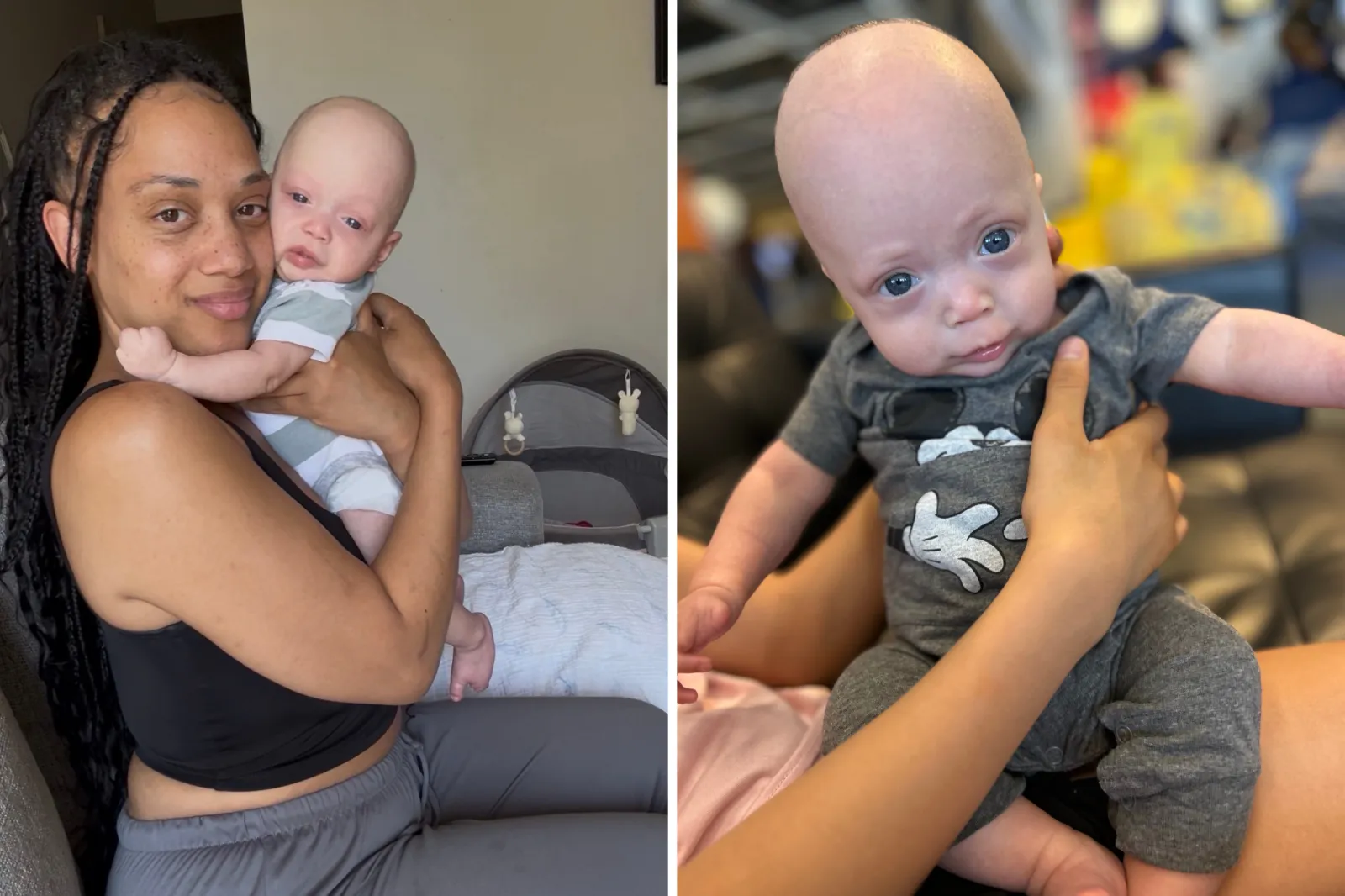
Mikey has two fingers on each hand; on one hand, two of his fingers are fused together. On his feet, he has his big toe and two smaller toes that are fused together. Internally, EEC syndrome has also affected his urinary tract. He also has tear duct differences, which cause his eyes to water frequently. We are continuing to monitor his eyes, teeth, hair, sweat glands, hearing and overall development as EEC syndrome is such a broad spectrum. He is still very young, so we will learn more as he grows.
If you met Mikey today, the first thing you would notice isn’t his diagnosis. You would notice his smile because he is one of the happiest babies.
He loves to be held, smiles all the time, and has started babbling, making little sounds, and giving tiny giggles that completely melt my heart. Honestly, most days I forget he has a diagnosis. He’s just Mikey.
I want people to know that a diagnosis is not the whole story. It’s OK to be scared and grieve the future you imagined, but it is also important to ask questions and educate yourself before making decisions. Every child with EEC syndrome is different, and an organization that helped me tremendously is the National Foundation for Ectodermal Dysplasias. They provide education, support, and connect families all over the world who are living through this, and knowing I wasn’t alone made an incredible difference.
When I look back on my pregnancy, there was so much grief. But this journey has shown me a version of myself that I never knew existed. I am stronger than I ever gave myself credit for.
If I could go back and sit beside the woman I was at 20 weeks pregnant, I would simply hold her hand and tell her this: your son is going to change your life but not in the way you’re afraid of. He’s going to make you stronger than you imagined and teach you what unconditional love looks like.
If I had to make the decision all over again, knowing everything I know today, I would choose Mikey every single time.
Jessica Vargas, 38, from Washington State shares Mikey’s story on TikTok (@tinybutmightymikey) as a means to raise awareness for EEC syndrome, while also showing what life is like beyond a diagnosis. Her hope is that other families feel less alone after seeing just how far Mikey has come, and the joy and love he exudes.
View 0 Comments
Submit Correction
View Editorial & AI Guidelines