10
Loading video...

By Daniella Gray
Reporter
0
Share
Newsweek is a Trust Project member
See more of our trusted coverage when you search.Prefer Newsweek on Googleto see more of our trusted coverage when you search.
A decision made by a Missouri mom to push for further testing over a spot on her son’s face ended up saving his life.
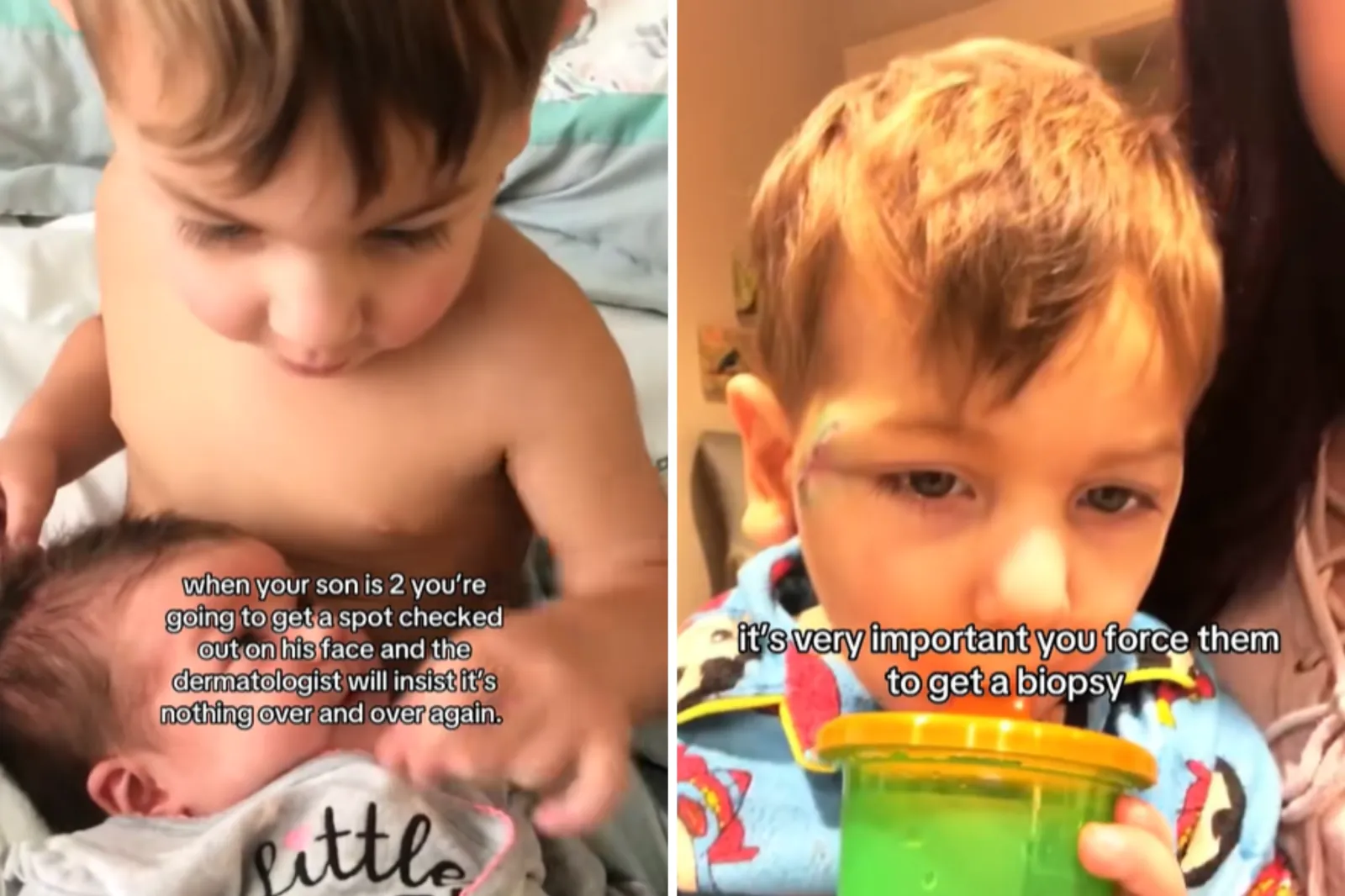
Years earlier, Shelby Rupp was assured by a dermatologist that a spot on her toddler’s face was nothing to worry about.
She first noticed it when Oliver was 2 years old, which appeared near the corner of his eye, close to his temple.
Read More on Family & Parenting
...
"It honestly looked like a bug bite,” Shelby, 34, told Newsweek. “It was summertime and we were outside, so I just assumed it was that.”
During their first visit, the dermatologist identified the lesion as a Spitz nevus—a type of mole that is common and usually benign in children. Shelby was told to monitor it and return if it changed.
But as time passed, the bump didn’t fade. As the spot slowly grew and shifted from a flesh tone to shades of pink, red and even purple, the mom's unease deepened even after a second dismissal.
“I had to make a third appointment and demand [a] biopsy,” Shelby said. “I was very pregnant and hormonal and... I was just not going to take no for an answer.”
Being brushed aside made her angry but also question how she was feeling. “It... kind of made me feel a little crazy, like maybe I was overreacting,” Shelby said.
Less than 24 hours after the biopsy was finally performed, the sample was rushed overnight to a specialized lab in California, which confirmed the diagnosis: spitzoid melanoma, a rare and aggressive form of skin cancer that can closely resemble benign lesions in children.
The findings were immediately forwarded to St. Jude Children’s Research Hospital in Memphis, Tennessee.
A call from St. Jude followed that same day, instructing the family to come in as soon as possible. Living about five hours away, they packed up and left almost immediately.
“I was trying to process what was going on,” Shelby said. “I was so extremely scared for my baby. We all just cried and cried.”
Thankfully, Oliver’s prognosis was far better than Shelby had feared. Because the melanoma was caught early, he didn’t require chemotherapy or radiation.
Instead, doctors at St. Jude placed him on a long-term preventative monitoring plan that spanned nearly seven years. Appointments were frequent at first—every few months—before gradually spacing out.
Shelby shared her son’s story in a clip on TikTok (@shelbyontiktok), where she wrote how she’ll always be his advocate.
Today, Oliver, now 9, returns only as part of an ongoing study and is cancer-free.
View 0 Comments
Submit Correction
View Editorial & AI Guidelines