...

By Anna Skinner
Associate News Editor
0
Share
Newsweek is a Trust Project member
See more of our trusted coverage when you search.Prefer Newsweek on Googleto see more of our trusted coverage when you search.
Hurricane Kristy strengthened to a Category 5 hurricane on Thursday, making it the most powerful storm on the planet.
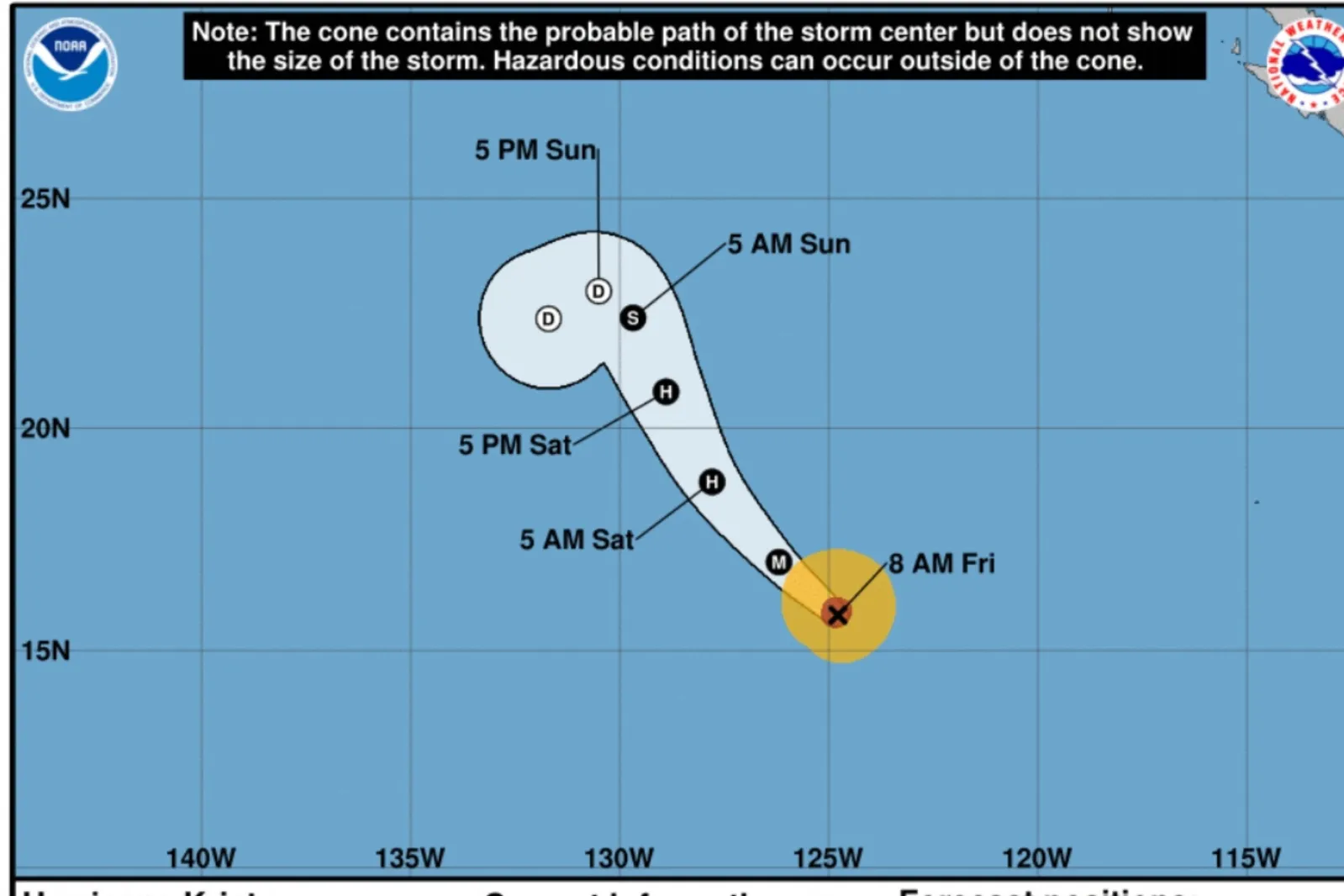
The storm became a major hurricane after it underwent rapid intensification earlier this week, in which it strengthened from a tropical storm to a Category 3 hurricane in less than two days. The storm has since gone through several cycles where its strength ratcheted up to a Category 4 and then a Category 5 hurricane. As of Friday morning, Kristy had weakened to a Category 3 hurricane with maximum sustained winds of 125 mph, although it's still considered a major hurricane.
"Timelapse of the most powerful storm on the planet," extreme weather chaser Colin McCarthy posted on X, formerly Twitter, on Thursday night, along with a video of the storm. "Category 5 Hurricane Kristy in the Eastern Pacific."
Read More on U.S.
More From Newsweek Vault: 5 Steps to Build an Emergency Fund Today
...
AccuWeather also shared a satellite loop of the storm, calling it "stunning" and expressing gratitude that the storm isn't a threat to land.
AccuWeather senior meteorologist Tom Kines told Newsweek that Hurricane Kristy is indeed the strongest storm on the planet.
More From Newsweek Vault: What Is an Emergency Fund?
"Even now it is," he said. "Even though it's weakened some, it is still the strongest storm existing."
Hurricane Kristy is the only tropical system currently being monitored by the National Hurricane Center (NHC). It became a tropical storm in the Pacific Ocean offshore of southern Mexico on Monday.
Formerly, Kristy was named Nadine. Nadine originated in the Caribbean Sea and moved west, over Belize and Central America, last weekend. The storm dissolved in Mexico, therefore losing its name. However, remnants from the storm restrengthened into Kristy, in the Pacific Ocean.
More From Newsweek Vault: Online Banks vs. Traditional Banks: Learn the Differences
The eastern Pacific hurricane season has a different list of names for its tropical systems. The Pacific season starts two weeks earlier than the Atlantic season, which begins June 1. Both seasons end on November 30.
Tropical Storm Nadine was the 14th named storm of the Atlantic hurricane season, and Hurricane Kristy is the 11th named storm of the eastern Pacific hurricane season.
The NHC anticipates that Kristy will make a turn to the northwest later in the day on Friday.
"A northwestward to north-northwestward motion at a slower forward speed is expected over the weekend," the most recent forecast said. "Steady to rapid weakening is expected during the next few days, with Kristy expected to become a post-tropical cyclone on Sunday."
Hurricane-force winds extend up to 30 miles from the storm's center, with tropical storm-force winds extending up to 105 miles.
Kristy is not expected to have any direct impacts on land, although swells from the storm could impact Baja California.
"Swells generated by Kristy will affect portions of the west coast of the Baja California peninsula beginning today and continuing into the weekend," the NHC said. "These swells are likely to cause life-threatening surf and rip current conditions. Please consult products from your local weather office."
View 0 Comments
Submit Correction
View Editorial & AI Guidelines