...

By Martha McHardy
US News Reporter
0
Share
Newsweek is a Trust Project member
See more of our trusted coverage when you search.Prefer Newsweek on Googleto see more of our trusted coverage when you search.
Authorities have issued a warning over "life-threatening" conditions amid Hurricane Kristy.
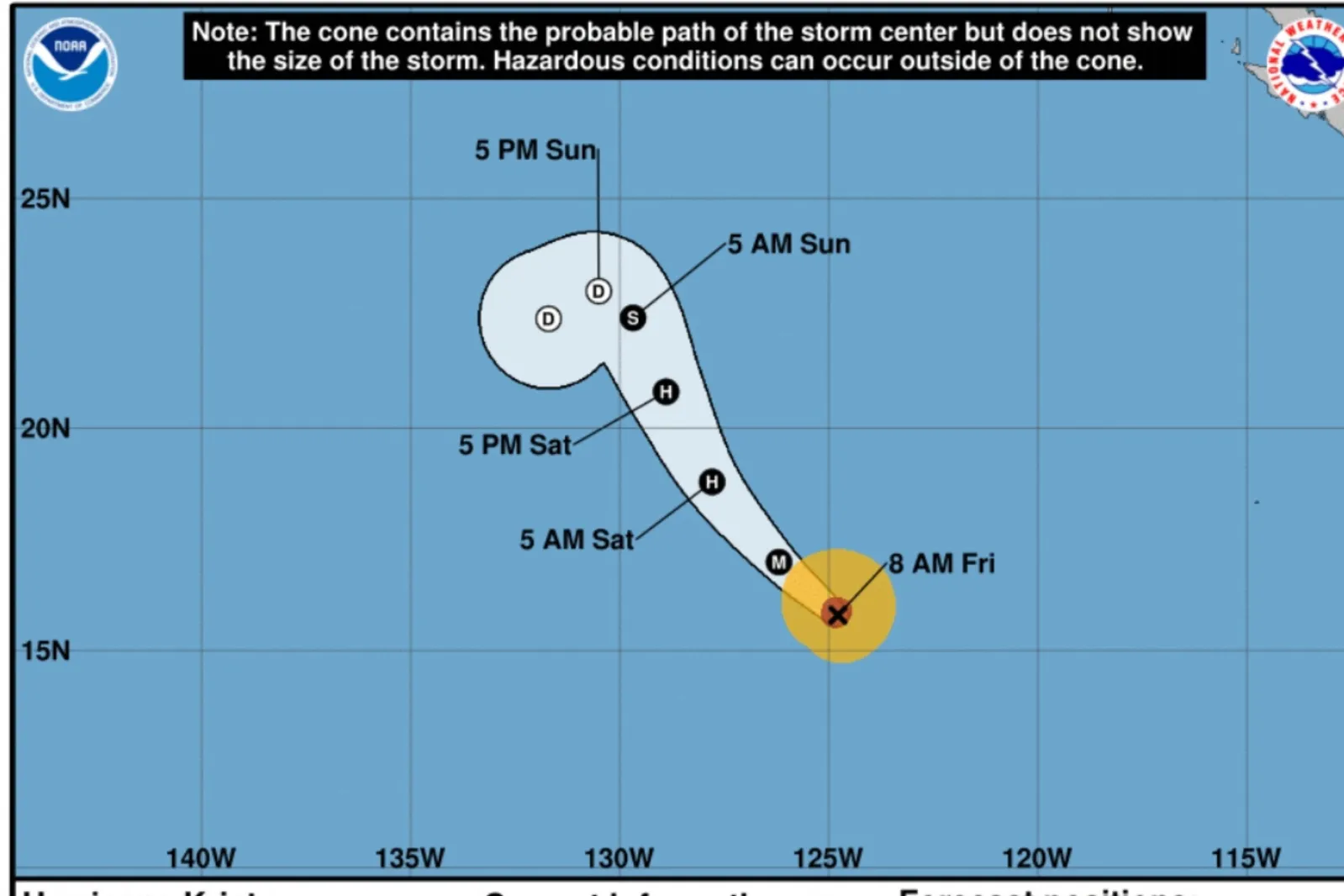
Kristy, formed from the remnants of Atlantic Tropical Storm Nadine earlier this week, is moving northwestward across the Pacific after strengthening from a Category 3 hurricane to a Category 5 hurricane on Thursday. With winds reaching up to 160 mph, it was the strongest storm on the planet.
As of Saturday, Kristy is a Category 2 hurricane with maximum sustained winds of 100 mph, although it is still considered a major hurricane, with "life-threatening" waves expected off the coast of Baja California in Mexico over the weekend.
Read More on U.S.
More From Newsweek Vault: 5 Steps to Build an Emergency Fund Today
"Swells generated by Kristy are affecting portions of the west coast of the Baja California peninsula and will likely continue to impact the region through the weekend. These swells are likely to cause life-threatening surf and rip current conditions. Please consult products from your local weather office," the National Hurricane Center said in an update on Saturday.
Kristy is not expected to affect the U.S. and is not expected to affect any land areas. The NHC added that the storm's "rapid weakening" is expected to continue over the weekend, as it downgrades to a tropical storm by Sunday.
...
Kristy, then called Nadine, initially formed in the Caribbean Sea, moving westward over Belize and Central America last weekend. After dissipating over Mexico and losing its original name, the storm's remnants reintensified in the Pacific Ocean, and it received a new name.
More From Newsweek Vault: What Is an Emergency Fund?
Hurricane Kristy is a Pacific storm, meaning it's on a different track from hurricanes in the Atlantic, such as Hurricanes Helene and Milton, which recently devastated parts of the U.S. Unlike Atlantic hurricanes, which often head toward the U.S. mainland or Caribbean islands, Pacific hurricanes usually veer away from the Mexican coast into the open ocean, though they sometimes affect Mexico or Hawaii.
Kristy is the 11th named storm in the eastern Pacific this season. While the Atlantic hurricane season begins on June 1, the eastern Pacific season starts on May 15. Both seasons end on November 30.
According to the NHC, "The eastern Pacific basin extends from Mexico and Central America westward to 140°W." Historically, the region averages 15 named storms, eight hurricanes and four major hurricanes each year. This season's first eastern Pacific hurricane, Carlotta, formed in early August, following two earlier tropical storms.
More From Newsweek Vault: Online Banks vs. Traditional Banks: Learn the Differences
AccuWeather senior meteorologist Tom Kines told Newsweek on Friday that Hurricane Kristy was indeed the strongest storm on the planet.
View 0 Comments
Submit Correction
View Editorial & AI Guidelines