...

By Daniella Gray
Reporter
0
Share
Newsweek is a Trust Project member
See more of our trusted coverage when you search.Prefer Newsweek on Googleto see more of our trusted coverage when you search.
A major paleontology discovery in southern France has revealed an unusually dense dinosaur nesting ground containing hundreds of fossilized eggs.
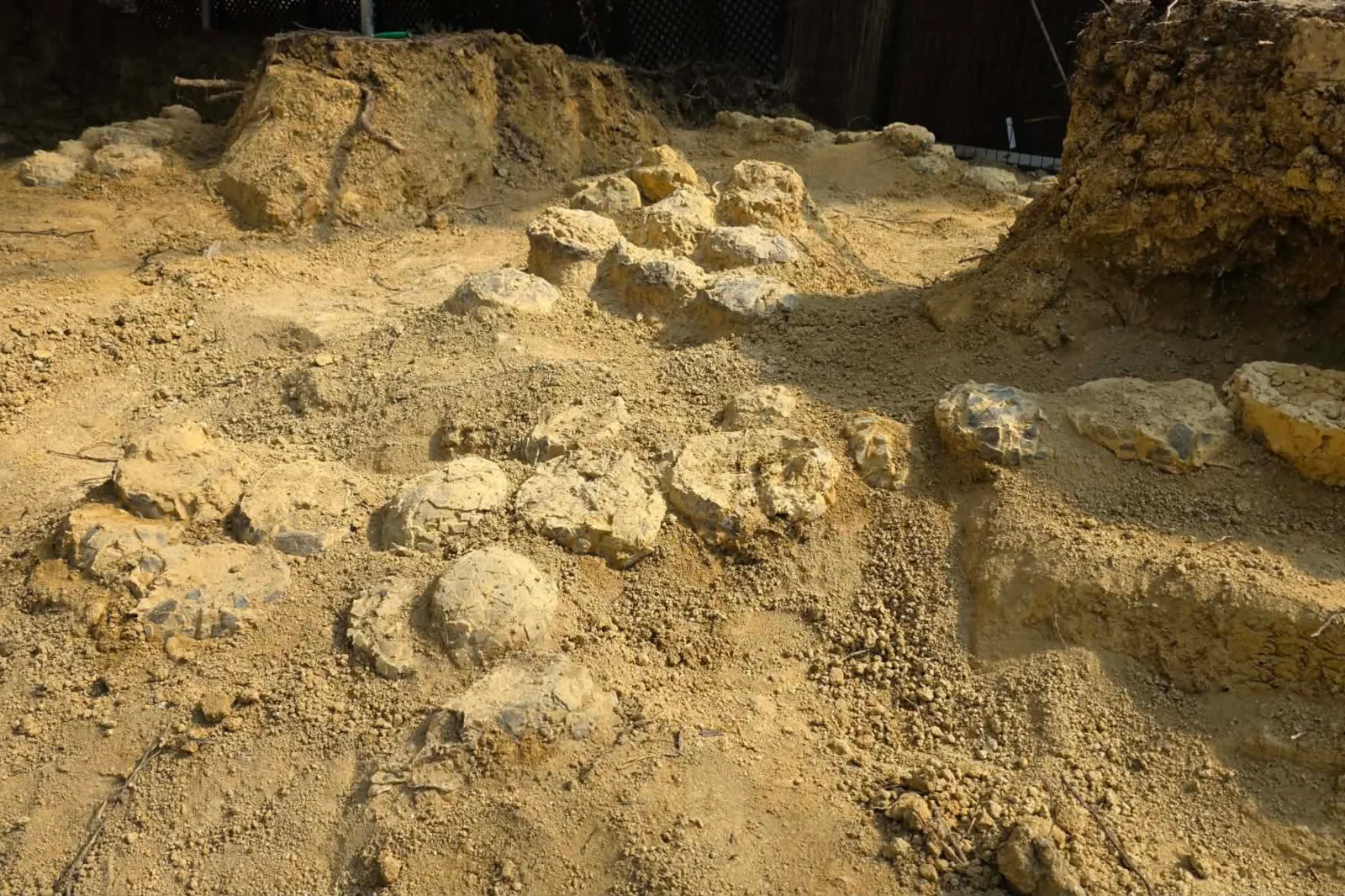
The find was announced on Facebook by the Musée-Parc des Dinosaures de Mèze in the Hérault region, where ongoing excavations on the Mèze fossil site have brought to light what the museum’s director-curator Alain Cabot called an exceptional concentration of eggs.
According to the museum, the discovery follows several months of meticulous excavation work, during which teams uncovered several hundred remarkably well‑preserved dinosaur eggs.
Read More on Science
...
Museum officials said the Mèze site is now considered the largest dinosaur egg deposit in Europe and among the largest fossil nesting grounds worldwide, comparable to sites in Argentina, China and Mongolia.
Alain Cabot said the find reflects nearly three decades of work at the site. He explained that he initially surveys areas for eggshell fragments on the surface before carefully digging beneath them—a method that led to the first egg discoveries at Mèze nearly 28 years ago. “Today we found a hundred more,” Cabot said, adding that such dense concentrations are extremely rare, as most sites yield only a handful of eggs.
Early observations suggest the fossilized eggs date back around 72 million years and could offer rare insight into dinosaur reproductive behavior, the environment they lived in and the species that once inhabited the region. Some of the eggs retain intact internal structures, giving the find considerable scientific value, the museum said.
The unusually high concentration of nests within a single area suggests a vast, shared nesting ground—what researchers describe as a genuine fossilized reproductive ecosystem.
The museum’s Facebook announcement has garnered more than 1,500 reactions and hundreds of shares. Many commenters expressed awe at the scale and age of the discovery, while others praised the museum’s scientific work and said the find deserved broader media coverage.
This discovery may be only the beginning. Indian business and financial news platform Moneycontrol reported that more than 100 eggs were visible within weeks once the team reached a fossil-rich horizontal layer, and noted that the egg-bearing layer extends beyond the current trench.
Researchers believe the ancient environment helped preserve the nests. Moneycontrol described the region as a river-laced floodplain, where dinosaurs likely nested in shallow pits covered with vegetation; periodic flooding then rapidly buried the nests under sediment, sealing delicate eggshells for tens of millions of years.
As for which dinosaurs laid them, initial studies suggest that the eggs belonged to different herbivorous species that lived toward the end of the Cretaceous period, between 72 and 70 million years ago, including titanosaurs—whose eggs are distinguished by their round shape—as well as Rhabdodon priscus.
Cabot said the discovery was especially moving because it represents “a real fragment of dinosaur life,” and noted that researchers expect several more years of excavation at the site, with much still left to uncover.
Update 3/31/26, 10:58 a.m. ET: This article was updated with new information and comments from museum director‑curator Alain Cabot.
Do you have a tip on a science story that Newsweek should be covering? Do you have a question about dinosaurs? Let us know via science@newsweek.com.
View 0 Comments
Submit Correction
View Editorial & AI Guidelines