
...


By Amanda Greenwood and Jasmine Laws
0
Share
Newsweek is a Trust Project member
See more of our trusted coverage when you search.Prefer Newsweek on Googleto see more of our trusted coverage when you search.
Virginia has become synonymous with data centers.
Home to the world's largest concentration of facilities, the state has spent years attracting billions of dollars in investment from technology companies seeking to power cloud computing, artificial intelligence, streaming services, and the broader digital economy.
But the collapse of the proposed Prince William Digital Gateway project shows that even in America's data-center capital, new developments are not always guaranteed.
Read More on News
Blackstone-owned QTS recently abandoned its plans for the Digital Gateway project after withdrawing its final appeal in a years-long legal battle with residents and historians over the proposed plans.
The development, which was planned across roughly 2,100 acres in Prince William County—around twice the size of New York's Central Park—could have become the world's largest data center campus. But the plans were ultimately derailed by a court ruling that found the county had failed to meet public-notice requirements during the rezoning process, which is when local officials change the rules governing what can be built on a piece of land.
...
Why Virginia Became America's Data Center Hub
Virginia's dominance in the industry is difficult to overstate.
According to the Virginia Joint Legislative Audit and Review Commission (JLARC), Northern Virginia is the largest data-center market in the world, accounting for approximately 13 percent of global operational data-center capacity and about 25 percent of capacity across the Americas.
Officials attribute that growth to a combination of extensive fiber-optic infrastructure, access to reliable electricity, available land, proximity to major customers, and longstanding state tax incentives.
Industry tracking data suggest there are hundreds of operating facilities across the state, with hundreds more proposed or in development. One industry database lists 371 operating data centers and 421 planned projects in Virginia, illustrating the enormous pipeline of future construction.
The growth has been fueled further by the rapid expansion of AI, which has dramatically increased demand for computing power and the facilities needed to house servers and networking equipment.
But some experts argue that the state's success is now creating new challenges. "The reality is that we are running up against fundamental limits in the current model of data center development," Ali Fard, an Associate Professor of Architecture and Director of the MIST Lab at the University of Virginia, told Newsweek.
Fard said that as available land becomes scarcer and concerns grow over electricity and water consumption, communities are increasingly scrutinizing projects that might once have received little opposition.
Related Story
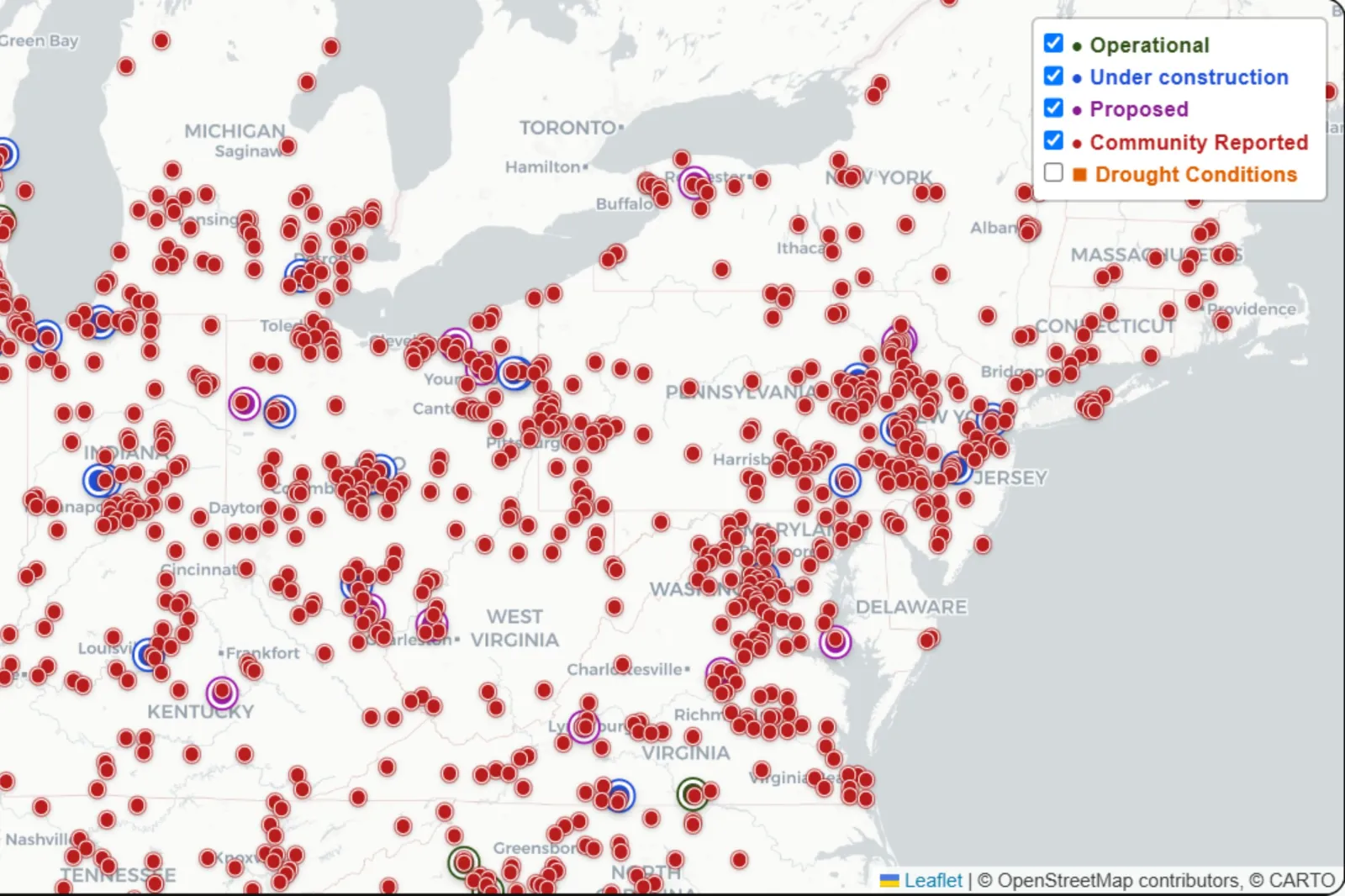
Maps Show Data Centers in Areas Where Power Grids Struggling
Why This Project Failed
The Digital Gateway project appeared well-positioned to move forward after receiving local approval in December 2023. Supporters argued it would generate tens of billions of dollars in investment, create thousands of jobs, and provide substantial tax revenue for local government.
But unlike many other Virginia data-center proposals, the project encountered unusually strong opposition.
Residents, environmental groups, and historic-preservation organizations objected to the site's proximity to Manassas National Battlefield Park, arguing that the development would alter the landscape surrounding a significant Civil War site while increasing pressure on local infrastructure and natural resources.
Community support is increasingly playing a role in whether data center projects go ahead, Peter Aiken, an associate professor at Virginia Commonwealth University, told Newsweek. He said that plans like this "are being rushed through without community involvement," and "the public associates them with AI and sentiment is running against that as well."
The project's opponents ultimately prevailed in court.
Judges ruled that Prince William County failed to comply with public-notice requirements before approving the rezoning.
In 2025, a circuit court voided the approvals, and the Virginia Court of Appeals unanimously upheld that decision in March 2026. Once Prince William County and co-developer Compass Datacenters dropped their appeals, QTS was left fighting alone before eventually abandoning the project.
In other words, one of the largest data-center projects ever proposed didn’t fail because of financing problems, lack of demand, or regulatory restrictions on AI. It failed because a procedural error in the rezoning process gave opponents a legal pathway to overturn the approvals.
But experts say the court ruling only tells part of the story.
Fard told Newsweek that although the project's demise ultimately hinged on a procedural issue, it reflected broader concerns about the pace and scale of data center development.
"While it seems the final nail in the coffin, in this case came down to a small technicality. Highly visible data center projects like QTS's 'Digital Gateway' are rightly facing increasing scrutiny," he said, adding that Northern Virginia is increasingly confronting limits on land, power and water resources, with proposed developments drawing opposition when they are located near historic sites or environmentally sensitive areas.

...
Growing Concerns About Power Demand
The decision comes as scrutiny of data-center growth is increasing across Virginia.
Recent headlines focused on Henrico County, where government employees and school staff were asked to conserve electricity by turning off lights, shutting down computers, and adjusting blinds after electricity costs rose by nearly 25 percent. According to Futurism, the county is home to 37 data centers and has at least 17 more planned.
While county officials said the conservation effort was a response to rising electricity costs generally, the episode became a symbol of growing public concern about the industry's energy demands.
Dominion Energy—Virginia's largest electric utility that supplies power to millions of customers in the state—has repeatedly acknowledged that rapidly growing electricity demand, much of it tied to data centers, is driving major grid investments across Virginia, telling Inc that higher rates charged to municipal utilities reflect “inflationary pressures and rising costs of fuel, purchased power, grid equipment, and the necessary investments to maintain a reliable grid to serve growing demand.”

...
What Happens Next
Despite the collapse of Digital Gateway, Virginia is unlikely to lose its status as America's leading data-center market anytime soon.
QTS itself told Reuters that it remains heavily invested in Virginia and continues to spend billions elsewhere in the state.
However, the demise of Digital Gateway is not an isolated case.
Uzi Dvorkin, an Associate Professor at the Johns Hopkins Whiting School of Engineering, told Newsweek that similar projects around the country are increasingly running into economic, regulatory, and community obstacles.
"This news is part of the growing national trend when original data center plans, some of which were speculative, are abandoned either under pressure from communities or because the project economics don't pencil out," Dvorkin said.
"In this case, the costs—including the costs imposed by regulatory and legal barriers—outweigh the project benefits and make the project prohibitively expensive."
Fard said the collapse could also signal a broader shift in how states and communities evaluate future data center projects.
"The growing resistance will directly affect the pace and scale of infrastructure build out to support AI rollout," he said.
According to Fard, policymakers are beginning to grapple with concerns over electricity demand, water consumption, and the impact of large-scale developments on surrounding communities, although policy has not always kept pace with the industry's rapid growth.
He argued that the outcome may force governments and developers to more carefully weigh the costs and benefits of proposed projects, including their environmental and infrastructure impacts.
"It may force us to be a little more critical about where and how we develop this infrastructure and to weigh the real costs and benefits of each project relative to the rest of the region," Fard said.
Developers will likely face increased pressure to engage communities earlier, carefully follow local approval procedures, and address concerns about power consumption, water use, noise, and impacts on nearby neighborhoods. At the same time, opposition groups may view the Digital Gateway outcome as evidence that even the largest projects can be challenged successfully.
For Virginia, the challenge now is balancing its position as the center of the nation's digital infrastructure with growing concerns from residents who increasingly want a greater say in where—and how fast—the next generation of data centers gets built.
View 0 Comments
Submit Correction
View Editorial & AI Guidelines