...

By Jasmine Laws
Reporter
0
Share
Newsweek is a Trust Project member
See more of our trusted coverage when you search.Prefer Newsweek on Googleto see more of our trusted coverage when you search.
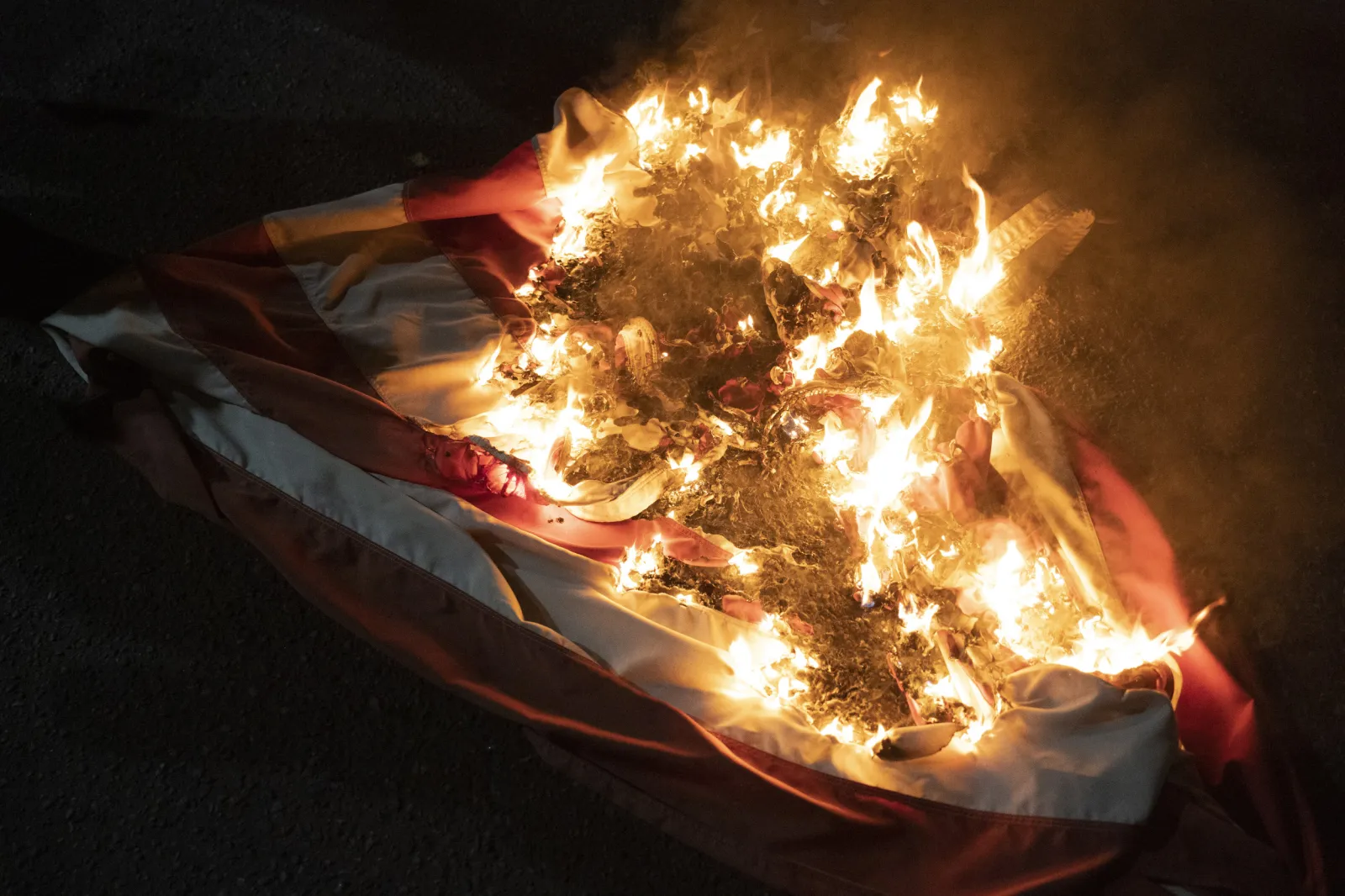
President Donald Trump signed an executive order on Monday directing the Department of Justice to prosecute, to "the fullest extent possible," any Americans who desecrate the country's flag.
While Trump's order has little power—as the Supreme Court has previously ruled flag burning is not illegal—it signals the president's desire to reopen the question of criminalizing flag desecration and shrinking back First Amendment protections.
The Trump administration therefore seems poised to fight for America to join a number of other countries across the globe that have legislation determining that burning the national flag is illegal—and punishable by varying degrees depending on the country.
Read More on News
Why It Matters
Laws on flag desecration are often met with mixed views—with some believing that a country's flag is an important symbol and should not be damaged, while others think criminalizing flag desecration goes against the principle of freedom of speech.
...
What To Know
Broadly desecration of a flag refers to any action that damages or disrespects it—such as burning it, urinating or defecating on it, defacing it, stepping on it, damaging it with stones or bullets, cutting or ripping it and many others.
Countries That Ban Flag Burning
A number of countries in Europe have criminalized the burning of the national flag including France, Germany, Italy, Latvia, Lithuania, Estonia and Poland.
The punishment for burning the national flag in Russia is reportedly one year in jail.
Some countries across Africa also have bans on flag desecration, as well as a significant number in Asia.
China, Hong Kong, the Philippines, Singapore, South Korea, India and Indonesia all have punishments in place for those who desecrate the national flag.
Even using the flag as a tablecloth, a covering for walls, or a pennant in the hood, side, back or top of a motor vehicle is prohibited in the Philippines.
In Latin America, Mexico and Brazil also have laws in place to protect the national flag.
Punishment for burning the national flag varies, with some requiring those who desecrate a flag to pay a fine, such as Italy, while others, like South Korea, enforce multiple years of jail-time.
Germany has gone so far as to make the burning of any flag, including the European Union flag, punishable by up to three years in jail.
Countries That Allow Flag Burning
While some countries see flag burning as disrespectful and a crime, others see implementing such laws as an infringement of freedom of speech laws.
Canada is one of those countries. It has no laws prohibiting the desecration of the Canadian flag, and the country sees flag desecration as an expression of speech protected by the Canadian Charter of Rights and Freedoms.
Australia is another country that allows flag burning—although there have been cases where those who have burnt the national flag have been prosecuted, but only because the fire caused by the burning became a public safety risk.
While Denmark has no laws against the burning of its own flag, it does prohibit the burning of any foreign flags, as well as those of the United Nations and European Union.
According to the Michigan State International Law Review, Denmark adopted this approach as a matter of foreign policy, hoping that punishing those that burn foreign flags could help avoid diplomatic incidents.
America's Stance
Trump has long condemned the act of burning the American flag, calling it "disgraceful" and his order directs the Attorney General to "vigorously prosecute those who violate our laws in ways that involve desecrating the flag, and to pursue litigation to clarify the scope of First Amendment in this area."
Although, Trump's order was met with varying degrees of support, even from longtime conservatives, most likely because it defies a longstanding Supreme Court order that burning the flag is protected by the First Amendment.
For example, the right-wing broadcaster Erick Erickson wrote on X: "This is actually not brilliant. While I agree with the sentiment, it is unfortunately well settled constitutional law that burning the flag is a matter of free speech and the executive does not get to create crimes."
"The argument in support of flag desecration laws is that the flag, as a symbol of the nation, should be treated with respect," Geoffrey Stone, a professor of law at the University of Chicago, told Newsweek.
"But if that is deemed a sufficient justification then so, arguably, would be laws prohibiting the desecration of images of the president or of the White House or of the Supreme Court, and on and on and on," he added.
What People Are Saying
Geoffrey Stone told Newsweek: "In two decisions half-a-century ago, Spence v. Washington and Texas v. Johnson, the Supreme Court held flag desecration laws unconstitutional as applied to individuals who engaged in such activity as a means of expression. The Court held that such actions are speech within the protection of the First Amendment and cannot be punished because they offend others or even cause others to engage in unlawful activity, either consistent with the intentions of the actors or in opposition to them, except in extraordinary circumstances. That is, unless the government can prove that the speakers specifically intended to create and did in fact create a clear and present danger of grave harm. No speaker has been punished under that standard for decades."
He added: "Basically, then, the Court held that flag desecration laws, as applied to people who desecrate the flag for expressive purposes, are unconstitutional in the same way that laws prohibiting people from criticizing the president or the government are unconstitutional."
President Donald Trump said while signing the order: "They burn the American flag. They call it freedom of speech. When you burn a flag, the area goes crazy. If you have hundreds of people, they go crazy. You can do other things…but when you burn the American flag, it incites riots at levels we've never seen before."
The White House wrote in the order: "The American flag is the most sacred and cherished symbol of the United States of America, and desecrating it is uniquely and inherently offensive and provocative. It is a statement of contempt and hostility toward our Nation, and an act used by groups of foreign nationals calculated to intimidate and threaten violence against Americans."
What Happens Next
Even on Monday, just hours after Trump signed the order, a man was arrested for burning the American flag near the White House.
View 0 Comments
Submit Correction
View Editorial & AI Guidelines