
...

Brendan Cole
Senior Reporter
0
Share
Newsweek is a Trust Project member
See more of our trusted coverage when you search.Prefer Newsweek on Googleto see more of our trusted coverage when you search.
Touted as a revolution in urban living, Saudi Arabia’s futuristic city known as The Line—part of Crown Prince Mohammed bin Salman's Vision 2030 strategy—has been hit by issues with costs pressures, job cuts and delays.
The half-trillion-dollar high-tech city planned for the northwest of the kingdom was intended to offer a futuristic and environmentally friendly way to house 9 million people when the proposal was unveiled in 2021.
But fluctuating oil prices and budget shortfalls have led to a strategic review of the ambitious plans that are part of the NEOM development project, according to reports.
Read More on News
Newsweek has contacted NEOM for comment.

...
Why It Matters
The Line was one of the flagship projects for Crown Prince Mohammed bin Salman as he pushes to diversify Saudi Arabia’s oil-reliant economy.
NEOM told Bloomberg in July that The Line “remains a strategic priority,” but the outlet said the project has faced scale-backs, with officials now expecting the development to house fewer than 300,000 residents by the end of the decade, suggesting that budget shortfalls can prove to be obstacles to constructing the cities of the future.
What To Know
The Line is one of the planned futuristic venues that the kingdom hopes will bring millions of new residents to Saudi Arabia and revolutionize living and technology.
Plans revealed in a video in 2022 outlined how the site in Tabuk province would stretch 110 miles across desert valleys and mountains and toward the Red Sea.
The video depicted a mirrored, vertical city 600 feet wide and 1,500 feet high with stacked layers for housing, work and leisure. There would no cars, only high-speed transit and 100 percent renewable, aiming for zero carbon emissions.
But by July 2025, Saudi Arabia had asked consulting firms to conduct a strategic review of the plans, according to Bloomberg, citing unnamed sources familiar with the matter, as the kingdom assesses priorities for its project-related expenditures.
Amid a lack of public information about the project, a unit of the kingdom’s sovereign wealth fund is asking the firms to review whether current plans are feasible and to suggest possible changes, the outlet reported.
Lower oil prices, weaker-than-projected foreign investment and budget shortfalls mean Saudi Arabia needs to reprioritize its projects, Bloomberg reported.
...
Bloomberg Economics estimates that Saudi Arabia needs a price of $96 a barrel to balance its budget, and $113 to pay for the crown prince’s projects. On December 19, the price of Saudi crude was $55.60.
The government had hoped it would have 1.5 million residents by 2030 and a stadium on top of a skyscraper to host games for the 2034 men’s soccer World Cup, but that has been scaled back to 300,000, Bloomberg reported in April 2024.
Officials have long said that The Line would be built in stages, but the scale-back in 2024 meant that only 1.5 miles of the project would be completed by 2030, according to the same report.
Semafor, a global news outlet, reported in July 2025 that NEOM was looking to cut its workforce and relocating more than 1,000 employees to Riyadh to control costs and improve oversight of the project.
But Saudi Arabia will need to considerably accelerate construction to complete The Line by its stated deadline, according to the industry publication New Civil Engineer (NCE), in October 2024, which referred to Google Earth satellite images and experts.
A side-by-side satellite image comparison—from a barren landscape in 2018 to October 2024—visually confirmed the site's transformation into large-scale earthworks, completed buildings, grid-like infrastructure layouts and support facilities.
Imperial College London Faculty of Engineering visiting professor Mike Cook told NCE that building something of such a scale within a few years was “unrealistic.”
He said that there’s only a finite supply of steel and concrete in the world that cannot be suddenly increased to meet the project’s demands.
...
For the Line to be completed by 2030, Cook said, it would need to be constructed at 15,000 times the rate of normal U.K. construction times.
The project has been criticized for alleged human rights violations and the displacement of the Huwaitat tribe, while environmental groups have raised concerns over its ecological footprint.
There are also discrepancies over the length of the city. AtkinsRéalis, a delivery partner on The Line, has said it measured 140 kilometers, 30 fewer than the official measure.
Heriot Watt University School of Energy, Geoscience, Infrastructure and Society associate professor Rod Macdonald told NCE that there are geographical challenges to the project, such as mountains and seismic activity.
Tarik Solomon, chairman emeritus at the American Chamber of Commerce in Saudi Arabia, told CNBC in July 2025 that he did not think expectations were managed well from a leadership perspective and that for a project of this scale to succeed, it had to adjust to market realities.
While he praised The Line as “one of the boldest ideas I’ve seen,” the architectural and consulting firms involved "should have more of a sense of ownership and responsibility to carry.”
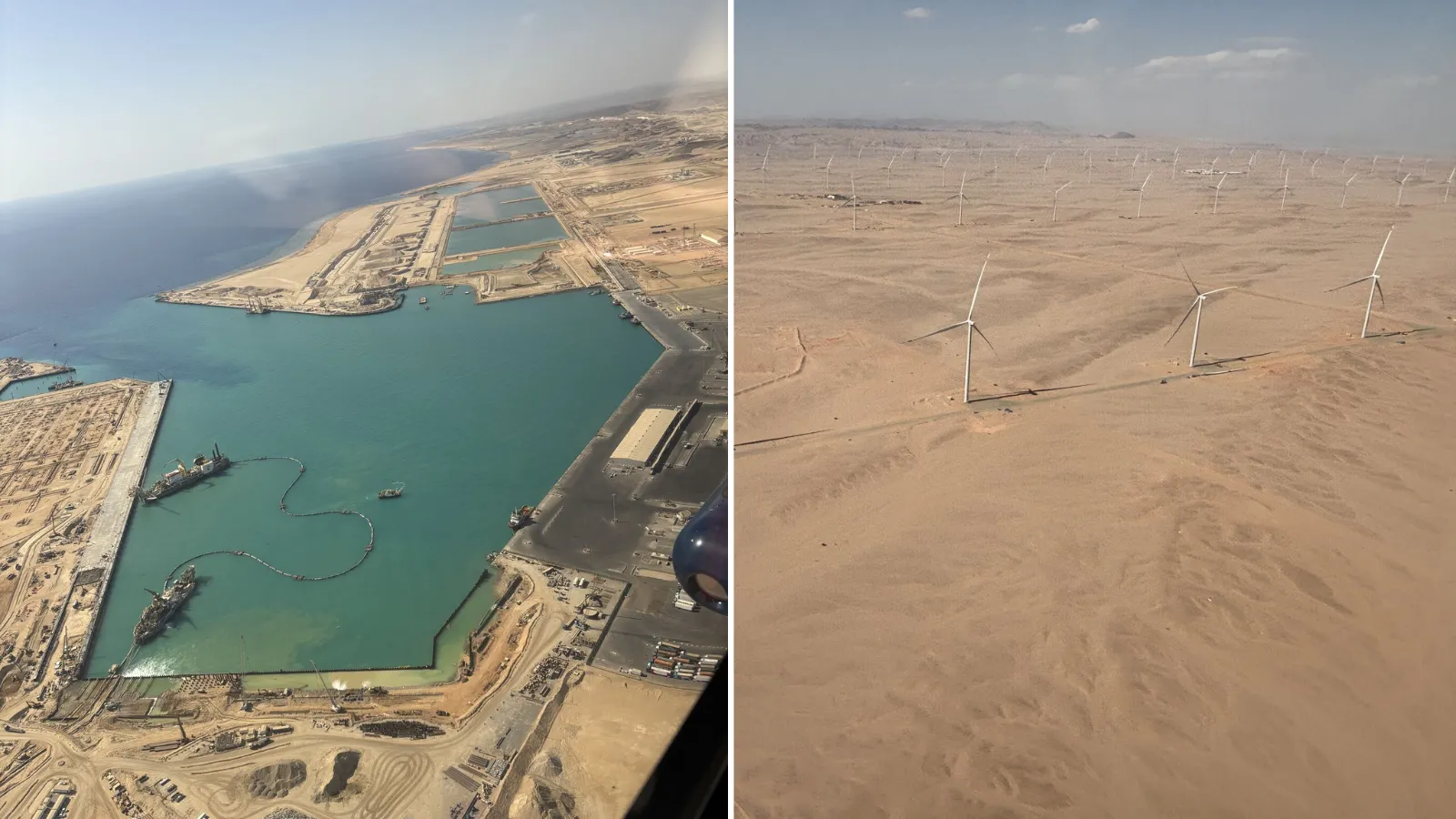
Giles Pendleton, chief operating officer for The Line, released on-site photos in April 2025 showing ground infrastructure taking shape.
What People Are Saying
Tim Callen, a visiting fellow at the Arab Gulf States Institute, to CNBC in July 2024: “Is the cost of development too high? That’s clearly become an even more pressing issue as oil prices have headed down the last couple of years.”
Imperial College London Faculty of Engineering visiting professor Mike Cook, to NCE in October 2024: “I think it’s such a crackpot idea, as surely everyone agrees who is involved in city planning, to have something of such a scale, to think that you’re going to build it within a few years is unrealistic.”
Semafor.com: ”Saudi Arabia’s NEOM is considering significantly cutting its workforce and relocating more than 1,000 employees to Riyadh as the kingdom tries to control costs and improve oversight of the vast new city.”
NEOM, in a statement to Bloomberg: “As is typical with large-scale, multi-year projects, strategic reviews are common practice and occur several times over the course of a major development project or infrastructure program.
“The Line remains a strategic priority and Neom is focused on maintaining operational continuity, improving efficiencies and accelerating progress to match the overall vision and objectives of the project.”
What Happens Next
Despite reports of the project being scaled back and a lack of public information about its status, NOEM has said in July that The Line remained a strategic priority for the kingdom.
View 0 Comments
Submit Correction
View Editorial & AI Guidelines