10
Loading video...


By Ellie Cook and Dan Gooding
0
Share
Newsweek is a Trust Project member
See more of our trusted coverage when you search.Prefer Newsweek on Googleto see more of our trusted coverage when you search.
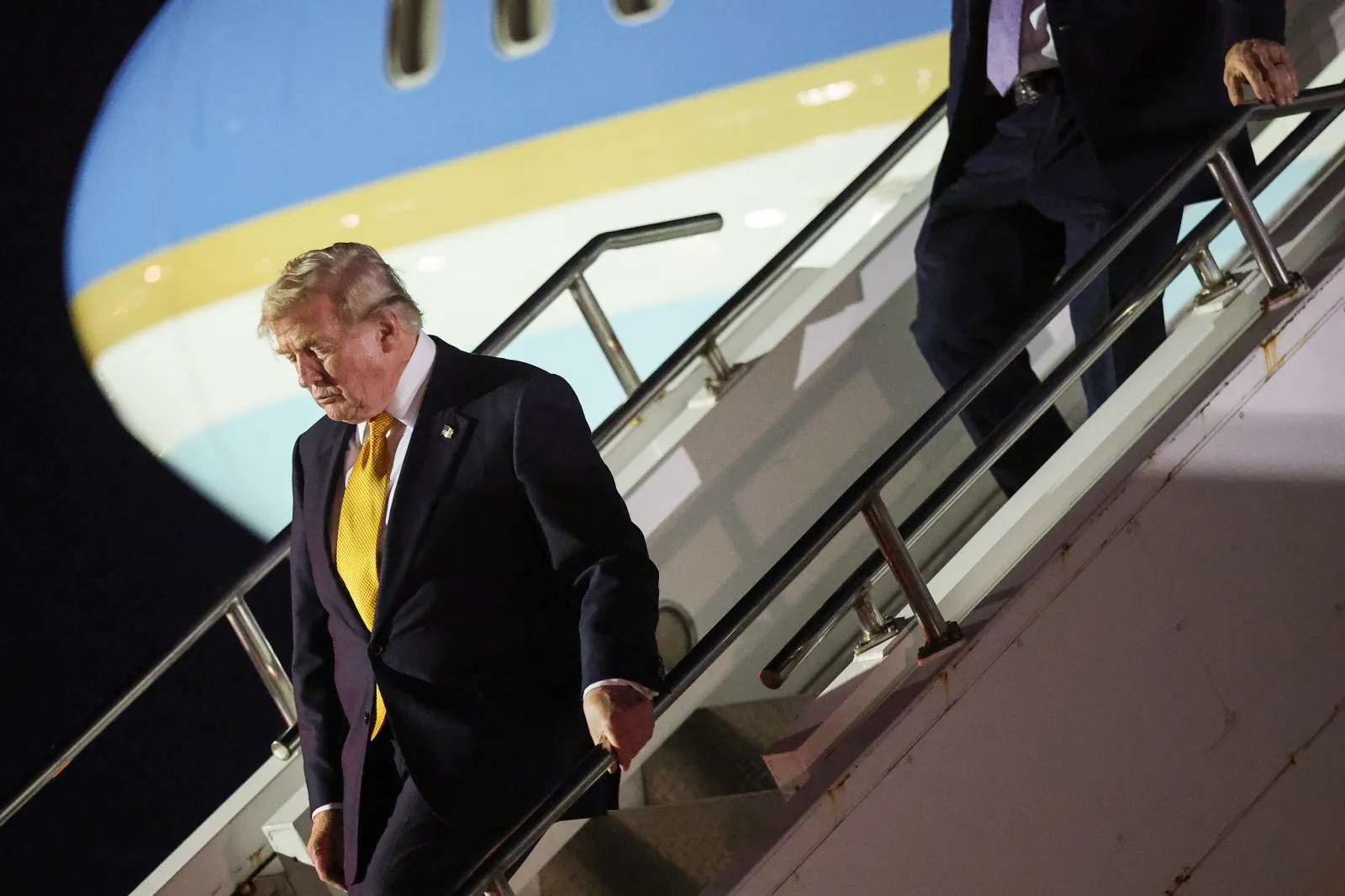
President Donald Trump reportedly secretly traveled on a smaller military plane, rather than Air Force One, because of the threat of an Iranian assassination plot as he left the NATO summit in Ankara, Turkey, last month, piling fresh attention on the safety and security status of presidential transport.
The president was seen embarking Air Force One in the Turkish capital, but was then smuggled onto an alternative plane, an Air Force C-32A, in a catering truck used to bring meals onboard an aircraft, The Washington Post reported on Monday.
This essentially made Air Force One, and the White House staff strapped in next to journalists, a decoy. Newsweek has reached out to the White House and Secret Service for comment via email.
Read More on World
Trump had announced ahead of the journey he would take the "former Air Force One" from the NATO summit to an air base in the U.K. "for old time's sake," rather than travel on the controversial, Qatari-donated Boeing 747-8 jet.
Reacting to the report on Tuesday, Trump said in part, "I go by Secret Service and the military. They wanted me to go on a different flight, a different plane... I do what they say... I guess there was a threat out there. I didn't really ask too much about it. I get a lot of threats."
Questions had swirled over the security status of the Qatari jet, which has been since modified by the U.S. military. It was unveiled by Trump at Joint Base Andrews in June, when the president said the aircraft boasted a "level of luxury that nobody's ever seen before."
What Happened in Turkey?
Details that have emerged in recent days suggest the reported plane swap was part of an unusually elaborate security operation carried out as Trump departed the NATO summit in Ankara, Turkey, on July 8.
According to reporting by The Washington Post, later corroborated by other outlets, U.S. intelligence had received what officials described as a credible threat against the president linked to Iran, prompting additional security measures.
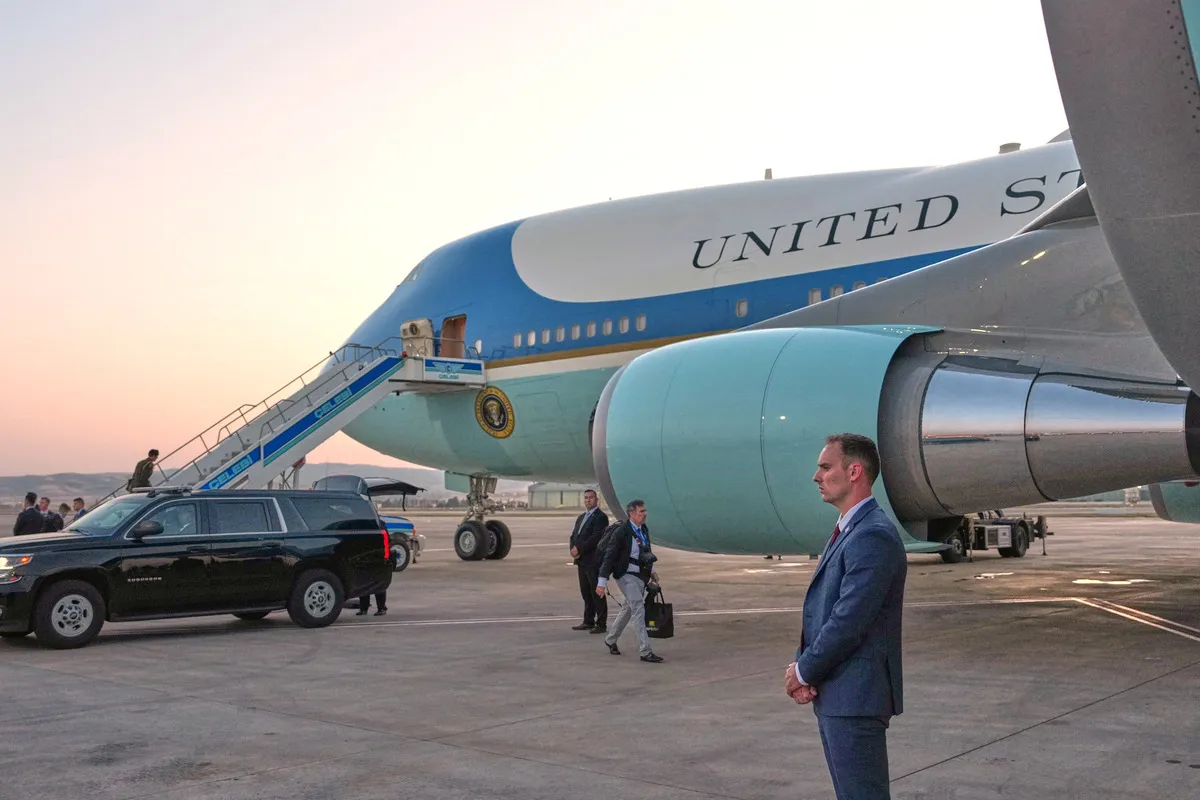
Television cameras and members of the traveling press pool saw Trump board the older blue-and-white Air Force One aircraft at Ankara's airport. But according to the reports, Trump was then secretly moved off the plane using an airport catering truck positioned on the opposite side of the aircraft, out of sight of reporters. He was reportedly transferred to a separate Air Force C-32A, a military version of the Boeing 757 commonly used by the vice president and other senior U.S. officials.
Pool photos from the day have given more insight into what reporters experienced, with some images showing the reported catering truck which was used to transport the president to the other aircraft.

...

...
The operation effectively turned Air Force One into a decoy. Journalists and some White House staff members reportedly remained aboard, believing the president was with them, while Trump traveled separately to the United Kingdom.
Reporters on the aircraft later said they had been instructed to keep window shades closed during the flight from Ankara, a precaution that drew attention at the time, but whose significance only became clear after details of the operation surfaced.

...
At the NATO summit, Trump had publicly said he would return on the older Air Force One "for old time's sake" rather than use the newer Boeing 747-8 donated by Qatar that had flown him to Turkey. Subsequent reporting indicated security concerns and the threat information were key factors behind the travel arrangements. White House officials have defended the security measures, saying the administration uses every available tool to protect the president from foreign threats.
What Is The Air Force's C-32A?
The C-32A is often used by the vice president, the first lady, and senior politicians traveling around the globe. When they're on board, it uses the call sign Air Force Two.
The cabin, where passengers sit, is split up into four sections. One part has a communications center, 10 seats, refreshment facilities and a toilet, while a second is a "fully-enclosed stateroom," the U.S. Air Force says. Within this, there is a changing area, an entertainment system, a fold-out bed, another toilet and two first-class seats.
Another eight seats are located in a third section of the plane, while a further 32 seats, a galley, and two toilets are positioned at the back.
Related Story
Trump’s Reported Plane Switch Amid Iran Threat ‘Downright Scary’: Senator
How Does Air Force One Compare?
The current Air Force One fleet is made up of two, specially-configured Boeing 747-200B aircraft, known as VC-25.
The interior of the commercial airliner has been changed, and the aircraft has been fitted with advanced avionics, according to the Air Force.
The C-32 is much smaller than the VC-25, which is set up to be a flying command center for the president and his staff.
But because the C-32 is a military aircraft—an upgraded version of the Boeing 757-200, regularly used by the vice president and other top U.S. officials—security is a top priority.
...
The C-32 is built so it's easier for those onboard to see around and underneath the aircraft, to more quickly detect any threats to the plane and its passengers, the military says.
Many of the security and defense systems built into both aircraft aren't public knowledge. The Air Force says the C-32 has systems built in that alert the crew to any possible threats to the aircraft from the air and ground in advance, as well as sophisticated navigation systems and information to make sure it doesn't collide midair with another aircraft.
But the roughly $400 million jet donated by Qatar was criticized for not having many of the defense measures presidential transport typically does, like technology that pushes away heat-seeking missiles heading for the jet.
The C-32s and VC-25s have been in service for decades, and replacement Boeing jets are in the works and expected to be handed over by roughly 2028.
Contact Newsweek editors on this story: Ben Kelly, Cristina Diciu, and Anna Commander
View 0 Comments
Submit Correction
View Editorial & AI Guidelines