...

By Hugh Cameron
Reporter
0
Share
Newsweek is a Trust Project member
See more of our trusted coverage when you search.Prefer Newsweek on Googleto see more of our trusted coverage when you search.
President Donald Trump’s new namesake savings accounts are being framed as a major, wealth-creating tool for American families, but some economists have questioned whether "Trump Accounts" are as lucrative as the administration's own projections suggest.
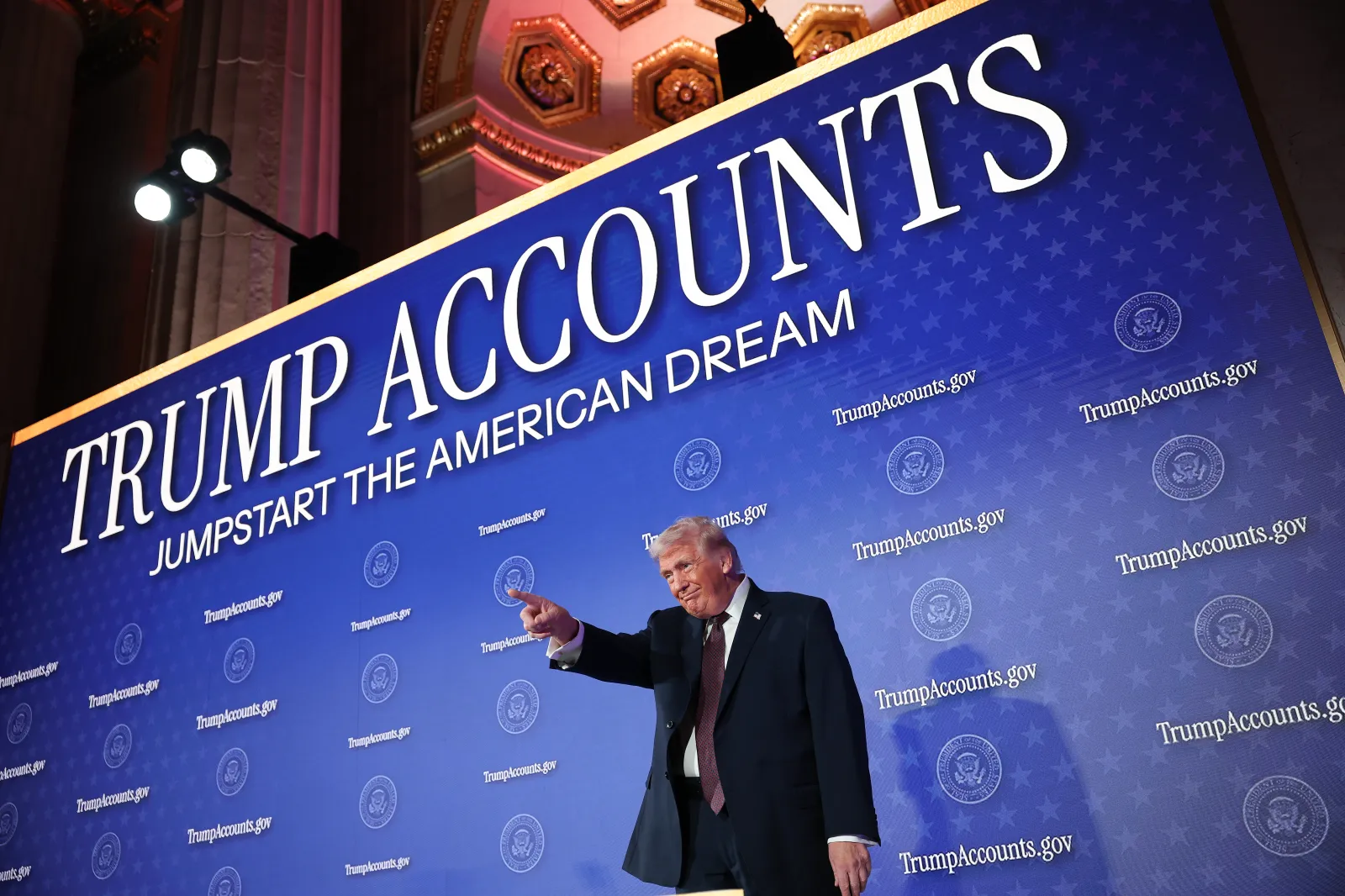
“The ultimate success of the Trump accounts will be measured not just in the wealth created; it will be seen in young people buying houses that they could never have even dreamed of buying,” Trump told the crowd at a launch event on Wednesday. “It'll be seen in diplomas earned, companies founded, families formed, and more babies born.”
“Economists have spent a year predicting economic catastrophe under President Trump,” White House spokesman Kush Desai told Newsweek in response to economists who have doubted the return potential of Trump Accounts. “The exact opposite has happened instead: accelerating GDP growth, multiple stock market all-time highs, and cooling inflation.”
Read More on Politics
What To Know
Trump accounts were created as part of the One Big Beautiful Bill Act signed into law by Trump last July.
A kind of retirement account for children, Trump Accounts are designed to encourage parents to save and invest with a slight boost from the federal government. Each account includes a $1,000 government contribution for children who are U.S. citizens born between January 2025 and the end of 2028.
These accounts permit up to $5,000 in annual contributions and allow savings to grow tax-deferred until the owners make withdrawals. Generally, withdrawals can begin only after a child turns 18, at which point the account functions like a traditional individual retirement account, with the associated tax penalties.
Contributions may only be invested in a qualified mutual fund or exchange-traded funds that track either the S&P 500 or another basket of American equities, according to the IRS guidance.
How Much Could Trump Accounts Grow by 2043?
The president’s Council of Economic Advisers (CEA) published projections last month for how much Trump Accounts could yield for those born after January 1, 2025. The agency estimates that balances could range from $5,800 to $303,800 by the time an account holder turns 18, depending on whether they make the maximum annual contribution of $5,000 or simply sit on the government’s $1,000 deposit.
The figures rise to $18,100 and $1.1 million, respectively, by the time account holders reach the age of 28.
But economist Desmond Lachman told Newsweek that these projections “are very rosy and exaggerate the benefits of the plan for a number of reasons.”
“To get to the $1 million by 28, you would have to assume that in addition to the $1,000 in seed money given by the government, the parent would need to put $5,000 a year into the account and the account would need to yield 7 percent a year,” said Lachman, senior fellow at the American Enterprise Institute and former deputy director at the International Monetary Fund (IMF).
“The government's seed money alone would only amount to around $15,000 by age 28 even if you assumed that the yield was 10 percent a year,” he added.
...
A recently launched Trump Accounts website provides similar projections to the CEA. By 2043, and using only the $1,000 seed contribution, it says, balances could reach $6,000, rising to $271,000 if one makes the maximum $5,000 contribution per year. And at age 55, these figures increase to $243,000 and $13 million, results it says are “derived from historical S&P 500 averages” but which “may differ and are not guaranteed.”
These projections assume an annual rate of return of just over 10 percent—in line with the S&P’s long-term average—though this drops to around seven percent when adjusting for inflation.
In a study published last week, Alan Viard, senior fellow at the American Enterprise Institute, said that the government’s projections “greatly overstate the accounts’ likely payoff” by failing to adjust for inflation and relying on “unduly optimistic assumptions about future U.S. stock returns.”
Viard told Newsweek that his view on the “exaggerated payoffs” projected by the administration had not changed, and Betsey Stevenson, a professor of economics at the University of Michigan, said his comments on the optimistic stock market assumptions were likely correct.
“The most important point is that the stock market is unlikely to return 10 percent a year for the next half century,” Stevenson told Newsweek. “6.7 percent is a common number used looking at historical returns. A lower number is probably better for the next decade.”
“Todays' equity market valuations are close to all-time record levels,” said Lachman. “This makes it likely that over the next 28 years, the long run return will be less than its 7-10 percent long run average.”
Economist Len Burman said creating wealth for young people “seems like it’s a worthwhile thing,” but said the Trump Accounts will “widen the wealth gap” between the rich, who are able to max out these accounts and everybody else.
Burman also described the projections as “really questionable” and said these assume the growth in U.S. equities seen over the past decade will continue, “which might be the case, but most analysts think the market has kind of peaked out.”
What People Are Saying
White House spokesman Kush Desai told Newsweek: “Trump Derangement Syndrome-afflicted economists who couldn’t see one year into the future need to have the humility to admit that they probably can’t predict 28-plus years of compound growth that a generation of American children will enjoy thanks to Trump Accounts.”
Gopi Shah Goda, director of the Retirement Security Project at the Brookings Institution, told Newsweek: “Trump Accounts present a great opportunity for people to understand the role of exponential growth in the accumulation of savings. Rather than providing projections based on certain assumptions, the administration could create a tool that allows people to enter rates of return, additional contributions, and other details to allow them to determine how funding accounts for children today could accumulate into the future.”
Economist Len Burman told Newsweek: “If the government was actually running surpluses and putting that money into kids’ accounts, then you could say having more money could be useful. It could increase the capital stock of the country.”
“The U.S. government is borrowing money to put into the accounts…So at best it’s like rearranging the deck chairs on the Titanic,” he said.
John Berlau, director of Finance Policy at the Competitive Enterprise Institute (CEI), told Newsweek: “Trump accounts offer American families another option for tax-advantaged-savings and give philanthropists and employers an easier way to boost savings for children. These are very good things. Families and their financial advisers will have to evaluate their particular circumstances to decide if contributions to Trump Accounts are their best options for building savings.”
What Happens Next
In an interview with CNBC on Wednesday, Treasury Secretary Scott Bessent said 600,000 families had already applied for Trump Accounts since the start of the tax season on Monday.
Several businesses have said they will match employee contributions to the accounts, and a handful of billionaires have also pledged donations to increase the overall pool of initial funds.
Update 1/30/26 7:35 a.m. ET: This article was updated with a response from the White House.
In a polarized era, the center is dismissed as bland. At Newsweek, ours is different: The Courageous Center—it's not "both sides," it's sharp, challenging and alive with ideas. We follow facts, not factions. If that sounds like the kind of journalism you want to see thrive, we need you.
When you become a Newsweek Member, you support a mission to keep the center strong and vibrant. Members enjoy: Ad-free browsing, exclusive content and editor conversations. Help keep the center courageous. Join today.


View 0 Comments
Submit Correction
View Editorial & AI Guidelines