10
Loading video...

By Anna Rahmanan
New York-based writer and editor
0
Share
Newsweek is a Trust Project member
See more of our trusted coverage when you search.Prefer Newsweek on Googleto see more of our trusted coverage when you search.
The last seconds of Bernard Cowan’s life were captured by the body camera of one of the gunmen who killed him.
Early on the morning of October 7, 2023, Hamas gunmen were moving through Kibbutz Sufa, less than two miles from Gaza. Cowan, 57, a British-Israeli grandfather, had left the family’s safe room; his brother later said he was claustrophobic. His wife, Margaret, remained inside.
One of the gunmen spotted Cowan sitting inside the house, raised his rifle and fired twice through the window. Cowan collapsed. The camera continued recording as the attackers moved through the kibbutz, shooting at homes and the tires of an ambulance. In another house, it captured something quieter: a telephone still ringing on a kitchen table. Cowan was one of roughly 1,200 people killed in the October 7 attacks in Israel. That number, horrific and tragic though it is, may also obscure what such an atrocity truly means to a country of Israel’s size.
Read More on World
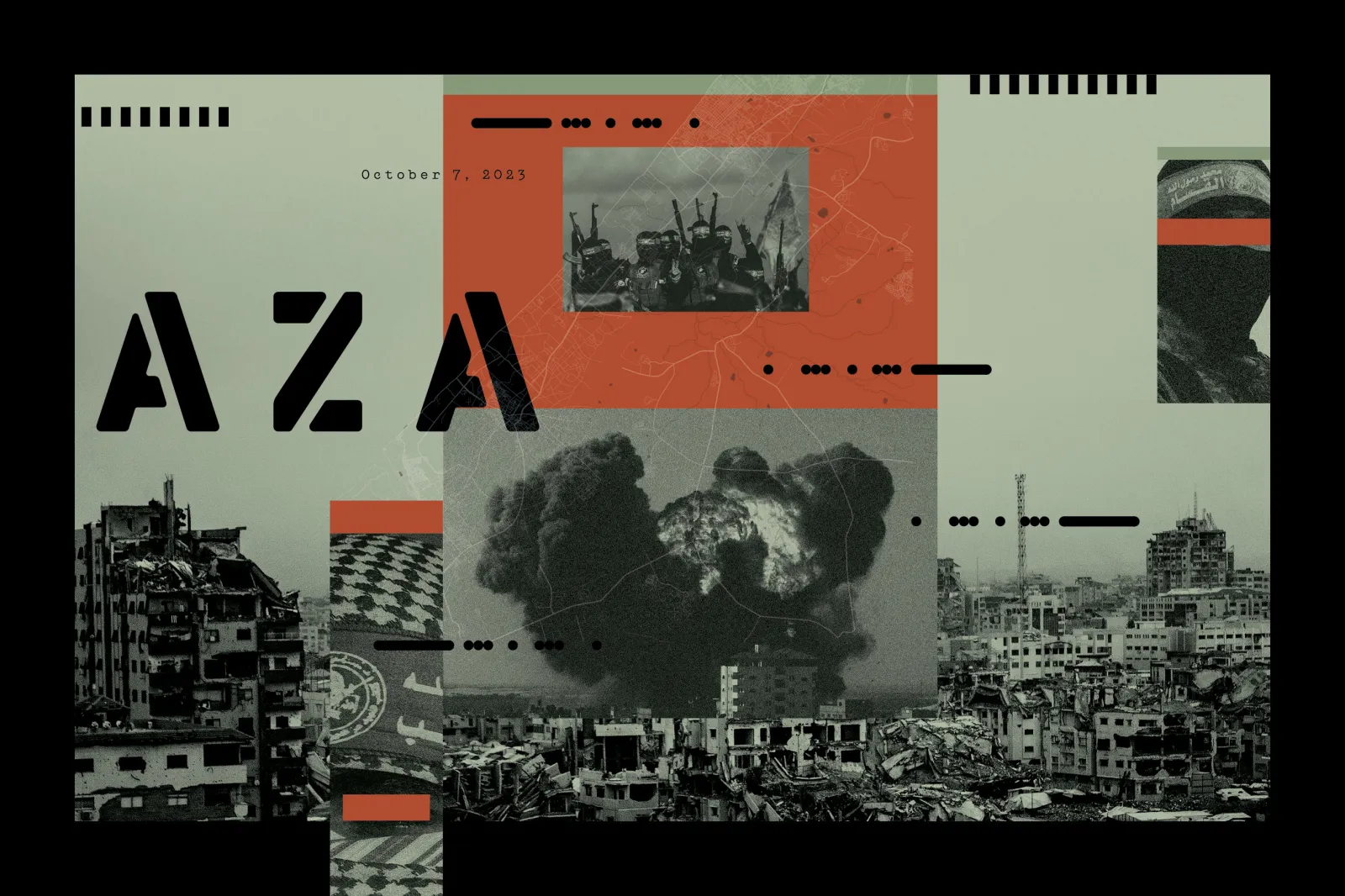
Photo illustration by Newsweek/Getty
America has just marked the 25th anniversary of 9/11, in which 2,977 people were killed by 19 hijackers. An attack on America equivalent to October 7 would have killed about 40,000 people.
The comparison highlights a sense of proportion that raw casualty figures can’t explain: Hamas inflicted a national trauma on a scale that made an overwhelming Israeli response not just probable, but politically and psychologically foreseeable.
Whereas most interpretations of October 7 focus on what Hamas hoped to achieve through the attack itself—hostages, prisoners, regional war, the end of Israeli-Saudi normalization—Dov Waxman, a scholar of Israel and U.S.-Israel relations at UCLA, says that Hamas may also have calculated that Israel’s response itself would advance its aims.
“The thing that convinced me of this within days of October 7 is the decision to film, using GoPro cameras, and to broadcast the kinds of atrocities and violence they were doing,” he says. “Why would they do that?”
Waxman compares the logic to Osama bin Laden’s strategy on September 11. A much weaker force could not defeat the stronger power directly, but might induce it to respond in ways that would change the political environment.
Three years later, that has become the paradox of October 7.
Hamas did not destroy Israel. However, much of Hamas’ senior leadership has since been killed. Its military capabilities were severely damaged. Gaza, itself a tiny sliver of land, suffered a devastating Israeli assault and humanitarian crisis that claimed tens of thousands of innocent lives and displaced much of its population.
The political world has also changed. The Palestinian cause has returned to the center of international politics. Israel’s global reputation has fallen sharply. Among young Americans, Palestinians are now viewed far more favorably than Israelis, to the extent that, for some, support is seen as an ideological purity test. For different reasons, opposition to U.S. support for Israel is also a purity test for a growing fraction on the right. One day, those young Americans will take up positions of power.
Hamas lost the war it appeared to think it was starting. But it may have won something else, something its leadership has always dreamed of: a lasting change in how Israel is judged, particularly by those who will one day lead its closest ally.
What Did Hamas Want?
For three years, the world has been arguing about what Hamas accomplished on October 7. Another place to begin, though, is with what Hamas thought it was accomplishing.
The answer, according to Daniel Sobelman, a professor of international security and diplomacy at the Hebrew University of Jerusalem who has studied Hamas and its military strategy, is more audacious than the conventional explanations.
Hamas thought Israel might fall.

...

...

...
1 of 3
In documents now held by Israel, Sobelman says, the objective was explicit: “The destruction of the state of Israel, the liberation of Palestine.” The behavior of Hamas’ leadership that morning was consistent with that ambition: Within minutes of the invasion, Hamas appealed privately to Hezbollah to join the attack and, publicly, its leaders called upon their regional allies to enter the fight.
“This is your opportunity,” Sobelman says Hamas told Hezbollah leader Hassan Nasrallah.
For a few extraordinary hours, Hamas’ fantasy did not look entirely like wishful thinking: Israeli military positions collapsed, Hamas fighters poured across a border protected by one of the world’s most technologically sophisticated militaries and communities were overrun.
According to Israeli peace activist Gershon Baskin, the Middle East Director of the International Communities Organisation, who spent years communicating with Hamas officials, Hamas itself had underestimated how successful the initial assault would be.
“They were shocked on October 7 when the Israeli army wasn’t there,” Baskin says. He says one Hamas leader later told him that 1,500 fighters had been sent across the border with the expectation that perhaps 1,000 would be killed.
Hamas expected something else, too: that Israel’s apparent imminent collapse would summon the rest of the region.
“They thought there would be a coalition all ganging up against Israel,” Baskin says, referring to a rise of Palestinians in the West Bank, action by Hezbollah and a wider mobilization of the Arab world. “They thought of the possibility because the Israeli army wasn’t there. It was all going to be collapsing quickly.”
As we now know, none of that happened. And within a little over one year of the October 7 attack, central figures in Hamas’ political and military leadership were killed: Saleh al-Arouri, a founder of the organization’s military wing, political chief Ismail Haniyeh, military commander Mohammed Deif and, of course, the principal architect of the attack, Yahya Sinwar.
In addition to the decimation of its organization, Hamas has also had to contend with the fact that the regional assault it was seeking did not materialize, at least not in the form that its leaders had anticipated. Hezbollah opened a northern front, for example, but did not launch the mass invasion anticipated in Sobelman’s account.
The losses, of course, extended beyond Hamas itself. Around 75,000 Palestinians have died in Gaza, according to Associated Press reporting that cites the Gaza Health Ministry. A February 2025 assessment by the World Bank, United Nations and European Union estimated that nearly $30 billion in physical infrastructure had been damaged during the first year of the war. Housing bore by far the largest share of that destruction, accounting for 53 percent of the total.
The toll has continued to rise. As recently as September 16, 2026, a Gaza City building previously damaged by Israeli strikes collapsed after earlier attacks had left it structurally unstable, killing at least 21 people. AP journalists documented bodies being carried from the rubble as machinery worked through the wreckage.

...

...

...

...
1 of 4
Baskin’s conversations with Hamas officials offer little evidence that the aftermath resembled their expectations.
“I haven’t heard anyone in Hamas saying it was worth it,” he says. “But I also don’t hear anyone say they are sorry.”
He describes surviving officials as “confused and bewildered by everything that’s happened since,” uncertain about their future role and divided over the organization’s direction.
In his account, Hamas’ goal was to seize Israelis and force a prisoner release, while hoping the attack would ignite a broader regional campaign against Israel. He specifically traces Sinwar’s determination to free Palestinians held by Israel to the years after his own release, along with 1,026 other prisoners, in the 2011 exchange for captured Israeli soldier Gilad Shalit. In Baskin’s telling, failed efforts to negotiate subsequent swaps helped convince Sinwar that a much larger hostage-taking operation was necessary.
Shibley Telhami, the Anwar Sadat professor for Peace and Development at the University of Maryland, doubts that Hamas realistically expected to eliminate the Israeli state. “They are not so naive or ignorant as to have assumed that it was within their capabilities to destroy the state of Israel,” he says.
For Telhami, the stronger explanation concerns Hamas’ determination to change a deteriorating political environment: continuing occupation, no credible prospect of a two-state settlement and Arab governments establishing relations with Israel without resolving the Palestinian conflict. He distinguishes a desire to overturn that environment from knowledge of what would replace it.
Hamas’ public explanation also invoked religious sites and prisoners. In his statement announcing Operation Al-Aqsa Flood, Hamas’ name for the October 7 attack, Deif cited Al-Aqsa Mosque, Israeli actions in the West Bank and the treatment of Palestinian detainees.
Taken together, the accounts point to overlapping ambitions: freeing prisoners, mobilizing allies, exploiting an Israel perceived as vulnerable, disrupting normalization and forcing the Palestinian question back onto the international agenda.
The Results
In assessing October 7 and everything that has happened since, the question isn’t simply, did Hamas get what it expected? But, did the war Hamas started move the world in a direction that it wanted?
Three years later, we can begin to answer the question.
In the spring of 2022, 55 percent of Americans viewed Israel favorably and 42 percent unfavorably. By March 2026, those numbers had effectively reversed: 37 percent favorable, 60 percent unfavorable. The proportion holding a very unfavorable view had nearly tripled, from 10 percent to 28 percent.
None of those numbers show that Hamas persuaded America to embrace Hamas, but they do highlight an erosion of Israel’s standing across the country.
Israel’s international standing can be measured in ways that go beyond ordinary approval ratings. Brand Finance’s Global Soft Power Index, which tracks perceptions of countries across reputation, influence, culture, business, governance and other measures, put Israel 39th in 2026, down six places in a single year, the steepest decline among the top 50 nation brands. Israel also ranked among the bottom five countries for the perception that it had a net negative impact on the world.
A separate Nation Brands Index, which asks about people, culture, tourism, exports, governance and investment, recorded the sharpest annual fall in its two-decade history for Israel in 2025. It ranked dead last on measures including the perceptions of its people.
David Makovsky, director of the Project on Arab-Israel Relations at the Washington Institute for Near East Policy, cautions against assuming that today’s relationship represents Israel’s permanent position in America, given the travails of its prime minister, Benjamin Netanyahu.
“I think we could be witnessing more of an aberration than a data point on a downward trend,” he says.

...

...

...

...
1 of 4
Israel is approaching an election, Makovsky notes, and a different government could behave differently. It could crack down on extremist violence against Palestinians, for example, change policies that have alienated Americans and, perhaps most importantly, begin speaking to audiences beyond Israel’s domestic political constituencies.
“The old Israel knew how to do internal and external messaging,” Makovsky says. “This year in particular, with the elections looming, they put much more premium on the internal messaging, and that is all the world hears.”
His argument amounts to an important warning against writing the obituary of the U.S.-Israel relationship while one particularly divisive Israeli government is still in power.
Waxman, however, points to “the impact of the Gaza war on young Americans,” whose understanding of Israel has been formed not by the Six-Day War, the Cold War or the Oslo peace process, but by what they have watched over the past three years.
“Their perception of Israel has been greatly shaped by what they saw on their cells, Instagram, Twitter feeds,” he says. “That will have long-term repercussions on U.S. policies because once that generation enters power, we’ll see it.”
The polling cannot tell us whether those attitudes will survive another Israeli government, a different regional landscape or simply the passage of time. Makovsky may be right that a change of government could “stop the bleeding.”
Israel’s problem in America, though, is no longer merely that Americans dislike its prime minister or oppose the decisions of his government. Increasingly, especially among the generation that will inherit American politics, the country itself is being viewed differently.
For decades, the political argument over Israel took place largely inside a bipartisan assumption: the United States would remain Israel’s principal ally. Democrats and Republicans could disagree about settlements, peace negotiations, Palestinian statehood or individual Israeli governments without seriously contesting the architecture underneath the relationship.
That assumption is now being challenged from two directions at once. Makovsky calls it “horseshoe politics.”
On the progressive left, the argument centers on Gaza: Palestinian civilian suffering, Israeli conduct and the American weapons and diplomatic protection that, critics contend, make the United States complicit in those actions.
On the isolationist right, the objection is different. Gaza is not necessarily the center of the argument at all. The question is why Israel should occupy such a privileged position in American foreign policy—and whether that relationship can pull the United States into conflicts Americans would otherwise avoid.
“I don’t think Tucker Carlson is so focused on Gaza as much as he is on why did Trump decide to go to war in Iran,” Makovsky says.
Progressive Senator Bernie Sanders, by contrast, has concentrated his criticism on Gaza and its aftermath, for example.
The change is already becoming visible in U.S. politics.

...

...
1 of 2
Maxwell Frost, the 29-year-old Florida Democrat who became the first Gen Z member of Congress, told Axios this year that Democratic opposition even to funding Israel’s Iron Dome missile-defense system had been “seen as insanely fringe four years ago.”
It no longer is. In July, 103 House Democrats voted to eliminate $3.3 billion in annual military aid to Israel. The vote failed, but nearly half the Democratic caucus supported something that until recently sat well outside the party’s mainstream.
The shift on the right is smaller, but more surprising. Josiah Neumann, a 20-year-old College Republican leader at Xavier University in Cincinnati, told The Washington Post: “To be ‘America First,’ the Stars and Stripes must come before the Star of David.”
Another 20-year-old College Republican, Elysia Morales, at Saint Mary’s College in Notre Dame, Indiana, still supported Israel’s war against Hamas but added: “Israel has a right to be upset, but there’s also a time when we need to pump the brakes.”
The divide, then, is not simply left against right. On the Democratic side, skepticism of military support for Israel has moved rapidly toward the mainstream. On the Republican side, congressional support remains overwhelmingly pro-Israel, but an America First argument against foreign entanglement has acquired particular force among some younger conservatives.
One critique asks what American support allows Israel to do, and the other asks what supporting Israel requires America to do.
As a result, the generation has developed a relationship with Israel that is dramatically different from the one that Washington has held for decades.
Today’s 20-year-olds are not yet chairing congressional committees, running the State Department or occupying the White House. But eventually, in the not too distant future, some of them will.
That is the timeframe on which October 7 may ultimately have to be judged. Hamas lost the war it thought it was starting. The political war that followed will be shaped by the new generation coming to power.

Photography by Hassan Salem/Middle East Images/AFP/Getty
View 0 Comments
Submit Correction
View Editorial & AI Guidelines