NOAA

By Joe Edwards
Reporter
0
Share
Newsweek is a Trust Project member
See more of our trusted coverage when you search.Prefer Newsweek on Googleto see more of our trusted coverage when you search.
Americans may see their energy bills shift as El Niño strengthens, a meteorologist told Newsweek, with the climate pattern expected to help influence both winter heating needs and summer cooling demand.
The weather phenomenon, part of a recurring global weather cycle, can influence temperature and precipitation in the United States and worldwide.
According to the Climate Prediction Center (CPC), El Niño conditions are present and are expected to strengthen in the Northern Hemisphere this winter.
Read More on Weather
What Is El Niño?
El Niño represents the warm stage of a natural climate cycle in the tropical Pacific called the El Niño–Southern Oscillation (ENSO). This cycle swings irregularly every two to seven years, altering ocean temperatures and disrupting typical wind and rainfall patterns across the tropics. These shifts in the seasonal climate of the Pacific, the world’s largest ocean, can trigger wider global impacts.
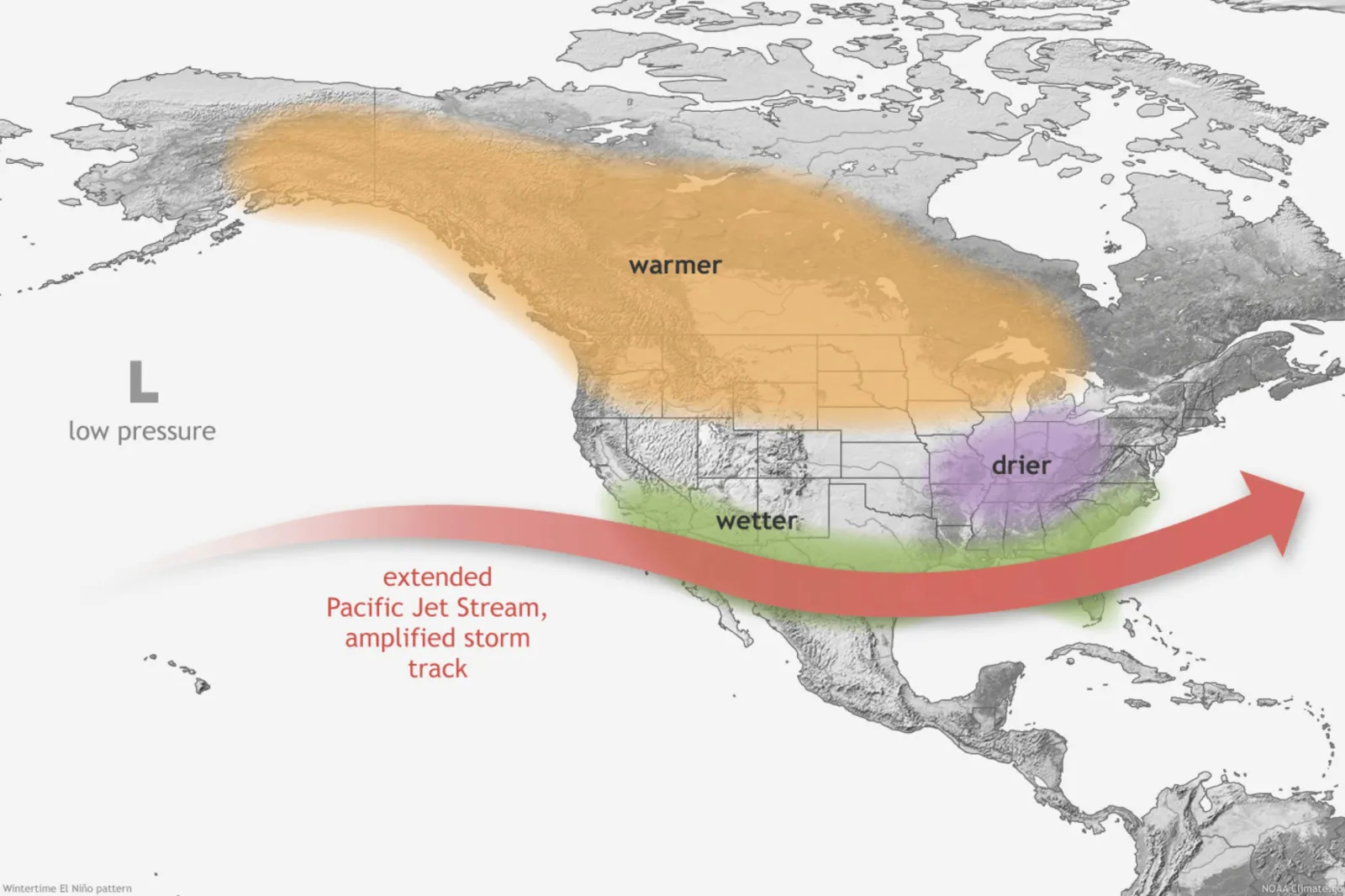
In the U.S., typical effects of El Niño during the winter months include warmer conditions along the northern tier of the country, wetter conditions in southern areas, and drier conditions across the Midwest, according to the National Oceanic and Atmospheric Administration.
...
How El Niño Could Affect Energy Bills Across the U.S.
“With El Niños, generally Arctic airmasses are less frequent across the U.S. in the colder seasons, but not absent. We generally see moderate temperature winters. This can help save on energy costs,” AccuWeather lead long-range forecaster Paul Pastelok told Newsweek.
Pastelok also said the risk of intense, long heat waves across the Ohio Valley, Northeast and mid-Atlantic is low during the summer. Increased wet conditions can reduce the frequency of prolonged heatwaves, which in turn may lower energy demand, he said.
“In contrast, the Northwest and upper Midwest can see drier conditions during the course of summers and falls, which can lead to above average temperatures and higher energy costs in the summer, but less energy costs for heating in the fall," he said.
Meteorologists Warn Super El Niño Possible
Meteorologists have also cautioned that a particularly strong or “super” El Niño is possible this time around.
The CPC says there is a 63 percent chance of a very strong event during the November to January period “that would rank among the largest El Niño events in the historical record going back to 1950.”
“Even very strong El Niño events do not lead to the expected impact everywhere, but stronger events can more significantly tilt the odds in favor of expected outcomes,” it said.
AccuWeather estimates a 40 percent chance that it will evolve into a “super” El Niño, which it defines as sea surface temperatures near the equator reaching 3.6 degrees Fahrenheit above the long-term average.
“Looking back at past El Niños, the Very Strong El Niños of 1965-66, 1982-83 and 1997-98 turned dry in the second year across the many areas of the Plains, leading to drought formation,” said Pastelok. “Drought persisted years after as well. Following the 1982 El Niño, from the summer of 1983 to 1985, drought was present across the central and northern Plains into the Midwest."
“With the drought conditions came higher temperatures, especially in the summer and early fall season resulting in higher cooling usage for a more widespread area of the nation,” the meteorologist explained.
“This summer should not be a high energy demand summer compared to average in the lower Midwest and central Plains, but could the next couple of years, if this potential super El Niño follows the path of other super El Niños," he said.
View 0 Comments
Submit Correction
View Editorial & AI Guidelines