Newsweek/Getty

By Newsweek Editors
0
Share
Newsweek is a Trust Project member
See more of our trusted coverage when you search.Prefer Newsweek on Googleto see more of our trusted coverage when you search.
Last week, in a courtroom in Brooklyn, prosecutors began laying out a story they said started in Iran and ended, bizarrely, with a napkin on a hotel table. The defendant, Asif Merchant, a Pakistani national, came to the United States in 2024 with, it is alleged, three goals: steal documents, stage a protest and kill a political figure, later said to include Donald Trump.
The centerpiece of the case is a recorded meeting in June 2024. Merchant spreads out the napkin, sets a small object upright on it—thought to be a disposable vape—and asks: "This is the target. How will it die?" He allegedly wanted two contract killers, who turned out to be undercover federal agents, to carry out the hit for $5,000 upfront. The FBI has said the plot was "straight out of the Iranian playbook" and involved a man with "close ties to Iran." Merchant has pleaded not guilty.
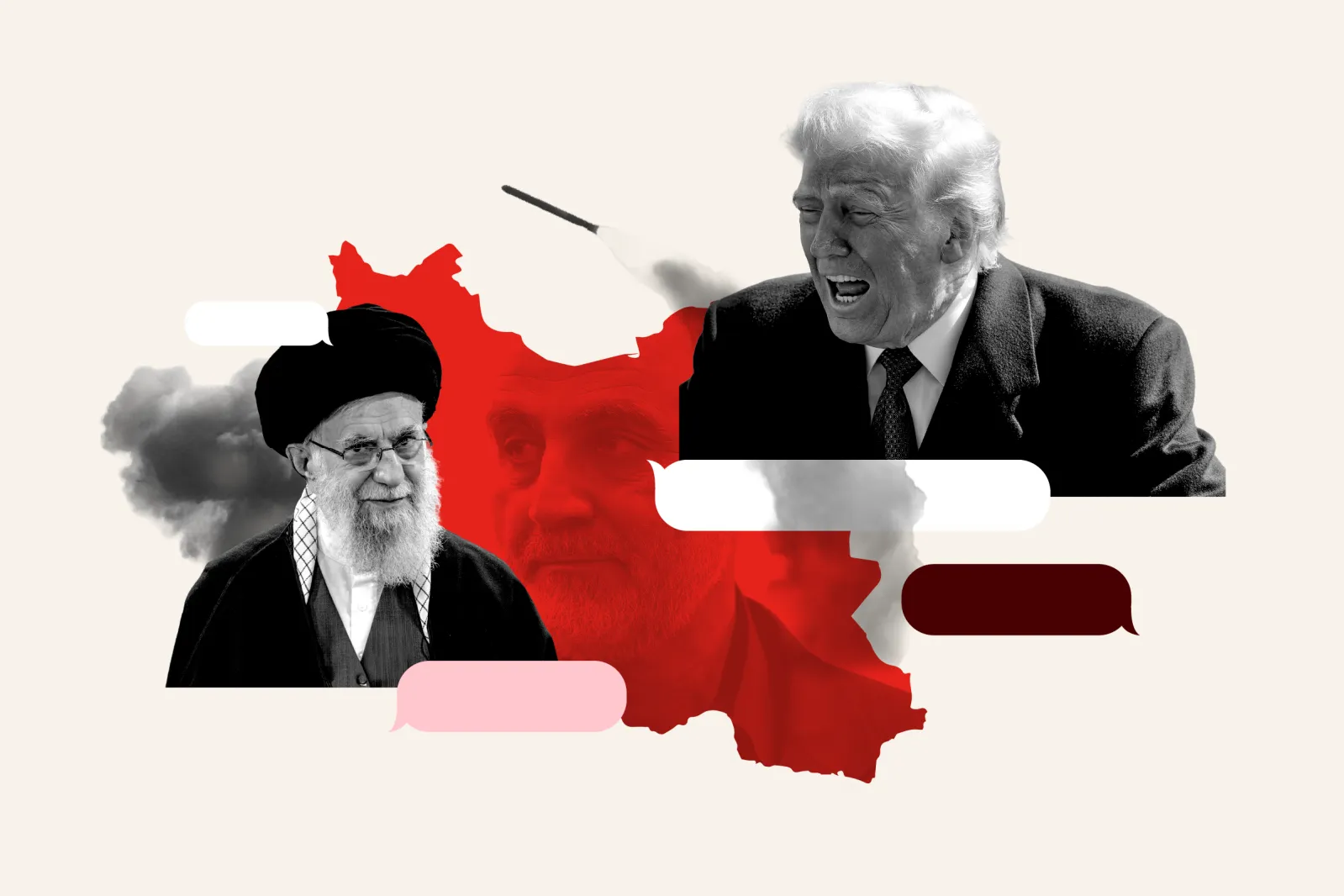
The case is one sharp edge of the social media-fueled feud that Trump has been fighting for years against Iran, particularly its late Supreme Leader Ayatollah Ali Khamenei. The trolling has been frequent from both sides. But it was also deadly.
Read More on Analysis
Days after the evidence against Merchant was shown in court, the United States and Israel launched strikes against Iran in Operation Epic Fury. Soon, Trump was able to boast about Khamenei's death on (where else?) Truth Social, calling him "one of the most evil people in History." It would be an omission not to at least consider that their personal animosity, and the fact that Iran had repeatedly threatened Trump's life, was part of the driving force for the operation.
Many internet acronyms have been attached to Trump in his second term. For his critics, the most apposite is TACO: "Trump always chickens out." Arguably, however, FAFO—"f*** around and find out"—is more appropriate for recent events.
Here's how Trump and Khamenei's blood feud was fought, not just in assassination plots and airstrikes but also in increasingly mocking and personal online spats.
2018: The Feud Gets Personal
Trump has always enjoyed trolling his opponents online. What is less well known is that Khamenei did as well, and Trump became one of his favorite targets.
In May 2018, as the U.S. exited the Iran nuclear deal in Trump's first term and Tehran absorbed the implications, Khamenei circulated a photo on Instagram showing him reading the Persian translation of Michael Wolff's contentious Trump-era tell-all Fire and Fury. It was a troll that directly treated the U.S. presidency as tabloid material.

...
Trump was infuriated by the book, which purported to be an insider account of the start of his first term and portrayed him as fickle and unstable. The White House dismissed it as full of inaccuracies. Trump himself had posted that the bestseller, whose title is derived from a Trump threat toward another of his enemies, North Korea, was a "Fake Book, written by a totally discredited author." Wolff stood by his reporting.
Khamenei didn't merely post the photo on Instagram. Separately, he accused the president directly, saying, "You cannot do a damn thing!" He also said Trump's speech announcing the end of the nuclear deal was "silly and superficial."
It wasn't what many expected from a cleric leading a country of 90 million people. Trump's own trolling was well established by then, and thus the tone was set.
December 2019–January 2020: Deadly Vendetta
By late December 2019, tensions were spiking around Iraq. Following unrest near the U.S. Embassy in Baghdad, Trump posted warnings blaming Iran and promising dire consequences.
Khamenei responded with goading that seemed calculated to hit Trump where it hurt: by diminishing him. On January 1, 2020, the ayatollah's English-language Twitter account referred to Trump as "that guy" who "has tweeted" and criticized Washington's foreign policy more broadly in no uncertain terms. Khamenei also told Trump, "You can't do anything."
On January 3, 2020, Trump ordered the killing of Qasem Soleimani, the commander of Iran's Quds Force, in a U.S. drone strike near Baghdad airport. It was a landmark moment. Though enemies of the U.S. had been killed in assassinations before, such as Osama bin Laden during the Obama administration and numerous other Al-Qaeda and Islamic State leaders since, Soleimani was an extremely senior official, who wielded immense influence in Iran and over the Middle East.
Khamenei's response was immediate. He declared three days of mourning and vowed a "severe revenge." Less than a week later, Iran fired ballistic missiles at U.S. positions in Iraq, including Ain al-Asad, an overt retaliation that American troops had been warned might come. Nevertheless, more than 100 U.S. troops were diagnosed with traumatic brain injuries from the strikes, which Trump described as "headaches."
November 2020–January 2021: Revenge Becomes Content
In November 2020, amid U.S. election turmoil, Khamenei's English Twitter account again trolled Trump. On November 4, Khamenei called the situation a spectacle and mocked U.S. democracy by using Trump's own words—"most fraudulent election in U.S. history"—against him, noting that Joe Biden's campaign was accusing Trump of trying to rig the election.
A few days later, after Biden was projected to win, Khamenei's account reposted a segment of a speech that again called the election a spectacle, adding that the events were the "ugly face of liberal democracy" and demonstrated the "decline of the U.S. regime."
By January 2021, the revenge narrative had turned visual. A Khamenei-linked Twitter account posted an image that depicted Trump golfing under the shadow of an aircraft, paired with the message "Revenge is inevitable." The account was suspended, but it had achieved its goal: to keep Trump, the killer of Soleimani, in the public imagination as a mortal enemy of Iran. The image was later hosted on Khamenei's official website.

...
Messaging from the Soleimani family also fueled the feud. Soleimani's daughter Zeinab Soleimani tweeted that Trump ordered the attack on her father with "the perverse hope that you will be seen as some sort of hero," but had left the White House "defeated, isolated and broken."
There was a disturbing, though unrelated, postscript to Khamenei's golf-based trolling. On September 15, 2024, two months after a separate assassination attempt in Butler, Pennsylvania, Ryan Wesley Routh attempted to shoot Trump in West Palm Beach—while he was playing golf. Routh was sentenced to life in prison without the possibility of parole on February 4 this year.
2022: A Name Enters the Docket
The first major U.S. case to place Iran's retaliation effort into a court filing after Soleimani's assassination did not name Trump as the target, but it did focus on the support system around him.
In August 2022, the Justice Department announced charges against Shahram Poursafi, described as a member of Iran's Revolutionary Guard, in connection with an alleged murder-for-hire plot targeting John Bolton, Trump's former national security adviser. Prosecutors described the alleged offer as $300,000 for Bolton's murder, framed as retaliation for Soleimani.
By September 2024, the U.S. had escalated the manhunt publicly, with a reward of up to $20 million for information leading to Poursafi's arrest or conviction, and indicated he remained at large abroad.
Poursafi's case highlights how the U.S. government saw Iranian retaliation as something pursued via intermediaries, money and time, rather than a single dramatic attack. U.S. retaliation proved to be the opposite.
June–July 2024: The Plot Thickens
By mid-2024, Trump was again the Republican presidential nominee, and the U.S. government was taking Iranian threats seriously enough to alter protection on the ground.
In June 2024, U.S. intelligence detected information about an Iranian threat to assassinate Trump, and the National Security Council contacted the Secret Service. In response, the Secret Service increased resources around Trump. At the same time, inside what would become the Merchant case, federal investigators were already recording.
According to the Justice Department, Merchant arrived in the United States in April 2024, after spending time in Iran, and contacted someone he believed could help him carry out a scheme to assassinate a politician or U.S. government officials on U.S. soil. That person reported him to law enforcement and became a confidential source.
Merchant moved through New York's Pakistani community, presenting himself as a business owner and discussing a clothing venture that prosecutors said doubled as cover—including by using "code words" related to T-shirts. Merchant was arrested on July 12, 2024, after he attempted to leave the U.S., authorities said.
The arrest occurred one day before the again unrelated assassination attempt on Trump at a rally in Pennsylvania. The image of Trump raising his hand in defiance, his head bloodied, became a defining image of his successful 2024 election campaign.
Last month, Iranian state TV broadcast a threat against Trump, showing footage of the assassination attempt, captioned in Farsi with the words: “This time, the bullet won’t miss.” Trump responded by saying that if that happened, the entire country would be blown up.

...
November 2024: The Shakeri Case
On November 8, 2024, the Justice Department announced charges against Farhad Shakeri, described as an Islamic Revolutionary Guard Corps asset residing in Tehran. The complaint described an Iranian murder-for-hire network that relied on criminal contacts Shakeri had made while previously in prison in the United States.
Shakeri, prosecutors said, was tasked on October 7, 2024, with providing a plan to kill Trump. He had two additional tasks: surveilling two Jewish Americans in New York, with an alleged offer of $500,000 for the murder of either, and targeting Israeli tourists in Sri Lanka.
Investigators learned of the alleged Trump plot while interviewing Shakeri, an Afghan national. The complaint suggested Tehran assessed that Trump might lose the election, and that it could be easier to assassinate him afterward. In effect, Trump was not being targeted because he was likely to become president, but because he was Trump.
Shakeri remains at large and was last believed to be in Iran.
January 2025: The Protection Problem
In January 2025, Trump moved to revoke John Bolton's Secret Service protection, which had been provided because of threats from Iran tied to Soleimani's killing. He also moved to revoke protection for other former officials who had faced Iran-linked threats, including former Secretary of State Mike Pompeo.
Whatever the merits of those decisions, they illustrate that threats tied to Iran were treated as enduring enough to justify additional protective measures, and contentious enough to become ammunition in domestic politics.
June 2025: The Feud Gets Personal Again
On June 13, 2025, Israel began 12 days of attacks on Iran, bombing military and nuclear sites and killing military leaders and politicians. Iran retaliated with ballistic missile barrages, but the two sides agreed to a ceasefire under U.S. pressure.
Part of that pressure was Trump addressing Khamenei personally. On June 17, 2025, Trump wrote on Truth Social: "We know exactly where the so-called 'Supreme Leader' is hiding. He is an easy target. … We are not going to take him out (kill!), at least not for now."
Minutes later, he wrote in a follow-up post, "UNCONDITIONAL SURRENDER!"
By June 18, Khamenei was posting warnings and defiance on Twitter, now X, in response. One of his posts warned that U.S. military entry would bring irreparable harm.
Trump responded. On June 27, 2025, on Truth Social, the U.S. president demanded to know why Khamenei would "so blatantly and foolishly" claim victory, insisting that "as a man of great faith, he is not supposed to lie." Trump then made a provocative claim: "I SAVED HIM FROM A VERY UGLY AND IGNOMINIOUS DEATH."
Trump said he knew "exactly where" Khamenei was sheltered and that he had stopped Israel from killing him. He said he had ordered Israeli aircraft to turn back—calling it "the biggest attack of the War, by far"—and warned Iran to "get back into the World Order flow."
Trump said he had been exploring sanctions relief, but changed course after Khamenei's speech. "I get hit with a statement of anger, hatred, and disgust," Trump wrote.
Iranian Foreign Minister Abbas Araghchi responded with a message that tried to police the president's rhetoric. "If President Trump is genuine about wanting a deal, he should put aside the disrespectful and unacceptable tone," he said, urging Trump to stop "hurting" Khamenei's followers.
Khamenei himself had said on television, after coming out of hiding, that Trump had exaggerated the impact of attacks on nuclear sites.
"The American president exaggerated events in unusual ways, and it turned out that he needed this exaggeration," Khamenei said.
"The Islamic Republic won, and in retaliation dealt a severe slap to the face of America," he added, referring to an Iranian missile attack on a U.S. base in Qatar, which was unsuccessful and widely seen as a way of saving face.
February 25, 2026: The Merchant Trial Opens
By late February, the Merchant case returned to the foreground as it reached a public stage: a jury.
Prosecutors told jurors that Merchant traveled to the U.S. to kill "U.S. politicians" and that he tried to hire undercover FBI agents as hit men. The government did not initially name Trump in its opening statement, but court filings and the defense's responses addressed allegations that Trump was among the "high-ranking government officials" Merchant was accused of targeting.
February 28, 2026: Khamenei Is Killed
On February 28, the U.S. and Israel launched the strikes that became the decisive obituary of the Trump-Khamenei feud.
In a coordinated campaign involving U.S. Navy and Air Force missile attacks alongside Israeli forces, Operation Epic Fury hit air defenses, missile sites and leadership facilities. Among the casualties was Khamenei himself.
On Truth Social, Trump was typically forthright.
"Khamenei, one of the most evil people in History, is dead," he wrote.
"This is not only Justice for the people of Iran, but for all Great Americans, and those people from many Countries throughout the World, that have been killed or mutilated by Khamenei and his gang of bloodthirsty THUGS," Trump continued.
Khamenei might have thought he was dealing with TACO Trump. What he got was FAFO Trump, and he paid the ultimate price.
Hey gang, Carlo Versano here. I hope you enjoyed this article. As Newsweek's Director of Politics and Culture and editor of the 1600 newsletter, I'm keen to hear what you think. Now, Newsweek is offering a new service to allow you to communicate directly with me in the form of a text message chat. You can sign up and get a direct line to me, as well as the reporters who work for me. You can shape our coverage.
As a Newsweek member, we're offering this service to you for free. You can sign up below, or read more about how it works here. Let's talk!
View 0 Comments
Submit Correction
View Editorial & AI Guidelines