

By David Averre
0
Share
Newsweek is a Trust Project member
See more of our trusted coverage when you search.Prefer Newsweek on Googleto see more of our trusted coverage when you search.
The 19th-century Prussian strategist Helmuth von Moltke the Elder is credited with a battery of sage military advice, but his best-known maxim is usually paraphrased like this: No battle plan survives first contact with the enemy.
If Iran had not already taught President Donald Trump that lesson, Yemen’s Houthis are now making sure he understands it.
By almost every conventional measure of power, Ansar Allah is the flyweight among the behemoths shaping the expanding conflict in the Middle East—a non-state movement from one of the world’s poorest countries, facing powers with vast defense budgets, gigantic economies and nuclear weapons.
Read More on Analysis
Yet the Houthis have acquired an extraordinary ability to make an already difficult conflict even more complicated for the White House. Their lightning offensive this week—striking Saudi cities and energy infrastructure while seizing strategic territory on the Red Sea—has added another unwanted equation to Washington’s calculations.
One War, Two Chokepoints
For six months, the world has worried about the Strait of Hormuz. Now another strategic waterway is coming into play.
The Houthis seized the Red Sea port of Mokha on Thursday before taking Mayun Island on Friday. This volcanic speck of land sits inside the Bab el-Mandeb Strait, the narrow gateway linking the Red Sea to the Gulf of Aden through which around 12 percent of global trade normally passes.

...
Bab el-Mandeb was hardly safe before Operation Epic Fury began. From November 2023 to October 2025, the U.S. Maritime Administration recorded more than 100 separate Houthi attacks on commercial vessels affecting more than 60 countries. With the Strait of Hormuz open, the threat could be tolerated.
That is no longer the case, because capturing Mokha port and Mayun Island gives the Houthis a physical foothold inside what is now another vital chokepoint.
U.S. Energy Information Administration data shows oil and petroleum-liquid flows through Hormuz collapsed from 21.6 million barrels a day in Q4 2025 to 4.9 million in Q2 2026. Over the same period, flows through Bab el-Mandeb rose from 5.4 million to 8.1 million barrels a day, as Saudi Arabia diverted crude to the Red Sea.
The Houthi foothold inside Bab el-Mandeb also gives Tehran another potential source of leverage over Washington.
Last month, Iran’s Supreme National Security Council made ending attacks on its allies in Yemen, Lebanon, Palestine and Iraq one of six conditions for fully reopening Hormuz. This week, an Islamic Revolutionary Guard Corps spokesman went further, calling for any negotiated settlement with the United States to include Yemen.
Earlier this summer, Trump could have reached an understanding with Tehran over one strait; now Iran expects him to factor in another.
The White House’s latest major Middle Eastern war gains more strategic complexities with each passing day.
Helmuth will be turning in his grave.
Who You Gonna Call?
The Houthi advance also ramps up the stakes for one of the region’s largest but most exposed players: Saudi Arabia.
Related Story
The New ‘Muslim NATO’ Faces First Major Test
Riyadh was already suffering from the battle over Hormuz. Saudi crude production fell to 6.2 million barrels a day in August, its lowest level since 1990, while crude exports dropped to their lowest level in 13 years.
Now the Houthis have attacked Abha, Khamis Mushait, Jazan and Najran, wounding 73 people and setting energy installations ablaze. Satellite imagery also appears to show significant damage to the Kingdom’s East-West oil pipeline, the very infrastructure helping Saudi crude to bypass Hormuz.
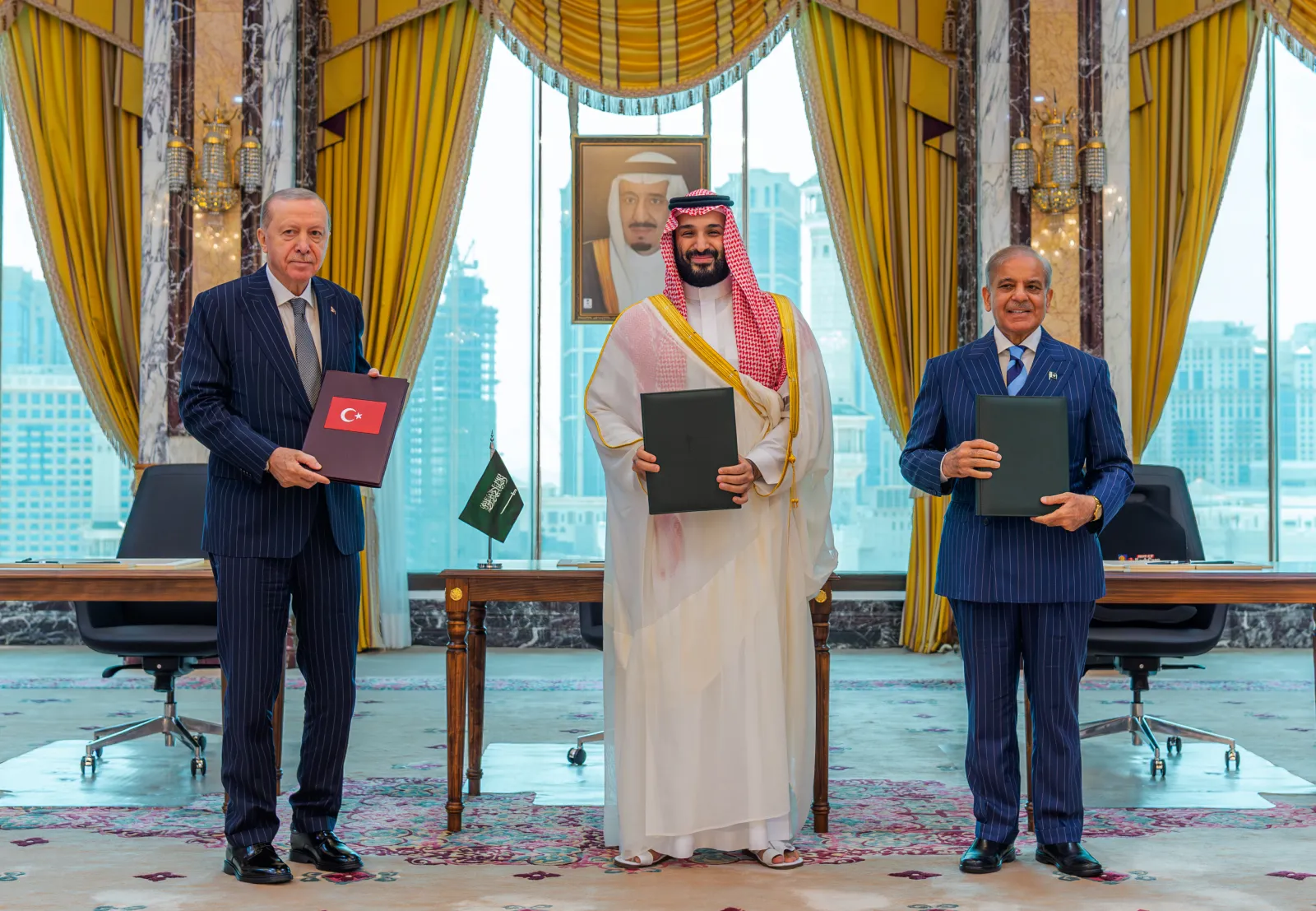
Barely five weeks ago, Riyadh entered the Mecca Joint Defense Agreement with Turkey and nuclear-armed Pakistan - a historic pact sealed in Islam’s holiest city. The grouping has been widely billed as the Muslim NATO, given that both blocs share a defining principle of mutual defense.
Yet when Houthi missiles began falling on Saudi cities earlier this week, Crown Prince Mohammed bin Salman’s first call wasn’t to Islamabad or Ankara.

...
Instead, he picked up the phone to Washington and asked the U.S. president to launch retaliatory strikes on Houthi targets. Trump declined, but agreed to provide Riyadh with intelligence and targeting data, according to Axios.
This doesn’t necessarily mean the Mecca pact is worthless. It is, after all, less than 40 days old, and neither Turkey nor Pakistan are automatically obliged to bomb the Houthis. Assistance can instead include intelligence, logistics or ammunition, and Saudi Arabia must first specify what help it wants before its new partners are expected to deliver.
But the Houthis have revealed that, in a time of crisis, Riyadh will still resort to calling its Atlantic ally, even as it purports to want more autonomy over regional security.
View 0 Comments
Submit Correction
View Editorial & AI Guidelines