...

By Lucy Notarantonio
Senior Reporter
0
Share
Newsweek is a Trust Project member
See more of our trusted coverage when you search.Prefer Newsweek on Googleto see more of our trusted coverage when you search.
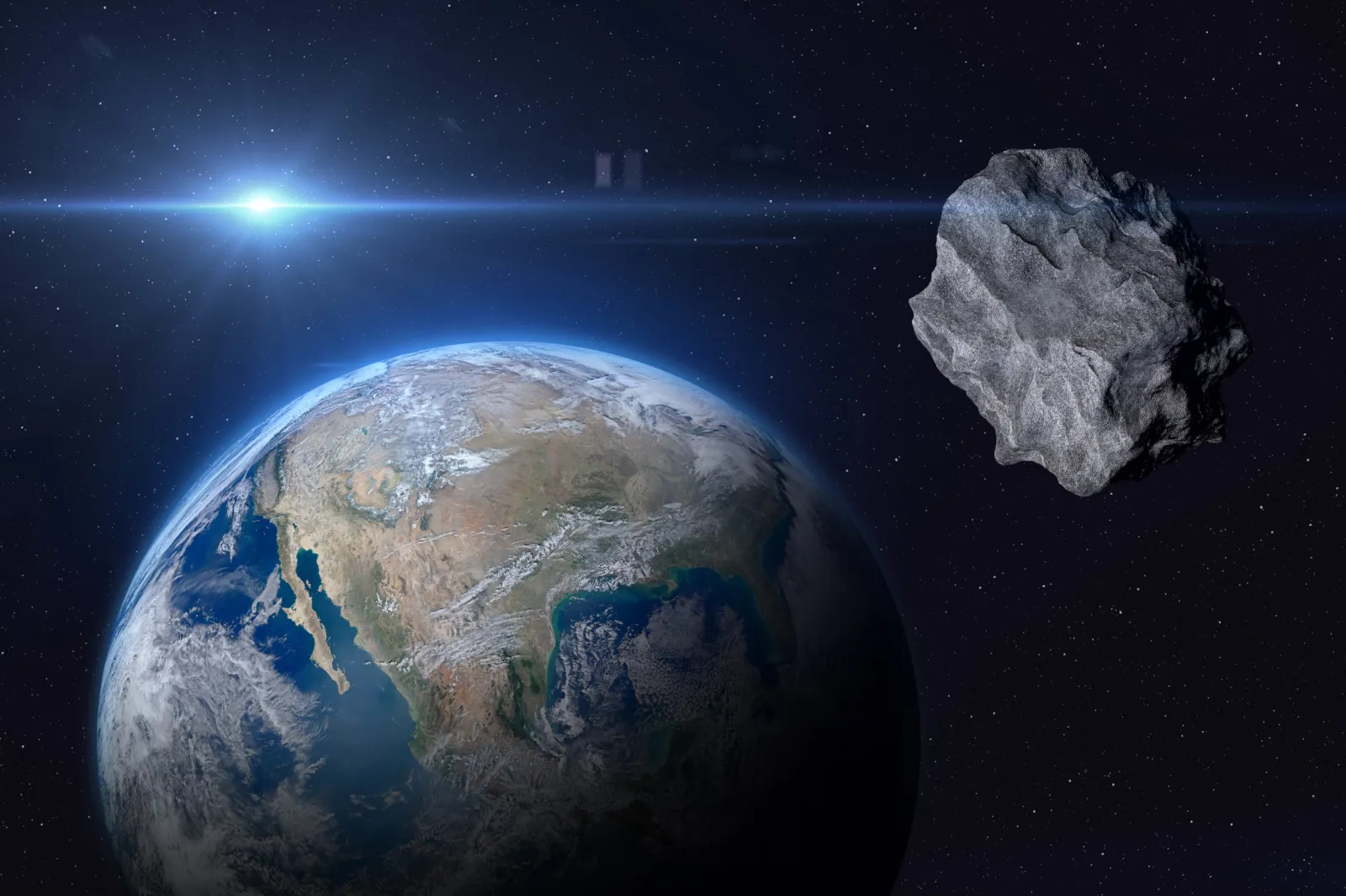
NASA is tracking a house-sized asteroid set to whiz past Earth tomorrow at a thundering 29,304 miles per hour.
The space rock—named "2025 DJ22"—is estimated by NASA's Jet Propulsion Laboratory to be approximately 47 feet across, making it about the size of a house.
It will miss Earth by a cosmically close 347,000 miles before hurtling off across the solar system, not to return to our neck of the woods until August 31, 2031.
Read More on Science
2025 DJ22 isn't the only asteroid on the radar for March 1—a 91-foot, airplane-sized one is also set to pass within 3,850,000 miles of Earth. Known as 2025 DV5, it is due to return in another century on November 11, 2135.
...
Asteroids, also known as minor planets, are rocky, airless objects that originated from the early formation of our solar system approximately 4.6 billion years ago.
The majority of asteroids orbit the Sun in the main asteroid belt, located between Mars and Jupiter.
Their sizes vary significantly, from Vesta—the largest, measuring about 329 miles (530 kilometers) in diameter—to much smaller bodies less than 33 feet (10 meters) across.
Despite their vast numbers, the combined mass of all asteroids is still less than that of Earth's Moon.
Thankfully, neither 2025 DJ22 nor 2025 DV5—today's visitors to Earth's doorstep—are at any risk of colliding with our planet in the near future.
According to NASA, asteroid impacts on Earth are mercifully rare events:
- 30 feet (10 meters): Asteroids of this size impact Earth about once a decade, causing a bright fireball and a strong sonic boom capable of breaking nearby windows.
- 160 feet (50 meters): Expected to hit approximately every 1,000 years, these asteroids can cause significant local devastation but may not always create an impact crater.
- 500 feet (140 meters): Colliding with Earth about once every 20,000 years, these asteroids create craters between 3,000 and 7,000 feet (1 to 2 kilometers) in diameter. Depending on the location, the impact could result in mass casualties across cities and states. Asteroids of this size or larger that come near Earth's orbit are classified as potentially hazardous asteroids (PHAs).
- 3,000 feet (1,000 meters): Impacting approximately every 700,000 years, these asteroids create a 6-mile (10-kilometer) wide crater, leading to global devastation and possibly the collapse of civilization.
- 6 miles (10,000 meters): Estimated to strike about once every 100 million years, these catastrophic impacts produce 60-mile (100-kilometer) wide craters, triggering mass extinctions and altering life on Earth.
One asteroid in particular—2024 YR4—made headlines recently when it was estimated to have a small chance of hitting Earth in 2032.
However, NASA has since ruled out any serious risk of asteroid 2024 YR4 hitting Earth anytime in the next 100 years.
Further observation allowed scientists to refined the space rock's projected path and found the odds of a collision on December 22, 2032, are now just 0.004 percent.
Do you have a tip on a science story that Newsweek should be covering? Do you have a question about asteroids? Let us know via science@newsweek.com.
View 0 Comments
Submit Correction
View Editorial & AI Guidelines