10
Loading video...

By Soo Kim
Reporter
0
Share
Newsweek is a Trust Project member
See more of our trusted coverage when you search.Prefer Newsweek on Googleto see more of our trusted coverage when you search.
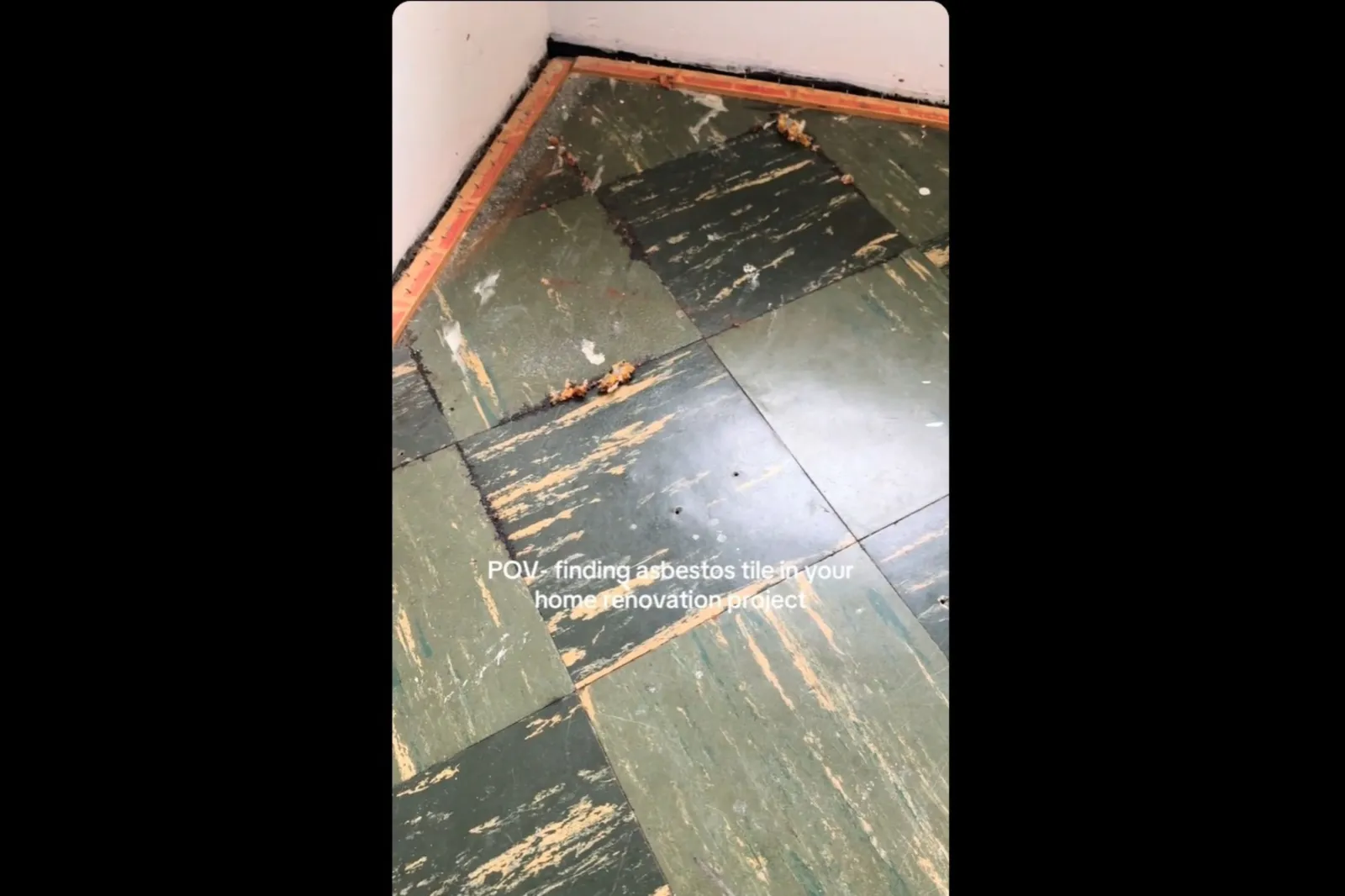
A video of a homeowner discovering asbestos on the tiles beneath the carpet in her 1800s home during renovation works has gone viral on TikTok.
The clip was shared by Lora Current (@loracurrent), 24, and has racked up more than 1.5 million views since it was posted on December 18. In the footage, Current lifts a section of carpet to reveal square tiles underneath as on-screen text reads: "POV [point of view]—finding asbestos tile in your home renovation project."
Current told Newsweek the moment happened as she continued long-term renovation work on her historic property. "It’s an 1890 home. I bought it three years ago in Ohio, which is where I’m from. I started working on the downstairs first, so I didn’t find the tiles until about two weeks ago," she said.
Read More on Home & Garden
...
Current said she initially didn’t realize what the tiles might be—and it wasn’t until she posted another TikTok video that viewers stepped in with warnings.
"Unfortunately, I didn’t realize there was asbestos at first … I posted a video of the green tiles to see if it could make them work," Current added. "Essentially, that’s when people started messaging me and leaving comments [saying] that might be asbestos. That’s when I was shocked and felt a little silly."
The United States Consumer Product Safety Commission advises that asbestos materials are not automatically dangerous simply because they exist in a home.
"Even if asbestos is in your home, this is usually not a serious problem. The mere presence of asbestos in a home or a building is not hazardous," the agency states. "The danger is that asbestos materials may become damaged over time. Damaged asbestos may release asbestos fibers and become a health hazard."
The unexpected asbestos discovery also reinforced why Current shares her renovation journey online. "I was so glad I posted that video. Otherwise, I may not have ever known and would have lived with it," she said*.*
After the floor tiles were identified as potentially hazardous, Current added that she began checking the rest of the home for similar materials.
The discovery beneath the carpet "started my hunt for asbestos in other places in the home; there was nothing else," she said. "I’m sure there was asbestos insulation at one point, just because of the age, but the people before us took really good care of the home and probably were the ones that had it removed and cleaned out."
Current admitted she hadn’t considered asbestos a major possibility when she first moved in—despite the home’s age.
"I was not aware of the possibility of asbestos. I definitely should have been, given the age. I was more concerned about lead in the walls," she said. "So, when I moved in, I tested for that and thought I was all set."
Current said the experience has become part of the learning curve of homeownership.
"As a young homeowner, I’m definitely learning a lot, and I’ve loved it! Every mistake helps me learn to fix it, leaves a funny memory, and brings some personality to my home," she added.
Home-improvement spending has surged across the United States.
A survey by Houzz, a home design website, found that median renovation spending jumped 60 percent between 2020 and 2023, rising from $15,000 to $24,000.
The survey found that Generation X spent the most on home renovation projects in 2023, reporting a median spend of $25,000, compared with $24,000 for baby boomers. Houzz noted that the top 10 percent of spenders in those groups had significantly larger budgets, with Gen Xers at $180,000 and baby boomers at $131,000, the report stated.
Do you have a home renovation-related video or story to share? Let us know via life@newsweek.com, and your story could be featured on Newsweek.
View 0 Comments
Submit Correction
View Editorial & AI Guidelines