...

By Jasmine Laws
Reporter
0
Share
Newsweek is a Trust Project member
See more of our trusted coverage when you search.Prefer Newsweek on Googleto see more of our trusted coverage when you search.
Cases of human metapneumovirus (HMPV), a virus which can cause respiratory illness, have been surging over the last few months.
"Nationally, we are continuing to see elevated levels of HMPV, with concentrations higher than they were at this time last year," Alexandria Boehm, professor of civil and environmental engineering at Stanford University, told Newsweek.
What Is HMPV?
HMPV is in the pneumoviridae family like respiratory syncytial virus (RSV), and was first discovered in 2001. However, until very recently most of the respiratory infections in adults were attributed to influenza, Dr. Octavio Ramilo, chair in the Department of Infectious Diseases at St. Jude Children’s Research Hospital, told Newsweek. He said that many surveillance studies used the term 'influenza like illness' or 'ILI' to follow the epidemiological trends.
Read More on News
Ramilo said that it was initially described as causing the symptoms of respiratory tract infections similar to RSV in children, but soon it became "clear that it affects adults as well with significant impact on older adults, those with chronic conditions and those living in nursing homes."
Symptoms of HMPV include cough, fever, nasal congestion, and shortness of breath, but for some symptoms may progress to bronchitis or pneumonia.
There are also other complications associated with the virus, including asthma attacks, and reactive airway disease, which would result in wheezing and difficulty breathing.
Some may develop middle ear infections, which is an infection behind the ear drum, or croup, which is known as a "barking" cough. Some may also develop fever.
Unlike influenza or RSV, there is no vaccine or treatment that can prevent HMPV infection. A person may also have multiple HMPV illnesses throughout their lifetime.

...
Cases Surge In Winter
HMPV is known to have a predictable pattern each year, typically surging in the winter months and lasting until spring. This means that while cases are surging, this is not out of the ordinary.
"Every year we see a surge of HMPV typically after influenza and RSV—many times there is overlap in their circulation and every year there is some variation," Ramilo said.
The virus typically spreads in the air, by coughing and sneezing, from close personal contact, such as by touching or shaking hands, or by touching objects or surfaces that have viruses on them, and then touching the eyes, mouth or nose.
Data collected by the Centers for Disease Control and Prevention (CDC) show that in the week of September 27, 2025, the weekly positive percentage for HMPV was 0.42, but for the week of March 7, 2026, it was 5.37. The surge in cases began in November, and has since been steadily climbing.
Last year, the weekly positive percentage for HMPV around the same time was 3.82, meaning cases are rising faster this year compared to 2025. Based on the data, it is likely that cases will continue to surge until April.
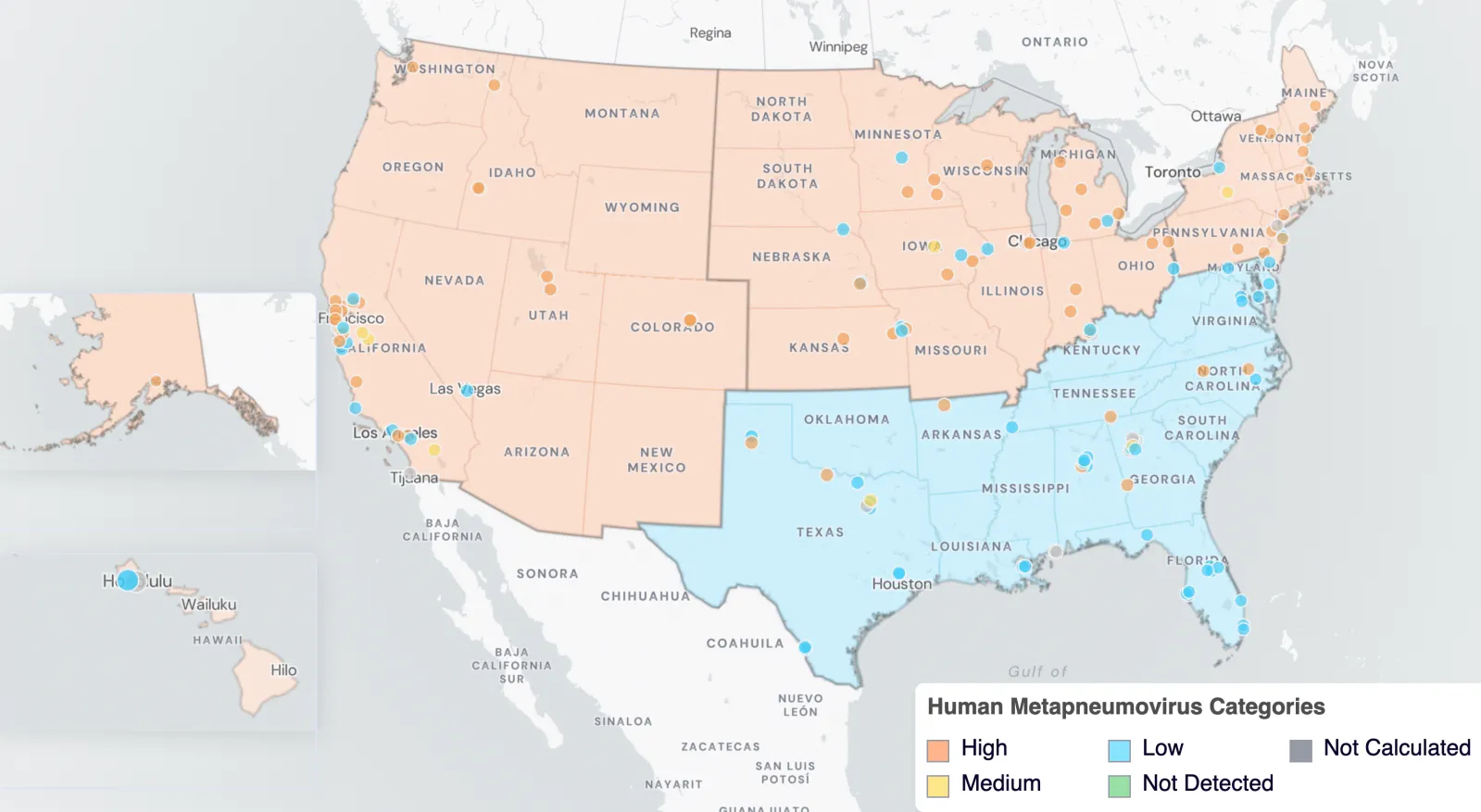
Data gathered by the WastewaterSCAN program, based at Stanford University, in partnership with Emory University, also shows that there is a high concentration of detections in California, and across the Northeast into the Midwest of America.
The program monitors infectious diseases through detections in municipal wastewater systems, data which is used to inform public health responses at the local, regional and even the national level.
Boehm, who is also WastewaterSCAN's principal investigator, told Newsweek that wastewater data "are like weather maps for viruses like HMPV. They provide a community-wide snapshot of diseases circulating, showing virus levels and trends in real-time that can help inform personal and public health decisions."
The program is not detecting the virus in water, but in "viral biomarkers, notable viral nucleic-acids in the case of HMPV, in wastewater," she explained. "The biomarkers are parts of inactivated viruses and they are present in waste streams which are thoroughly treated at wastewater treatment plants," she said.
All individuals in a community contribute to wastewater so a single sample contains biomarkers from the entire contributing community, she added. "When we see the concentration of HMPV RNA increase in that sample, it tells us that more people are shedding the viral biomarkers, which means it is circulating more widely in that area."
...
Should You Be Concerned?
While the surge in cases follows a similar pattern to that in previous years, Ramilo said that it is important for older individuals and those with chronic conditions especially to remember that when you get infected with flu, RSV and HMPV and COVID-19, "you are at high risk of developing serious complications such as pneumonia, but also cardiovascular complications such as myocardial infarcts and strokes."
The CDC advises that, to prevent the spread of HMPV, you should practice good hygiene, by covering their mouth and nose with a tissue when you cough or sneeze, or cough or sneeze into your elbow, not your hands.
The center also advises Americans to wash their hands properly, take steps to breathe cleaner air and a number of other measures, typically followed for preventing respiratory illnesses.
While there is no vaccine available for HMPV, Ramilo said you can still protect yourself by getting vaccinated against influenza, RSV, COVID-19 and pneumococcus, which is especially important for older adults and those with chronic conditions. "We cannot emphasize enough the importance of vaccination against all these respiratory infections," he said.
View 0 Comments
Submit Correction
View Editorial & AI Guidelines