...

By Micah McCartney
Reporter
0
Share
Newsweek is a Trust Project member
See more of our trusted coverage when you search.Prefer Newsweek on Googleto see more of our trusted coverage when you search.
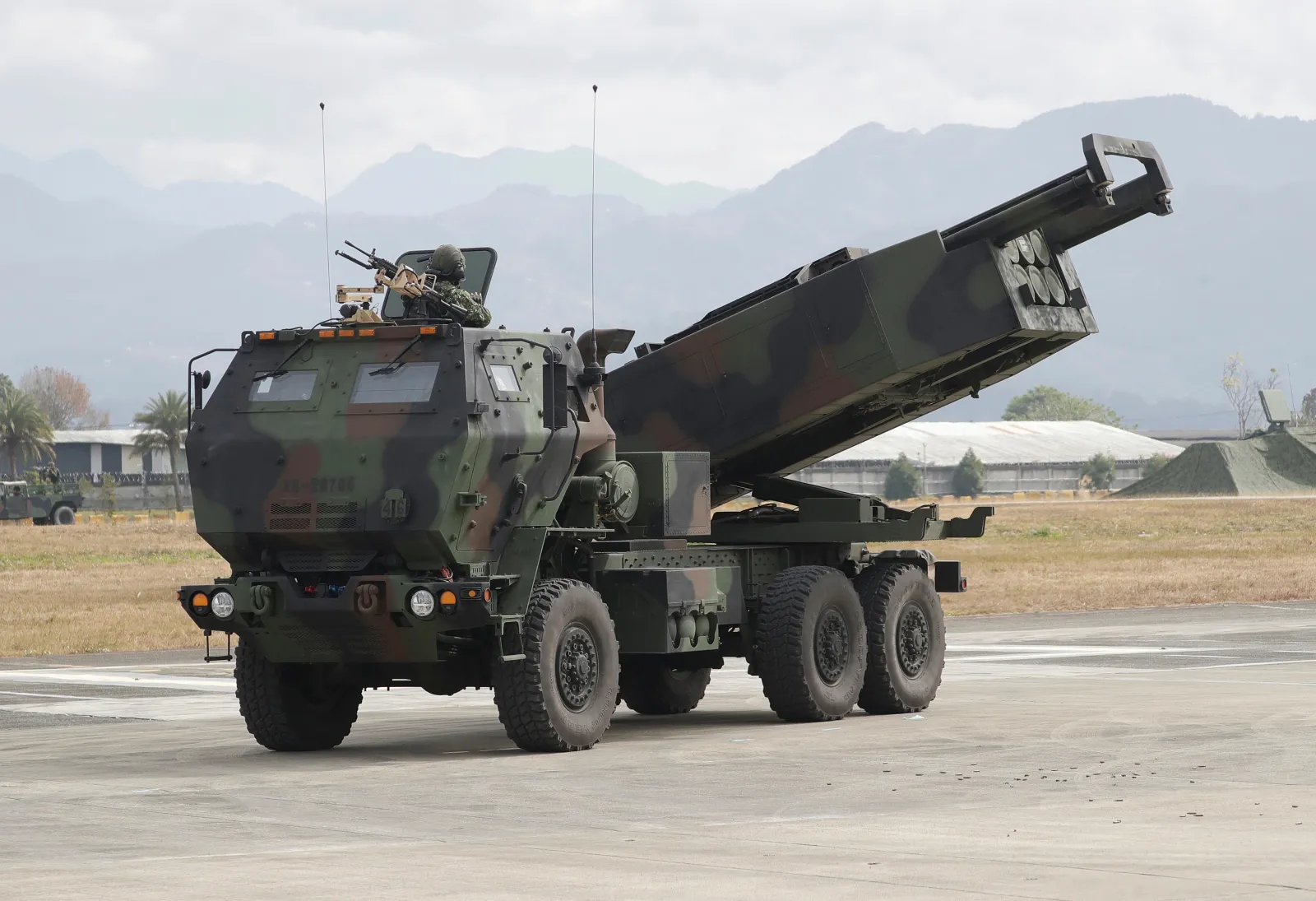
Taiwan's military is likely to stand up U.S.-made HIMARS rocket launchers on outlying islands in the Taiwan Strait, a move analysts say would pose a risk to People’s Liberation Army targets along China’s southeast coast—if the launchers survive the opening stage of a war.
Why It Matters
China claims Taiwan as its territory, though Beijing’s Communist Party-led government has never ruled there. President Xi Jinping has said the trend toward unification is "unstoppable."
Read More on World
China's threats and rapid military expansion have driven Taiwan to raise defense spending and step up orders of weapons aimed at deterring a People’s Liberation Army invasion. Washington has for decades provided Taipei with weaponry under the Taiwan Relations Act while maintaining "strategic ambiguity" over whether it would directly intervene in the event of a Chinese invasion.
Newsweek reached out to Taiwan's Foreign Ministry, Defense Ministry, and de facto embassy in Washington, D.C., via email for comment.
What To Know
Taiwan is planning to forward-deploy HIMARS systems to Penghu, an island county off the west coast of the main island, and to Dongyin, which sits less than 30 miles off China’s east coast, the Liberty Times reported, citing government sources.
HIMARS are capable of firing ATACMS (Army Tactical Missile System) missiles, whose 186-mile range would put ports, command and control centers, and other coastal infrastructure in China’s Fujian province and parts of Guangdong province within reach. The launchers can also be equipped with shorter-range GMLRS (Guided Multiple Launch Rocket System) rockets that could target invading forces over small areas.
The U.S. approved the sale of 82 HIMARS launchers and 420 ATACMS missiles in December as part of what could be an $11 billion arms package—the largest ever to Taiwan. Last year, Taiwan took delivery of the first 11 launchers from an initial order of 29 of the precision-strike systems.
The report comes after Taiwan included its new HIMARS units in a military drill on Tuesday that simulated an attack on Penghu by the PLA’s Eastern Theater Command.
"In front of the People’s Liberation Army, the Taiwan independence armed forces are shaking trees and overestimating their own strength, trying in vain to use U.S.-made weapons to cheer themselves up and provoke war," Chinese Defense Ministry spokesperson Jiang Bin told reporters during the ministry’s monthly press conference Thursday.
...
What People Are Saying
Raymond Kuo, senior political scientist at the RAND CORP. and inaugural director of the think tank's Taiwan Policy Initiative, told Newsweek: "The HIMARS deployment puts many of China's staging areas for an invasion under threat of attack, if they are armed with ATACMS. It's important to remember, however, that Taiwan will only have a few hundred of these missiles. Given those numbers, they wouldn't use them as an artillery barrage, but instead as a precision strike against key naval targets and command and control nodes.
"These forces would be a primary target in the opening stages of any conflict. As a result, force protection is key for Taiwan: providing hardened bunkers, securing firing points and alternative firing points, and training forces in 'shoot and scoot' maneuvers to preserve the HIMARS as long as possible. Air defense is particularly important."
What Happens Next
Senior U.S. defense and intelligence officials have said in recent years that they believe Xi has ordered the People’s Liberation Army to be ready to move against Taiwan by 2027, though they stress this does not mean he will necessarily launch an invasion that year or at any specific time.
Update 11:34 a.m. ET 1/30/26. This article has been updated with comment from Raymond Kuo and further information.
In a polarized era, the center is dismissed as bland. At Newsweek, ours is different: The Courageous Center—it's not "both sides," it's sharp, challenging and alive with ideas. We follow facts, not factions. If that sounds like the kind of journalism you want to see thrive, we need you.
When you become a Newsweek Member, you support a mission to keep the center strong and vibrant. Members enjoy: Ad-free browsing, exclusive content and editor conversations. Help keep the center courageous. Join today.


View 0 Comments
Submit Correction
View Editorial & AI Guidelines