
...

By Sam Stevenson
Associate News Editor
0
Share
Newsweek is a Trust Project member
See more of our trusted coverage when you search.Prefer Newsweek on Googleto see more of our trusted coverage when you search.
Dangerously hot conditions are expected to hit parts of California and Arizona from Sunday through early next week, with forecasters warning of temperatures topping 110 degrees during Mother’s Day weekend.
The timing raises concerns as many families plan outdoor celebrations, increasing the risk of heat-related illness.
Millions across major metro areas, including Phoenix and communities in southern California deserts, could feel the impact as conditions intensify.
Read More on Weather

...
Extreme Heat Watch Issued Across Southwest
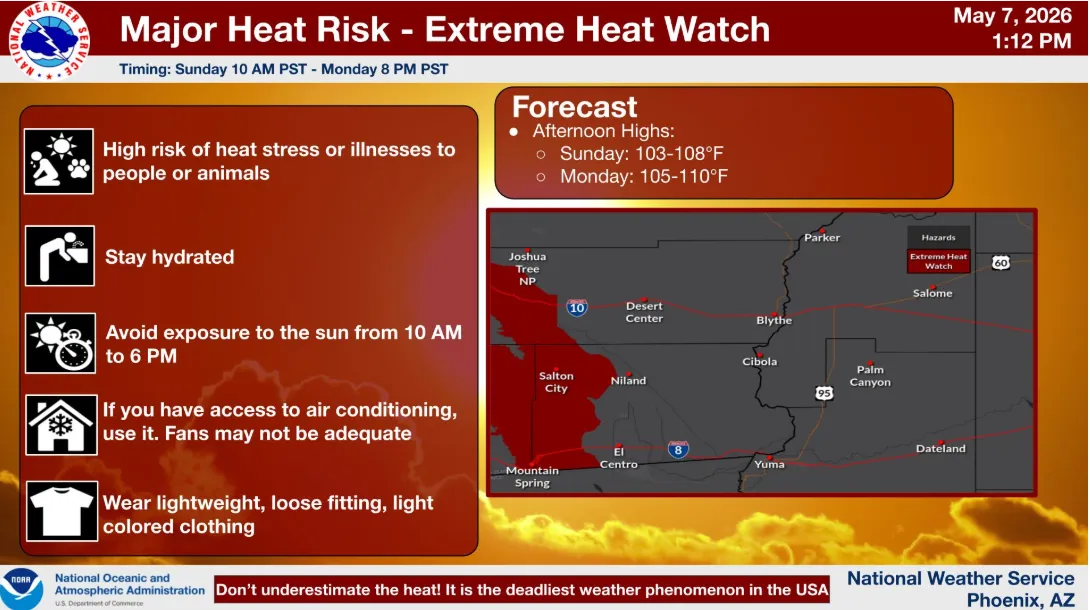
A stretch of unusually intense heat is set to build across the Southwest, prompting the National Weather Service (NWS) to issue an Extreme Heat Watch, which signals that unusually high temperatures are possible and that people should begin preparing now. This covers large parts of Arizona and southeastern California.
In the Phoenix metro area, temperatures could climb to between 104 and 110 degrees from Sunday morning through Monday evening.
A similar pattern is expected in California’s Imperial Valley, where highs may reach as much as 112 degrees.
Further west, desert regions including the Coachella Valley and areas near Palm Springs are also under alert, with highs forecast between 104 and 109 degrees.
There, forecasters say the heat could linger longer, lasting through Tuesday evening, with Monday expected to bring the most intense conditions.
Even by regional standards, meteorologists describe the heat as significant.

...
Holiday Plans Meet Rising Temperatures
The timing of the heat adds another layer of concern. Mother’s Day weekend typically draws people outdoors, from family barbecues to park gatherings and travel.
Forecasters have urged residents to factor the conditions into their plans. Afternoon heat is expected to peak when many are likely to be outside, increasing exposure risks.
In parts of Southern California, temperatures are forecast to climb steadily through the weekend before dipping slightly next week.
Inland areas such as Santa Clarita and Lancaster could approach the mid to upper 90s, while coastal cities remain milder but still warm.
The message from officials is consistent: plan, and adjust expectations where necessary. Simple changes, such as shifting activities to earlier in the day, could significantly reduce risk.
...
Health Risks Increase Quickly in Extreme Heat
High temperatures of this kind can quickly become dangerous, especially for those spending extended time outdoors.
The NWS warns that "dangerously hot conditions" and a "major heat risk" are possible across affected areas.
Health officials warn that extreme heat raises the likelihood of conditions such as heat cramps and heat exhaustion.
Without intervention, such conditions can escalate into heat stroke, a medical emergency that requires immediate attention.
Outdoor workers, older adults, and children are among the groups considered particularly vulnerable. However, anyone exposed to the heat for long periods could be affected.
The agency advises people working or spending time outdoors to take extra precautions and to be aware of the signs of heat-related illness.
Precautions and Support Services
Officials are urging people across affected areas to take steps to stay safe. Staying indoors in air-conditioned spaces during peak heat hours is strongly recommended.
When time outside is unavoidable, experts suggest wearing lightweight clothing, drinking plenty of water, and taking frequent breaks in shaded or cooled environments.
Strenuous activities should be postponed or moved to early morning or evening.
Workplace safety guidance from federal regulators also emphasizes rest breaks and access to cooling areas to reduce heat stress.
Community support systems are also being activated. In Maricopa County, residents can dial 211 to find cooling centers, transportation, and water resources.
A key message remains clear: extreme heat can escalate quickly, but preparation and awareness can make a significant difference.
A Weekend To Watch Closely
Forecasters expect temperatures to remain elevated across affected regions into next week.
While severe heat is not unusual in the Southwest, the combination of timing, intensity, and widespread coverage has prompted heightened concern this time around.
For families planning to celebrate Mother’s Day, the weekend may still go ahead—but with a closer eye on the thermometer.
View 0 Comments
Submit Correction
View Editorial & AI Guidelines