10
Loading video...

By Aliss Higham
Reporter
0
Share
Newsweek is a Trust Project member
See more of our trusted coverage when you search.Prefer Newsweek on Googleto see more of our trusted coverage when you search.
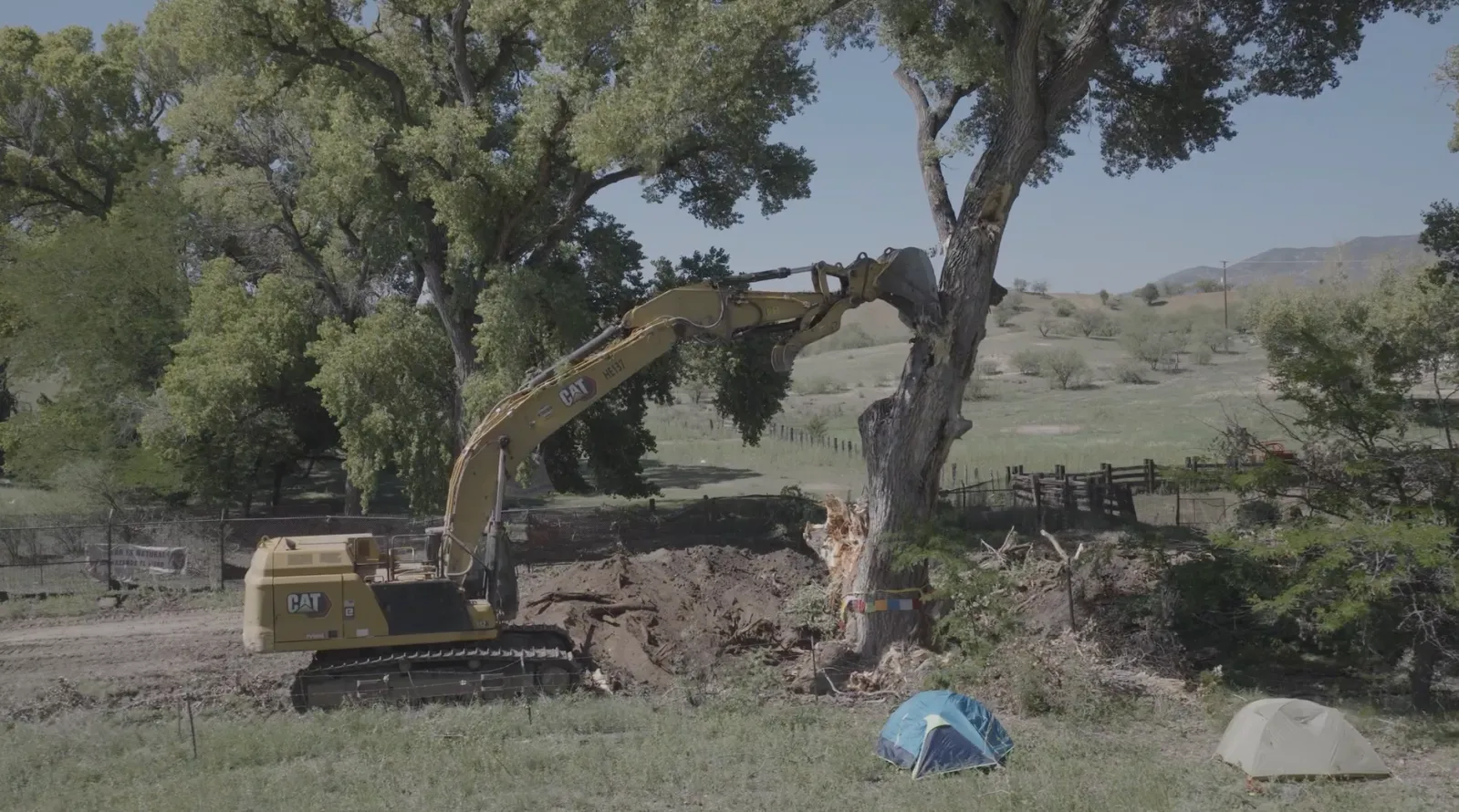
A monthslong protest against President Donald Trump's border wall ended on Monday when Border Patrol agents raided a camp in southern Arizona and crews cut down a centuries-old cottonwood tree that activists had been occupying.
The tree, known by protesters as the "grandmother tree," stood near Lochiel in the San Rafael Valley, close to the U.S.-Mexico border. Activists had been maintaining a round-the-clock sit-in for more than 70 days after three nearby cottonwood trees were removed to allow for planned border wall construction.
Footage posted online from the scene shows the tree being taken down while agents stand nearby. It shows the tree was meters away from the incomplete border wall.
Read More on News
According to The Washington Post, activist groups said about 10 people were arrested during the operation on Monday, with 10 others receiving citations.
"We have been raided, assaulted, battered, bruised, bleeding by the Border Patrol agents," activist Kate Scott told the outlet.
In a statement made to Newsweek, a spokesperson for U.S. Customs and Border Protection (CBP) said it conducted the operation "in support of authorized border infrastructure activities on federally managed land."
"The operation was conducted in coordination with partner agencies to maintain public safety, protect personnel, and ensure compliance with applicable federal laws and land-use restrictions," the statement continues.
"While most activity remained peaceful, agents took appropriate enforcement action in response to alleged violations and an alleged assault on a federal officer. U.S. Border Patrol respects the public’s right to lawfully express their views.
"Individuals are expected to comply with lawful orders and avoid conduct that endangers others or interferes with authorized federal operations."
...
What CBP Said About Trump's Border Wall
The tree stood close to the path of a much larger border-wall project running through Arizona's San Rafael Valley.
CBP awarded a $309 million contract in June 2025 to construct about 27 miles of new barrier in Santa Cruz County, with construction beginning that September.
The project includes 30-foot steel bollard fencing, roads and other border infrastructure.
Homeland Security also waived environmental laws, including the National Environmental Policy Act and Endangered Species Act, to accelerate construction in parts of the Tucson Sector.
At the time of the award, CBP said the area had a high number of "illegal-entry attempts" and experienced "large numbers of individuals and narcotics being smuggled into the country illegally."
"Continuing border wall construction in Tucson will support the Department of Homeland Security's ability to impede and deny illegal border crossings and the drug and human smuggling activities of transnational criminal organizations," CBP's statement said.

...
What Tree Removal Means for Wildlife
After three nearby cottonwoods were removed earlier this year, protesters began occupying the final tree on July 29 in an effort to stop it from being cut down and delay further wall construction.
The final felled tree was estimated to be between 150 and 250 years old, according to The Washington Post, while the Center for Biological Diversity said the former neighboring cottonwoods were roughly 200 to 250 years old.
Fremont cottonwoods are native to the Southwest and typically grow along rivers, washes and other riparian areas. The U.S. Forest Service says cottonwood stands provide important nesting, feeding and cover habitat for numerous birds and other wildlife.
The Center for Biological Diversity said the area is used by various species, including black bears, pronghorn and migratory birds. The organization has also warned that new border barriers could restrict the movement of wildlife between Arizona and Sonora, Mexico, including habitat and routes used by jaguars and ocelots.
"Destroying these ancient cottonwoods is a death sentence for an entire ecosystem," Russ McSpadden, Southwest conservation advocate at the Center for Biological Diversity, said in July, when the sit-in protest began.
"These magnificent cottonwoods survived centuries, nourishing wildlife through floods and drought, only to be bulldozed for the Trump administration's disastrous border wall. The San Rafael Valley is one of the most biologically rich landscapes in North America. It's both a refuge and crucial corridor for jaguars, ocelots, black bears, pronghorn and hundreds of bird species."
Newsweek’s reporters and editors used Martyn, our AI assistant, to produce this story. Learn more about Martyn here.
Contact Newsweek editors on this story: John Fitzpatrick, James Debens and Shakeema Edwards.
Update, 10/07/2026, 8:01 a.m. ET: this article was updated with comment from a spokesperson for U.S. Customs and Border Protection.
View 0 Comments
Submit Correction
View Editorial & AI Guidelines