...

By Hannah Parry
Associate News Editor
0
Share
Newsweek is a Trust Project member
See more of our trusted coverage when you search.Prefer Newsweek on Googleto see more of our trusted coverage when you search.
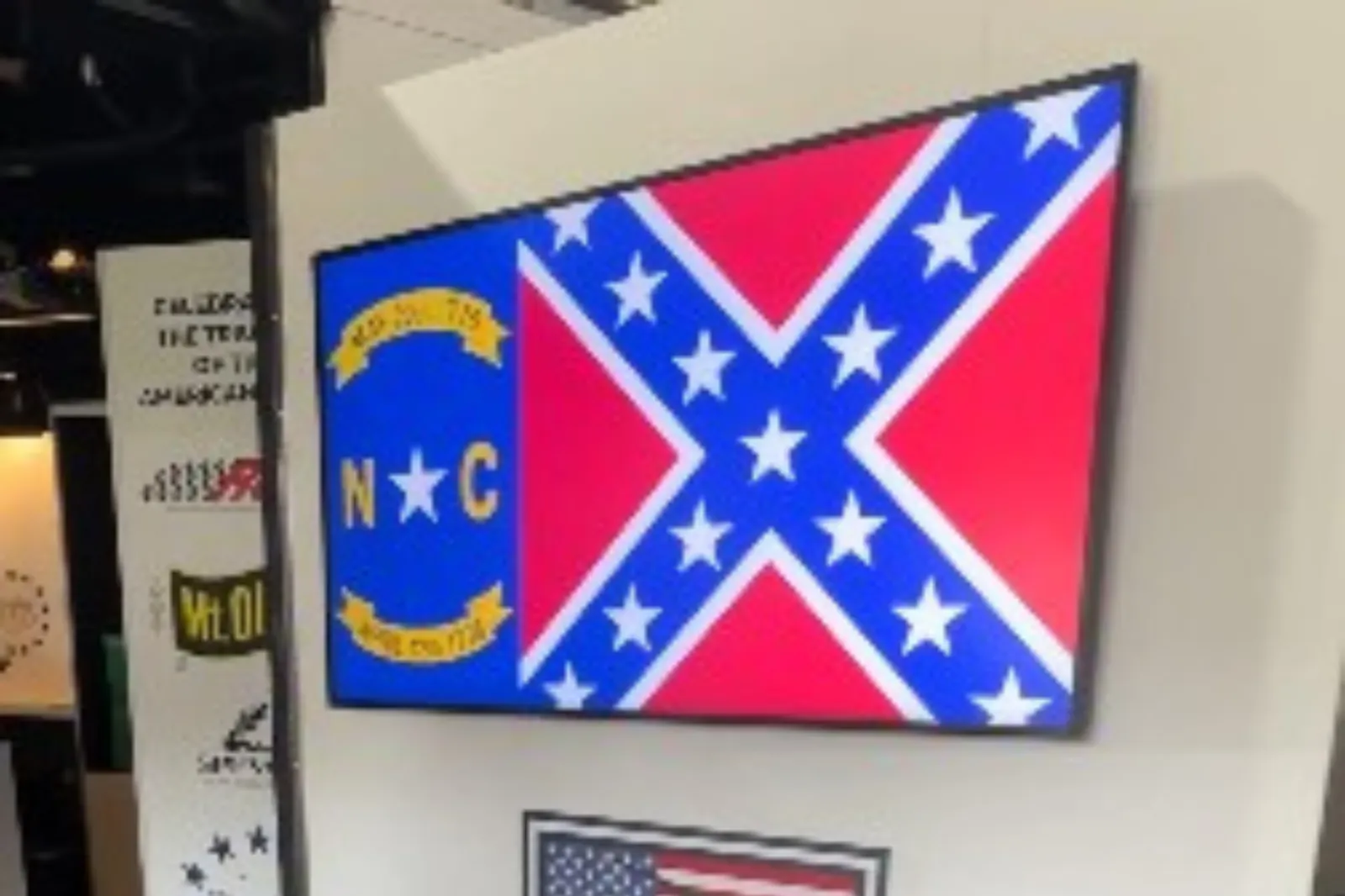
North Carolina Democratic Governor Josh Stein's office has condemned a display at the Great American State Fair in Washington, D.C., which included altered versions of the state flag featuring the Confederate's "Southern Cross."
The controversy erupted after journalist Reuben Jones posted footage from the North Carolina exhibit featuring two versions of the state flag with the Confederate battle emblem superimposed over the design.
A spokesperson for Stein said the video display of the flags misrepresented North Carolina and called on organizers to remove it.
Read More on News
"This display does not reflect the North Carolina that we love. America 250 is about unity and bringing our nation together. Glorifying this divisive Confederate symbol does the exact opposite. We demand the organizers stop dishonoring the flag of North Carolina," they said.
...
The exhibit is part of the Great American State Fair, an event celebrating the nation's upcoming 250th anniversary.
Newsweek has reached out to Freedom 250, the organizers of the fair, via email for comment.
A spokesperson for the North Carolina booth told Spectrum News that it had become aware of an "unapproved image in a video displayed inside the North Carolina Pavilion" on Friday. "As soon as we were made aware, we immediately removed the video and began reviewing how it occurred. Our focus remains on celebrating America’s 250th birthday and North Carolina’s role in our nation’s history.”
The video display, which showed the current North Carolina flag split with the Confederate flag, has since been removed.
The videos prompted criticism from historians, political figures and businesses participating in the North Carolina exhibit.
Stephen Jackson, a historian who specializes in North Carolina's past, wrote on X: "Unlike former flags from Georgia and Mississippi, the official flag of NC has NEVER incorporated the Confederate Battle Flag in its design. Shame on whoever is running this booth."
Democratic advocacy group Carolina Forward also criticized the display, posting: "So the privately-sponsored North Carolina booth at Trump's fair features not one, but two altered versions of the state flag with a big stars-and-bars on it. Disgusting."
Meanwhile, one of the exhibit's corporate sponsors, Mt. Olive Pickle Company, announced it was withdrawing after learning about the display.
In a statement shared by Jones, the company said: "Mt. Olive Pickle Company was invited to participate in the North Carolina exhibit for the Great American State Fair in Washington, D.C., as part of America's 250th celebration. We are proud of our North Carolina roots, and we agreed to be a part of an exhibit, as presented to us, that would represent the best of our great state.
"We were unaware that an image of the Confederate flag was included in a video as part of this exhibit, and we have withdrawn our participation. Our company stands on values of human dignity, opportunity, and freedom."
North Carolina Among 10 States That Declined to Attend Fair
The Tar Heel State is one of at least 10 that declined to send official delegations to President Donald Trump’s Great American State Fair, a centerpiece of celebrations marking America's 250th anniversary. The event is being organized by Freedom 250, the Trump-aligned nonprofit behind several semiquincentennial events.
Connecticut, Illinois, Maine, Massachusetts, Oregon, Rhode Island, Vermont, Washington and Pennsylvania also confirmed they will not officially participate.
The decision by the mostly Democratic states to skip the fair has exposed political tensions between the White House and state leaders.
While some blamed logistics or cost for their lack of delegation, such as North Carolina, Oregon Governor Tina Kotek's office was more explicit in her statement on why her state withdrew—because of "the cost of participating in the Fair and growing concerns that the event in Washington, D.C. is shaping up to be a more partisan affair than originally presented."
Has the North Carolina Flag Ever Incorporated the Confederate Flag?
North Carolina's official state flag has never included the Confederate battle symbol in any version of its design.
The current flag traces its origins to 1861, shortly after North Carolina seceded from the Union. That first wartime flag featured a blue vertical stripe bearing the letters "N C" and two dates commemorating the state's resistance to British rule.
In 1885, lawmakers adopted a redesigned state flag that remains the basis for today's version. The changes replaced one of the commemorative dates with May 20, 1775—the date associated with the Mecklenburg Declaration of Independence—and altered the flag's proportions and colors.
Neither the 1861 flag nor the 1885 redesign incorporated the Confederate's Southern Cross.
Did North Carolina Fight for the South or North in the Civil War?
North Carolina joined the Confederacy during the American Civil War. Initially reluctant to leave the Union, the state voted to secede on May 20, 1861, after President Abraham Lincoln called for troops following the attack on Fort Sumter.
More than 125,000 North Carolinians served in Confederate forces—more than any other Confederate state—although thousands of them also remained loyal to the Union and fought for the U.S. Army.
The state experienced some of the war's fiercest fighting, including the Battle of Bentonville in March 1865, one of the Confederacy's last major engagements.
History and Controversy of the Confederate Flag
The Confederate battle flag was originally flown by portions of the Confederate Army during the Civil War and was never the official national flag of the Confederate States of America.
Following the war, the symbol largely disappeared from public life before being revived during the 20th century by groups opposing civil rights and racial integration. It later became associated with segregationist movements and, in some cases, white supremacist organizations.
Supporters of displaying the flag often argue that it represents Southern heritage or remembrance of Confederate soldiers. Critics counter that because the Confederacy was founded to preserve slavery and the battle flag was later embraced as a symbol of resistance to civil rights, it has become an enduring symbol of racism and oppression for many Americans.
The debate intensified after the 2015 racist mass shooting at Emanuel African Methodist Episcopal Church in Charleston, South Carolina, prompting several states to remove Confederate symbols from government property. More recently, Mississippi redesigned its state flag in 2020, becoming the last state to remove Confederate imagery from its official flag.
Why It Matters
The dispute comes as states and organizations across the country prepare for events commemorating America's 250th anniversary.
For North Carolina officials, the issue is not simply the display of a Confederate symbol but the alteration of the state's official flag, which has never included the Confederate battle flag. The controversy also highlights the continuing political and cultural divisions over Confederate imagery more than 160 years after the Civil War.
View 0 Comments
Submit Correction
View Editorial & AI Guidelines