10
Loading video...

By Andrew Stanton
Reporter
0
Share
Newsweek is a Trust Project member
See more of our trusted coverage when you search.Prefer Newsweek on Googleto see more of our trusted coverage when you search.
Democrats are hoping to take Alaska’s governor’s office for the first time in nearly 30 years, eyeing a rare opportunity in a state that has voted reliably Republican for decades.
Alaska voters made their decision in the primaries on Tuesday, and it appears that two Democrats and two Republicans will advance to the November general election under the state’s unique jungle primary system.
Although Alaska has historically leaned toward Republicans, Democrats see it as a potential gain in this year's midterms, as they believe President Donald Trump’s declining national approval rating gives them an opportunity to expand the electoral battleground. The Senate race, in which GOP Senator Dan Sullivan is facing a challenge from Democratic former Representative Mary Peltola, is viewed as one of the most competitive races of the midterms.
Read More on Politics
Forecasters like the Cook Political Report have viewed the governor's race as more favorable to Republicans, though limited polling suggests it is competitive. Alaska’s use of ranked choice voting adds another layer of uncertainty to the race ahead of November.
Former state Senator Tom Begich told Newsweek on Wednesday, “The combined vote for candidates offering a more progressive vision is over 52 percent tonight. That is good news for Alaska’s future, and I’m very pleased to be among the top two. We’ve changed the conversation, and we’re just getting started.”
Newsweek also reached out to the gubernatorial campaigns of Jonathan Kreiss-Tomkins, Bernadette Wilson, Dave Bronson, Treg Taylor and Click Bishop for comment via email.

...
Alaska Jungle Primary, Ranked-Choice Voting Explained
Alaska uses an electoral system unlike other states. It uses both a nonpartisan top-four primary system and ranked-choice voting for the general election.
In the primary, all candidates appeared on a single ballot regardless of political party, and the four candidates with the most votes advance to the general election.
In the general election, voters will rank the four candidates by preference. If no candidate reaches an outright majority, the candidate with the fewest votes is eliminated, and their voters are redistributed based on their second choice. If no candidate again wins 50 percent plus one, the process repeats between the final two candidates.
Most other states hold partisan primaries and use a first-past-the-post system in the general election. The new electoral system was implemented in the 2022 election cycle, and this will be the second gubernatorial race using it.
Alaska’s use of ranked-choice voting and a nonpartisan primary could have key implications for the candidates in the governor race, Amy Lauren Lovecraft, professor of political science at the University of Alaska Fairbanks, told Newsweek.
“You’re not just relying on party loyalists to turn out to choose you in a party primary. It’s a different kind of conversation. For me, I’ll be very interested to see what the ads, once the four finalists are settled, are emphasizing because the messaging will shift,” she said.
The electoral system allows voters to “break up the national party messaging.”
“Even if you have two Democrats and two Republicans on your election ballot, you can still see differences in how they interpret their party's messaging,” she said. “That’s a significant advantage of Alaska’s ranked choice.”
Related Story
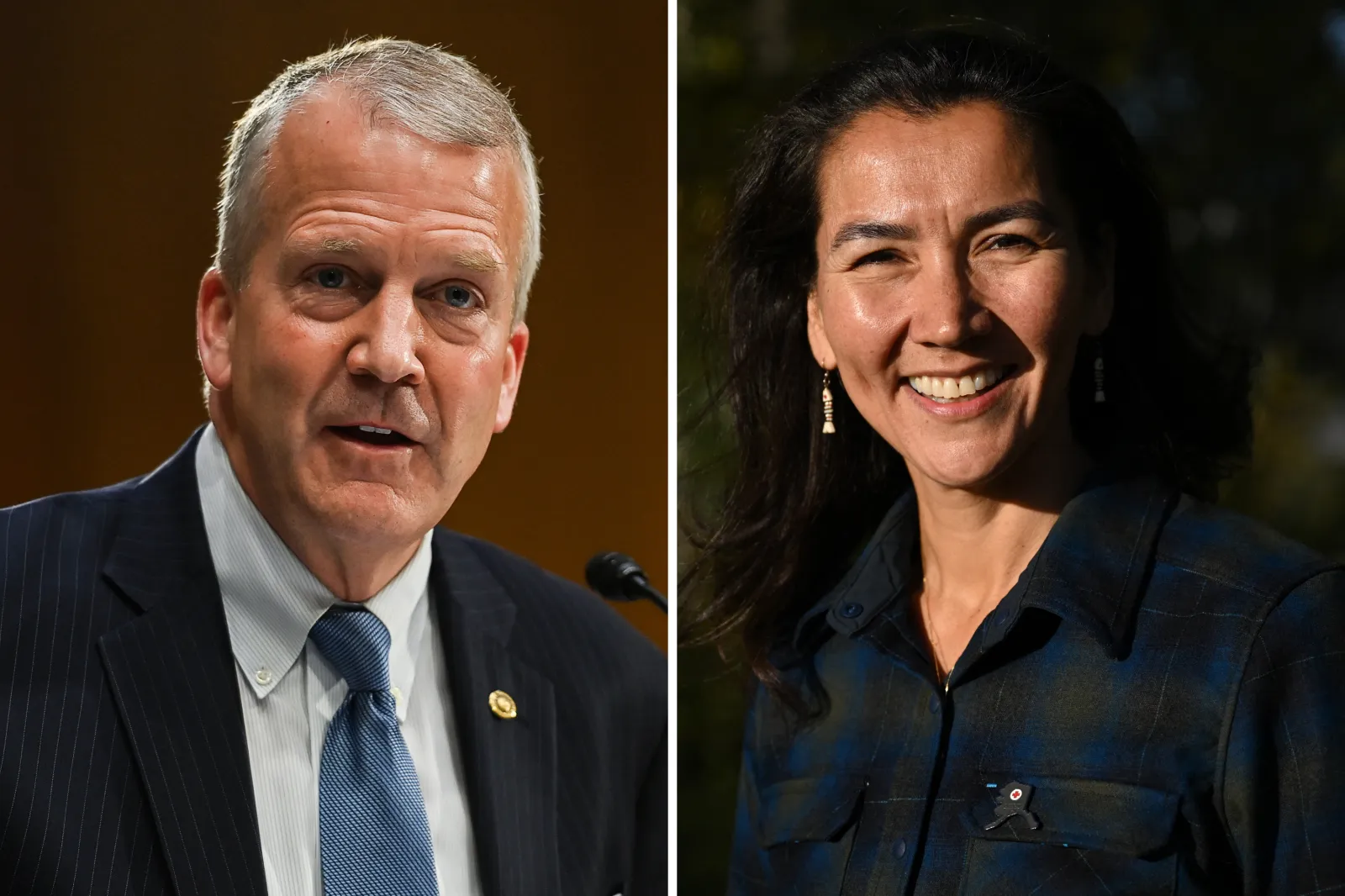
Mary Peltola’s Chances of Beating Dan Sullivan to Flip Alaska Senate Seat
Alaska Governor's Race Jungle Primary Results
As of Wednesday morning, Begich and former state Representative Jonathan Kreiss-Tomkins, both Democrats, had advanced to the general election, according to the Associated Press. Kreiss-Tomkins led the field with 21.7 percent of the vote, while Begich’s support stood at 20.1 percent.
The other two spots had not been called. Businesswoman Bernadette Wilson’s support stood at 10.5 percent, while former Anchorage Mayor Dave Bronson’s was at 8.4 percent. Former Attorney General Treg Taylor’s support stood at 7.5 percent, while former state Senator Click Bishop had received 7.1 percent. Several other candidates received less than 6 percent of the vote.
Only 80 percent of the vote had been counted as of Wednesday morning, so the numbers could still change.
While Democrats had the top two spots in the primary, Republicans were still on track to win more votes. With 80 percent of the vote in, Democrats had 54,479 votes, while Republican candidates received 66,743, according to the AP. Two Democrats appeared on the ballot compared to a dozen Republicans.
Democrats' Chances of Flipping Alaska Governor's Seat, According to Polls
The latest poll from Alaska Survey Research showed that in the final round of ranked-choice voting between Begich and Wilson, Begich held a 2-point lead, 51 percent to 49 percent. It surveyed 1,528 registered voters June 30-July 1, with a margin of error of plus or minus 2.7 percentage points.
An earlier Alaska Survey Research poll, which surveyed 1,923 likely voters April 16-19, showed that in the final round of ranked choice, Begich led Wilson 53.9 percent to 46.1 percent. The margin of error was plus or minus 2.5 percentage points.
Trump will be a key issue in the race, but local factors will also matter, according to Lovecraft.
“There’s always the issue of what is the federal government going to do with the lands they own in Alaska, versus what the state would like to see happen to those lands. That’s an issue that is cross-cutting. The preferences don't necessarily line up on Democratic and Republican sides. But when it comes to the use of the actual land, you tend to find more conservationists in the Democratic Party or Green Party,” she said.
Glenn Wright, a professor of political science at the University of Alaska Southeast, told Newsweek it is important to “be careful about extrapolating primary results to the general election” but that the results “mirror” the small number of public polls. Wright noted that Alaska is fairly moderate with a “strong civic and independent tradition.”
“Besides the obvious political tides at the national level—favoring Democrats—we have had a very conservative governor here for the last eight years who at the moment is extremely unpopular, and so I suspect any Republicans, especially conservative Republicans who can be tied to either the president or the governor, will face strong headwinds,” he said.
Wilson may be “too conservative” and too closely aligned with Trump, but it’s not impossible she could win, he said.
“Striking that of the primary votes counted so far, over 40 percent voted for Begich or JKT vs. about 19 percent for Wilson and Bronson. It may well be that Democrats are just more unified in the governor’s race, but I still think it’s going to be a heavy lift for a Republican to beat out one of the Democrats,” he said.
What Prediction Markets Show
Democrats’ chances of winning the governor's race have recently increased on Kalshi. Republicans had been favored until August 12, but the market now views the race as a toss-up, with Democrats having a 51 percent chance of winning.
On Polymarket, Kreiss-Tomkins had a 30 percent chance of winning in November as of Wednesday afternoon. Wilson had a 27 percent chance of winning, while Begich's chances stood at 25 percent. Taylor had a 5 percent chance and Bronson had a 4 percent chance on Polymarket.
Prediction markets let traders buy and sell contracts tied to political outcomes and current events, aggregating real-money wagers into probability estimates. Prices fluctuate as traders react to polling, fundraising, candidate developments and broader political trends. They measure trader sentiment in the moment but do not always accurately predict the future.
Alaska’s Independent Streak
Over the past few decades, Republicans’ margins in Alaska have narrowed as leftward shifts in places like Anchorage give Democrats hope that the state could become more competitive. For much of the early 2000s, the state was solidly Republican, but elections have been closer in the Trump era.
Trump carried Alaska by 13 points in 2024, 10 points in 2020 and 15 points in 2016. Republicans also won Alaska by 14 points in 2012, nearly 22 points in 2008, 26 points in 2004 and 31 points in 2000.
As of August 3, Alaska had 141,995 registered Republicans and 69,889 registered Democrats. However, there were 81,801 nonpartisan and 298,273 unaffiliated voters, making them the largest voting bloc, according to the Alaska Division of Elections.
Alaska has more of an independent streak compared to many states where partisan politics dominate. Its state Senate has a majority coalition of Democrats and moderate Republicans, and it has elected Democrats statewide before, with Peltola most recently.
Alaska’s other Republican senator, Lisa Murkowski, is also known as one of the chamber's most centrist members and has been willing to break with her party on key issues.
When Did Alaska Last Elect a Democratic Governor?
Alaska last elected a Democratic governor in 1998, when voters reelected Governor Tony Knowles. Four years later, voters elected Senator Frank Murkowski, Lisa's father, as governor.
In 2014, Alaska elected Bill Walker, an independent and former Republican, as governor. Walker ran in the 2026 primary but trailed other candidates with only 4.4 percent of the vote with 80 percent reporting.
What Happens Next
Forecasters give Republicans an advantage. The Cook Political Report and Sabato’s Crystal Ball classify the race as Likely Republican. Polls will continue to be watched as a gauge of the electorate’s mood ahead of the midterms on November 3.
Contact Newsweek editors on this story: Jason Lemon, Dave Siminoff, Sam Wilson.
View 0 Comments
Submit Correction
View Editorial & AI Guidelines