10
Loading video...

By Brendan Cole
Senior Reporter
0
Share
Newsweek is a Trust Project member
See more of our trusted coverage when you search.Prefer Newsweek on Googleto see more of our trusted coverage when you search.
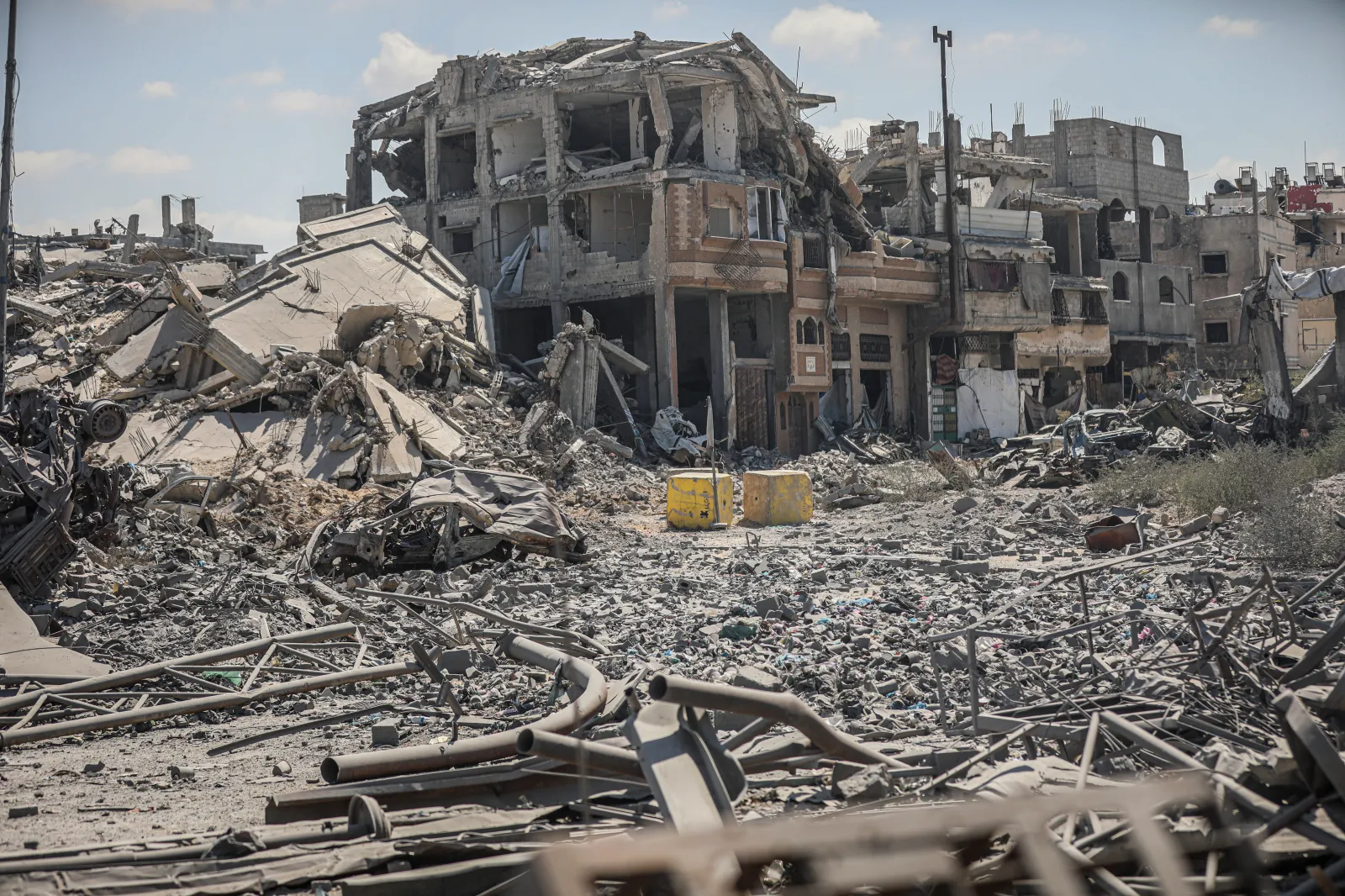
Google Earth images of Gaza showing the levels of destruction in the territory caused by the war between Israel and Hamas have prompted shock among social media users and analysts.
Social media users said that satellite imagery that appeared online on Sunday showed the consequences of the Israeli military offensive that followed Hamas' attacks on southern Israel on October 7, 2023.
However, Google told Newsweek on Monday that its most-recent satellite imagery of Gaza was from June 2026. "We update satellite imagery from our third-party providers on a regular basis," it added.
Read More on World
Newsweek has contacted the Israeli military for comment and is awaiting a response.
The imagery went viral on Sunday with Barry Andrews, an Irish Member of the European Parliament, posting on X "the updated Google satellite images of Gaza are quite incredible, for all to see," as he shared imagery of flattened buildings and districts reduced to rubble.
His post, as of Monday afternoon, had received five million views, 30,000 likes, and thousands of reposts.
...
"The Google images act as yet another record of the systematic destruction of Gaza where at least 82 percent of its buildings have been destroyed or damaged," Chris Doyle, director of the Council for Arab-British Understanding, told Newsweek on Monday. "These images have shocked the world for years. The question is when they will shift the positions of major leaders, not least the U.S.," he added.
Nathan Ruser, an analyst at the Australian Strategic Policy Institute, wrote on X that the imagery "shows the reality of Gaza in shocking resolution."
What Do the Google Earth Images Show?
Hamas killed at least 1,200 people and kidnapped over 250 in the October 7 attacks nearly three years ago. Following Israel's military response, 74,016 Palestinians have been killed, with another 175,068 wounded as of Monday, according to The Associated Press, citing Gaza's Health Ministry.
A ceasefire that came into effect on October 10, 2025 has stopped the heaviest fighting, although Israeli strikes have continued in what the IDF said are in response to threats and attacks.
The U.N. Satellite Centre (UNOSAT) said on August 12 that 82 percent of all Gaza structures, or 200,000, had faced some damage, with two-thirds of them destroyed in a statistic which chimes with the latest Google Earth imagery.
The southern city of Rafah features prominently, with areas that once had rows of homes now appearing mostly cleared, with makeshift shelters visible across wide areas.
In Gaza City, the satellite imagery shows destruction around Al Shifa Hospital, which sustained fierce Israeli assaults during the war. The hospital's urban surroundings differ greatly from previous imagery. Israel accused Hamas of hiding a command post inside and under the compound in claims denied by the group and hospital staff.
Rebecca Wolfe, a conflict and humanitarian response expert at the University of Chicago's Harris School of Public Policy, told Newsweek that little has been discussed about the challenging operating environment during the war in Gaza, which is tiny and densely populated.

...

...
A United Nations report published last week said that around 1.9 million people in Gaza had been displaced, with many forced to move more than once. It also said more than 60 percent of the population had lost their homes.
"Targets were often close to critical infrastructure and civilians," Wolfe said. "What is hard to digest is that this wasn't an information problem. Israel very well understood the operating environment and the strength of these weapons. Yet they still used them when targeting individual Hamas militants, even though there were other alternatives to conducting the operation."
Contact Newsweek editors on this story: Alabama Jackson, James Debens and Sam Wilson.
Update, 09/29/2026 6:29 a.m. ET: this article was updated with comment from Google.
View 0 Comments
Submit Correction
View Editorial & AI Guidelines