...

By Eileen Falkenberg-Hull
Senior Editor, Autos, Travel and Lifestyle
0
Share
Newsweek is a Trust Project member
See more of our trusted coverage when you search.Prefer Newsweek on Googleto see more of our trusted coverage when you search.
Cars have been sketched, modeled and brought to life for 140 years. General Motors designer Bryan Styles has a job that didn’t exist a century ago, or even 40 years ago. He is the director of design innovation and technology operations as part of the company's larger global design apparatus. Chief among his responsibilities is the rollout of artificial intelligence in the design process.
“We're really heavily focused on how we can best ride the coming tech wave of AI, and we’ve found that it's just coming so fast that if we don't have a shared philosophy and a strategy for how to leverage it, that we'll simply be inundated by that coming wave and left behind.,” Styles told Newsweek.
The process of designing and engineering cars has been finely honed by automakers over the decades, even as computer technology has revolutionized the industry and safety standards and requirements strengthened. AI is greatly disrupting that, allowing product teams to design, develop, manufacture and bring vehicles to market faster than ever before.
Read More on Autos
“We know that the waves coming and that is highly disruptive to the status quo, so our approach has been to embrace that reality and to disrupt ourselves and intentionally craft the future,” he said. “We realize that there is a massive upside to adopting AI at scale, with the caveat that it has to be done properly.”
Doing that “properly” means focusing on using AI to enhance workstreams, creating efficiencies but not keeping humans out of the design process. Stiles explained that the greatest benefit his team is currently seeing from the technology isn’t in product ideation but in reducing handoffs between steps, which enables more concurrent development time.
“If you think about our overall purpose at GM, we pioneer the innovations that move and connect people to what matters. Implicit within that purpose is this connection to people. And so as we approach any new technology, we have to stay true to that purpose, which means that we have to keep humans at the center of what we're doing,” the design lead said.
As AI has evolved within General Motors, a shift has occurred: The technology is moving from “cool” to “useful” to “mission critical”. Styles shared: “With AI, there's many cool things that we could do, but we got to go from cool to useful and then from useful to mission critical. That's really where we're focusing our application of AI, using it to create value in customer experiences and in employee tools and solutions.”
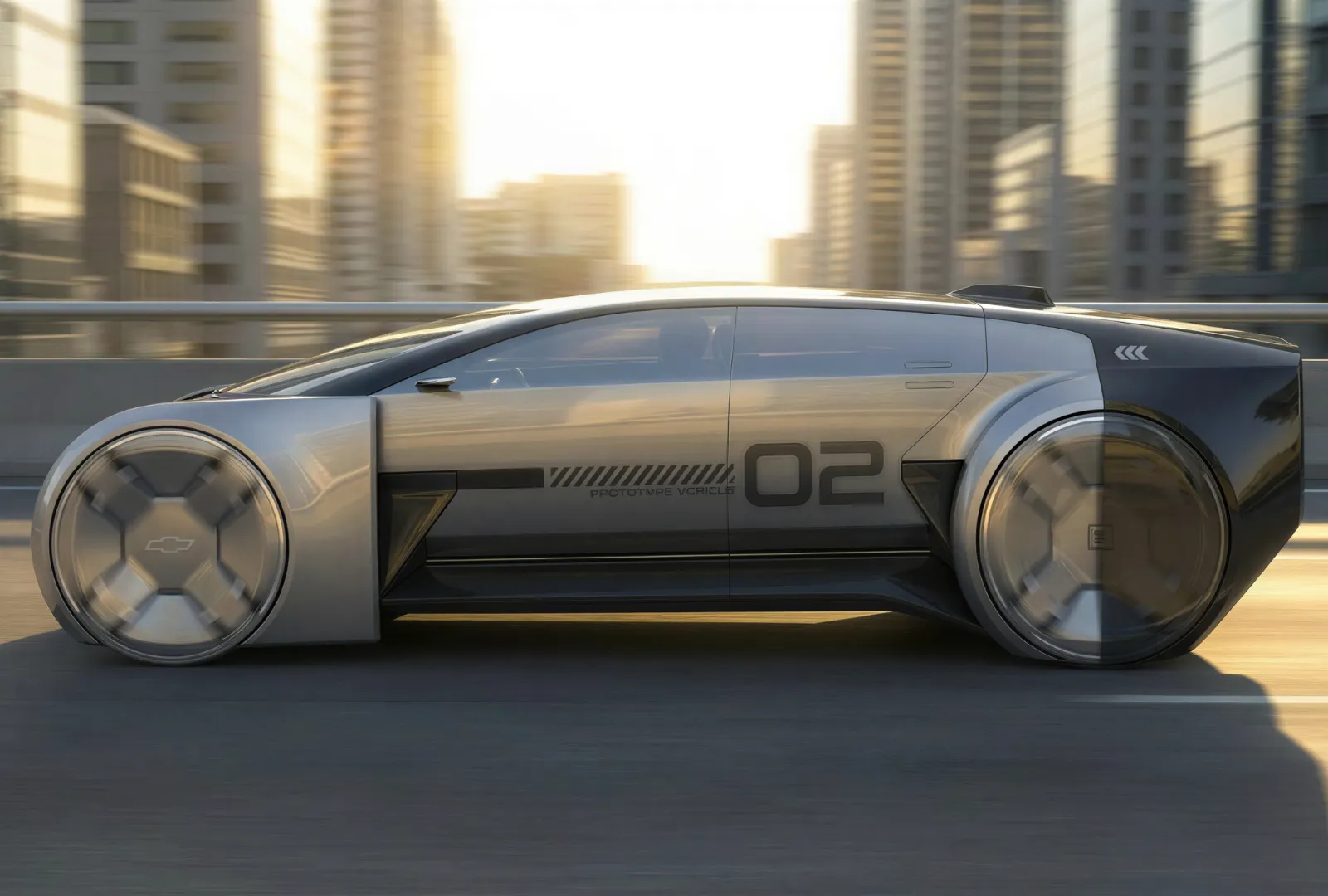
Dan Shapiro, a creative designer at the company, demonstrated for Newsweek what the integration of AI into his workflow means. General Motors uses Vizcom software to turn simple sketches into animated films. Within a few hours from putting digital pen to paper, Shapiro can produce a clip that showcases a new vehicle at varying angles, in different landscapes and in nearly any lighting condition.

...
“It all starts with the sketch,” Shapiro said. “AI isn't changing any of your design intent… human creativity sets the vision.”
General Motors only recently implemented the technology. “A year ago, going from a sketch to a short animation like this would have taken multiple teams, including design, sculpting and visualization several, several months to do. And now, by using AI tools, a video like this can be done by a single designer in less than a day. This enables us to explore a wider range of ideas before narrowing down to one direction,” Shapiro explained.
Despite the focus on human-tech partnership, AI is changing the jobs once held in a design studio. "We've kind of taken on more of the role of art director, and are letting the AI do the typically time and resource intensive work of setting up that CGI visualization," Shapiro said.
AI learns using what has already been created, generating from learned patterns and behaviors. Like other AI agents, Vizcom technology relies on inputted prompts to generate design. "Changing only a few words in the prompt can shift the entire atmosphere, stance of the vehicle and the materials that are on the vehicle. And so that's where human taste and decision making really matter the most," Shapiro said. "We're still the ones deciding what feels like a Buick, a GMC, a Cadillac and in this case, a Chevy."
Styles added: "At the end of the day, we produce physical products, and those are the ones that our customers drive and experience and fall in love with. And so we continue to believe it's very important for us to validate physically so that we can make sure that whatever it is that we've crafted over time is ultimately going to perform as intended. The tech is very much accelerating and not necessarily replacing."
View 0 Comments
Submit Correction
View Editorial & AI Guidelines