
By Jeffrey Young
Environmental and Sustainability Editor
0
Share
Newsweek is a Trust Project member
See more of our trusted coverage when you search.Prefer Newsweek on Googleto see more of our trusted coverage when you search.
It started in April, just after Earth Day, when former British Prime Minister Tony Blair and his think tank, the Tony Blair Institute, called for a “radical reset” in the way the world tackles climate change. Blair argued that current net-zero strategies were “doomed to fail.”
Next came Bill Gates, among the world’s richest men and a major force in clean tech through his Breakthrough Energy investment group. Gates released a memo just before the COP30 climate talks calling for “a different view” and urging leaders to “adjust our strategies” for dealing with climate change.

Photo Illustration by Newsweek/Getty
“Climate change is not the biggest threat to the lives and livelihoods of people in poor countries, and it won’t be in the future,” Gates wrote, infuriating many in the climate movement. University of Pennsylvania climate scientist and author Michael Mann told Newsweek the Gates memo was “horrifying.”
President Donald Trump, who has called climate change the world’s “greatest con job,” seized on the Gates memo. “I (WE!) just won the War on the Climate Change Hoax,” Trump posted on social media, and claimed that Gates had “finally admitted that he was completely WRONG on the issue.” (Gates denied this admittance, calling Trump’s comments a “gigantic misreading” of his memo.)
Along the way, several major banks and businesses have quietly edged away from earlier climate pledges and dropped out of net-zero groups as they reassess their approach amid Trump’s hostility to climate action and diminished enthusiasm for it in some other parts of the world.
The call for a climate “reset” is upon us. But just what does that mean and what would a climate reset look like? We asked some leading climate thinkers from business, economics, energy and politics to weigh in.
Focus on Climate Costs
“I agree with Gates, but he goes the wrong way,” Rhode Island Senator Sheldon Whitehouse said in a briefing with reporters at November’s COP30 in Belém, Brazil. “We need a different approach, a more aggressive approach, an approach that points out the corruption and mischief from the fossil fuel industry.”
Whitehouse is the top Democrat on the Senate Committee on Environment and Public Works and one of the most consistent Congressional voices for climate action. He said Gates’ framing of the issue provides cover for those who oppose a clean-energy transition. “I am sick to death of hearing my Republican colleagues come out of meetings with Bill Gates and tell me, ‘See, we don’t need to do anything after all—Bill Gates says innovation is going to solve this,’” Whitehouse said. “He’s just been wrong on that, and he’s been wrong on that for years.”
Whitehouse said climate and energy innovation will be stifled so long as there is no price on carbon pollution.
“The economy is tilted to discourage innovation by giving the fossil fuel industry massive political subsidies,” he said.
The reset Whitehouse wants is in messaging. He wants to more clearly connect climate change to economic impacts such as rising home insurance rates in places at increased risk of storms, flood and fire.
“All of those affordability concerns connect back to the fossil fuel industry and its business,” he said.
Democratic Senator Peter Welch of Vermont predicts a “consumer revolt” as ratepayers see their electricity bills rise, and he thinks it will be tied to Trump’s energy policies. Renewable energy and battery energy storage have together accounted for the bulk of new electricity generation brought online over the past year. But as AI data centers push power demand upward, Welch said, the Trump administration’s attempts to stifle clean energy development make it harder to supply more electricity.
“That is immediately going to spike the retail rates,” Welch told Newsweek during September’s Climate Week NYC. While climate change alone has not motivated voters, he said, cost concerns might. “Climate is a winning message when it’s tied to affordability and jobs,” he added.
...
The Move From Moral to Material Concerns
Andrew Prag is managing director for policy at the We Mean Business Coalition, a nonprofit that works with major companies on climate action. Prag said many companies are changing their climate strategies as the effects from warming become less theoretical.
“It’s become much more a question of risks and opportunities than it is around moralizing on climate change,” Prag told Newsweek at COP30. “There’s been a change of narrative which has come about in the business world, partly because of the change in economics.”
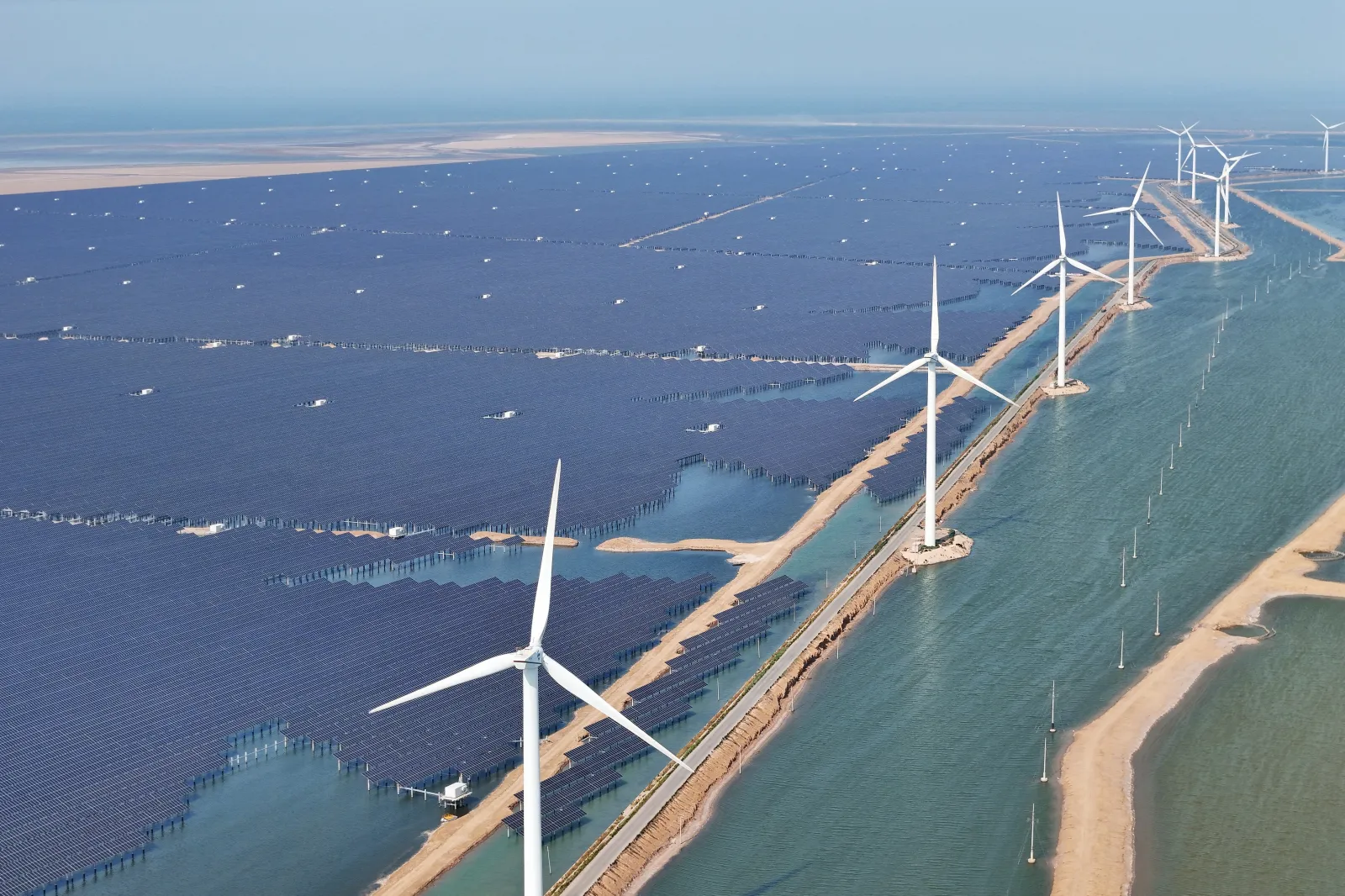
When the Paris Agreement came about 10 years ago, renewable energy was an expensive option. But as costs for clean tech continue to plummet, solar power is now the cheapest way to generate electricity in many markets, according to the International Energy Agency.
Similarly, in 2015, EVs made up less than 1 percent of passenger car sales. Today, globally, about one in five new passenger cars is electric, and in China, the world’s largest car market, EVs account for half of new car sales, according to the nonprofit Systems Change Lab. “We’re in a very different place now where a lot of the technologies and the implementation of clean tech is economically attractive and there’s a strong business case for it,” Prag said.
Other companies, however, are finding it harder to meet earlier climate pledges. Xia Li, assistant professor of strategy and entrepreneurship at London Business School, said that is due to political uncertainty in the U.S. and soft commitments by some companies.
“Many were never fully committed,” Li said via email. Companies might have announced ambitious goals but “as external uncertainties and operational constraints have become clearer, they are recalibrating.”
Li has written extensively about corporate sustainability, and she said the business shift underway on climate is complex. “Rather than a simple retreat, this looks like sorting under a changing environment,” Li said. Some companies are delaying action but others with stronger commitments are thinking more deeply about climate impacts.
“The physical impacts of climate change—heatwaves, floods, wildfire, water stress—are now material business risks,” she said. “They shape operating schedules, supply chains, insurance costs and access to finance.”
Corporate climate strategy is now less about high-profile announcements and more about ground-level operations. Investors are also changing how they assess a company’s environmental performance.
Traditional ratings provide an “investor checkbox” of a company’s environmental, social and governance record, Li said. But that approach won’t necessarily capture a company’s real impacts on the environment. New methods are emerging to better gauge company performance, she said, such as measures of the emission reduction potential of new innovations in climate tech.
“I welcome the shift from box-ticking to impact,” Li said, “because it puts societal outcomes on par with firms’ financial performance.”
The Rockefeller Foundation’s SVP and Power Program Leader Ashvin Dayal has spent much of his career using clean energy to expand electricity access in developing economies. Dayal said the talk of a climate reset won’t change the underlying facts about climate science or the economics of clean energy, but it does present a chance to change how those facts are communicated.
“I wouldn’t call it a reset, I would call it a reminder [to] really focus on what matters here,” Dayal told Newsweek. “The climate crisis will only ever be addressed if we continuously keep people at the center of it.”
When developing nations deploy more renewable energy, it isn’t just to cut CO2, he said. It is done to provide clean power to the millions of people who lack access to electricity.
“It’s clean energy for people,” Dayal said. “It is about improving the lives and livelihoods of people across the planet.”
View 0 Comments
Submit Correction
View Editorial & AI Guidelines