
By Jess Thomson
Science Reporter
0
Share
Newsweek is a Trust Project member
See more of our trusted coverage when you search.Prefer Newsweek on Googleto see more of our trusted coverage when you search.
A rarely seen giant squid normally found deep beneath the ocean's surface has been discovered dead on a beach in Cape Town, South Africa, just months after another washed up six miles away.
Tim Dee stumbled across the carcass on Scarborough Beach, near the Cape of Good Hope, on Tuesday. Dee shared pictures and a video of the huge creature on social media, which show the squid's characteristic huge eye.
Read More
Teenager Gored by Huge Bison in South Dakota State Park3 min read

Toddler Bites Snake to Death after It Sunk Its Fangs into Her Lip3 min read

Rampaging Lone Dolphin Keeps Biting Swimmers4 min read

"Giant squid species wrecked on Scarborough beach this morning," he wrote. "What's it to ya, Moby Dick?"
His video shows a marine biologist investigating the carcass while pulling back flesh to reveal the squid's beak, which it uses for hunting and feeding. The beak is around the size of the scientist's fist.
Giant squid are rarely seen alive outside of the deep and generally spend most of their time between 980 and 3,280 feet below the ocean's surface. The first time the elusive species was filmed alive was in 2006 off the Ogasawara Islands in Japan.
Their true distribution across the globe is not known because of the scarcity of live sightings, but their carcasses have been found washed up all around the world.
...
"It's not uncommon to have a giant squid wash up, but it's not a daily occurrence," Cape Town Coastal Manager Gregg Oelofse, told News24. "The last one washed up at Kommetjie about seven months ago. These are deep-ocean dwelling creatures that wash up from time to time."
The previous squid was found only a few miles down the coast and was in much worse condition, compared with the one found this week. Cape of Good Hope SPCA spokesman Jon Friedman said fishermen grabbed the eyes, beak and tentacles, leaving only the fleshy body. Samples were taken from the remains before the creature was thrown back into the sea.
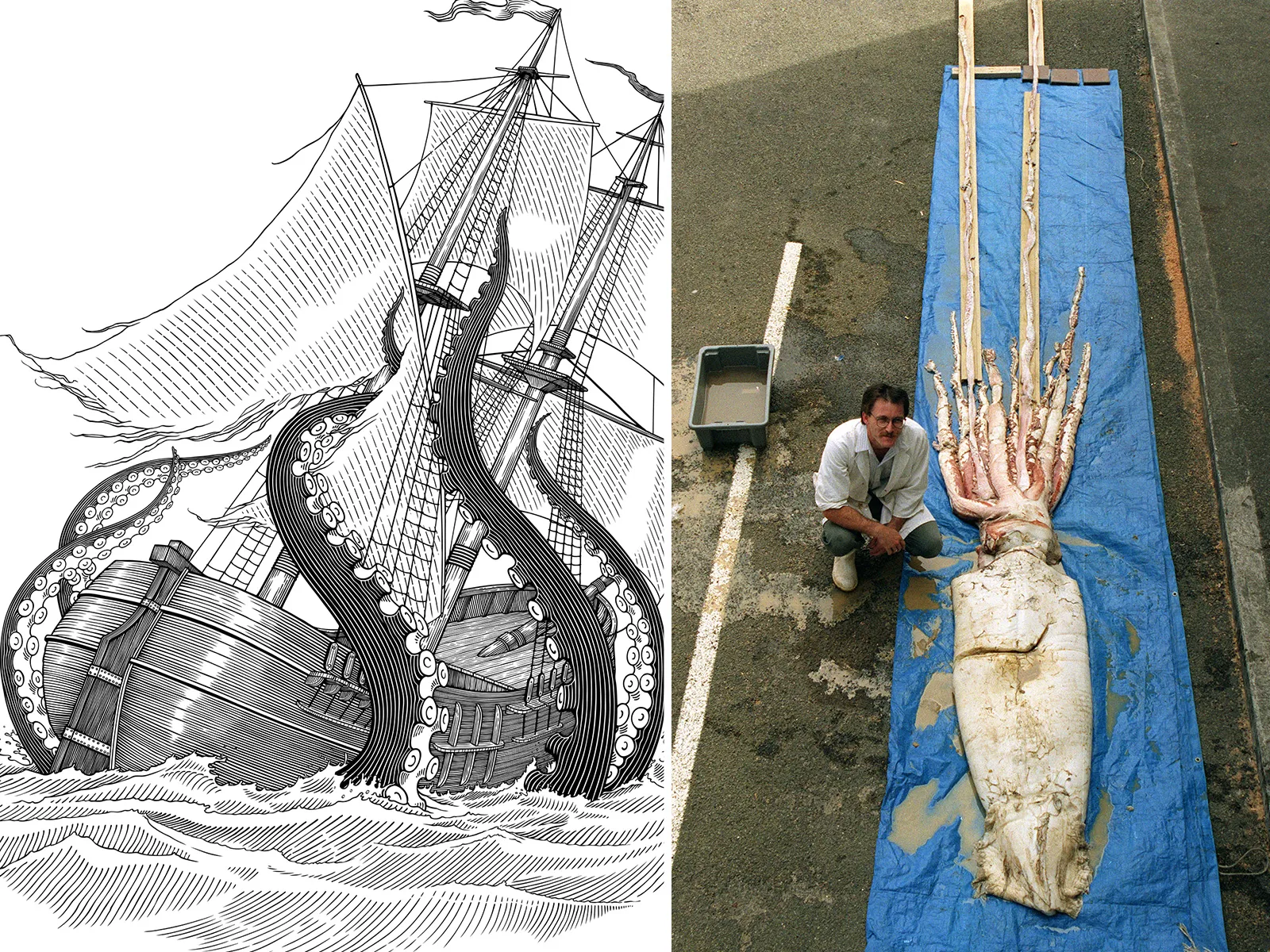
Giant squid, as well as colossal squid, their larger cousin, are the largest of all cephalopods. Giant squid like the one that washed up in Cape Town can grow up to 43 feet.
Like other cephalopods, giant squid have eight arms and two extra feeding tentacles, which are coated with large suction cups measuring between 1 and 2 inches in diameter. These suckers are thought to help the squid latch on to its prey and drag them toward its sharp beak in the center of the arms. This beak then slices the prey into bite-sized pieces, which are further broken down by a tongue-like organ, called the radula, inside the beak.
The giant squid possesses the largest eyes in the animal kingdom, which, according to National Geographic, measure up to 10 inches in diameter. (The average dinner plate is around the same size.) It's thought that eyes of this size evolved to aid the squid in catching scraps of light or bioluminescence in their deep-sea home.
They have few predators because of their size and the depth of their habitat. However, they are a favorite prey of sperm whales and are often found within the stomachs of pilot whales, southern sleeper sharks and occasionally killer whales.
Samples collected from the Scarborough carcass will be collected and taken to Cape Town's Iziko South African Museum to be studied.
View 0 Comments
Submit Correction
View Editorial & AI Guidelines