10
Loading video...


By Amanda Greenwood and Anna Skinner
0
Share
Newsweek is a Trust Project member
See more of our trusted coverage when you search.Prefer Newsweek on Googleto see more of our trusted coverage when you search.
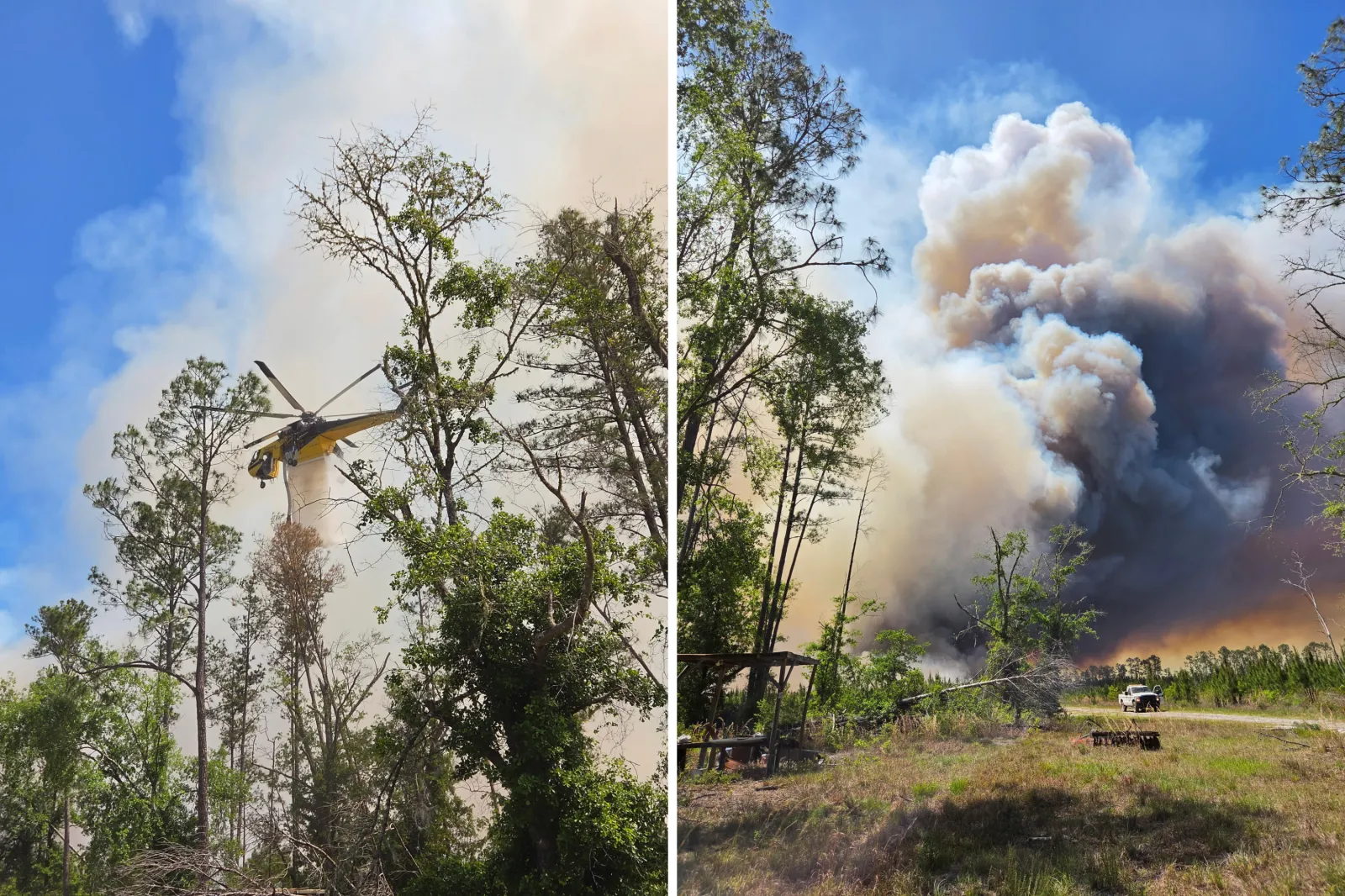
Wildfires driven by extreme drought, low humidity, and gusty winds continue to burn across South Georgia, forcing evacuations, destroying homes, and prompting Governor Brian Kemp to declare a State of Emergency for 91 Georgia counties, as fire crews struggle to contain multiple, fast‑moving blazes.
Newsweek reached out to the Georgia Forestry Commission via email for comment.
Latest Fire Update
According to the Georgia Forestry Commission, two major wildfires remain the primary concern:
Read More on News
Pineland Road Fire in Clinch County
As of April 23, according to a social media post made by the Georgia Forestry Commission, the fire has burned roughly 29,606 acres and is just 10 percent contained.
The Forestry Commission said that the cause of the fire remains undetermined, but fire crews are currently battling flames ripping across swamps and bays, making access difficult and slowing fire containment efforts.
Officials said the combination of extremely low humidity and exceptional drought—conditions that leave the air, ground, and vegetation extremely dry—is allowing the fire to spread rapidly, making it much harder for the 89-member crew to bring it under control.
Smoke from the fire is also affecting nearby communities, including Valdosta, Homerville, Lake Park, Statenville, and Fargo, the commission reported.

...
Highway 82 Fire in Brantley County
This fire has burned an estimated 5,000 acres and is 15 percent contained. Officials are describing the fire behavior as “extreme” and said it is likely to continue growing over the next 72 hours, with strong winds pushing the fire rapidly across the area, with embers igniting new fires ahead of the flames, and groups of trees torching at once, producing intense heat.
So far, 48 homes have been destroyed, and roughly 1,000 additional homes are threatened.
Suppression efforts are ongoing, but heavy fuels and swampy terrain continue to pose containment challenges.
A third group of smaller but still dangerous fires continues to burn across South and parts of Central Georgia, contributing to the statewide emergency. The commission posted that, in addition to the Pineland Road and Highway 82 Fires, fire crews are responding to about 34 new wildfires that have burned about 75 acres.
...
State of Emergency and Burn Ban
At the time of publishing, Georgia is the only state under a declared public emergency related to the fires.
Governor Kemp issued a State of Emergency for 91 counties on April 22, allowing additional resources, National Guard support, and federal assistance to be deployed.
Separately, the Georgia Forestry Commission issued the first mandatory burn ban in its history, also covering 91 counties across South and parts of Central Georgia. The ban is in effect immediately for at least 30 days and prohibits all outdoor burning, including prescribed fires, agricultural burns, and yard debris burning.
What’s Happening on the Ground

...
Fire crews from multiple agencies are focused on strengthening fire lines, protecting structures, and responding to new fires caused by wind‑blown embers.
Temporary drone flight restrictions remain in place over active fire areas to prevent interference with aircraft conducting firefighting operations.
Road congestion near the fires continues as personnel and equipment move constantly to respond to changing conditions, prompting officials to urge the public to stay away from active fire zones. On social media, the commission is urging people that if you “do not need to be in or near an active fire area, please stay out.”
Outlook
The short‑term outlook remains concerning.
According to the commission, the “chance of rain is unlikely for most of the affected area in the coming days.” Fire officials are warning that containment will be difficult, with hot temperatures, low humidity, and dry fuels expected to persist. Winds could continue to push smoke and embers into new areas, increasing the risk of additional fires and property loss.
Smoke, Air Pollution, and Health Impacts
Wildfire smoke has significantly increased fine particle pollution (PM2.5), which consists of tiny particles—less than 2.5 micrometers in size—that can penetrate deep into the lungs and enter the bloodstream, triggering symptoms ranging from coughing to shortness of breath and chest tightness.
According to the Environmental Protection Agency, PM2.5 levels across parts of South Georgia currently range from “unhealthy” to “unhealthy for sensitive groups,” meaning that while everyone in the affected areas is likely to be affected, those in sensitive groups—which include the elderly, children, those with existing heart and lung conditions, and outdoor workers—are likely to be the most affected.
Impacts extended beyond Georgia state lines. An air quality alert remains in place across South Carolina and southern North Carolina due to wildfire smoke, with local environmental agencies urging people to take precautions to protect themselves.
How to Protect Yourself
Officials recommend several steps to stay safe:
- Monitor local air quality reports and limit outdoor activity when smoke levels are high.
- Keep windows and doors closed and use air conditioning or portable air cleaners if available.
- Follow evacuation orders and guidance from local emergency management agencies.
- Avoid driving or parking vehicles on dry grass, as hot exhaust systems can ignite fires.
- Keep firefighting tools such as a shovel, hose, or fire extinguisher readily available.
- Call 911 immediately if you see smoke or fire.
With conditions expected to remain dangerous over the next few days, fire officials continue to urge vigilance, cooperation, and caution as Georgia faces one of its most severe wildfire outbreaks in recent history.
View 0 Comments
Submit Correction
View Editorial & AI Guidelines