10
Loading video...

By Rachael O'Connor
Reporter
0
Share
Newsweek is a Trust Project member
See more of our trusted coverage when you search.Prefer Newsweek on Googleto see more of our trusted coverage when you search.
A college student with a full-time job arrived at the home she shares with her mother and found a contract with rules to allow her to continue living there had been left in her bedroom.
Kayla, who only shared her first name, is 22 and from Alabama. She works full-time as a supervisor and also attends a full-time online college course, telling Newsweek she is "barely home" because of how busy she is.
Kayla's situation isn't unique. A record number of adult children under the age of 35 in the United States are moving back in with their parents due to the cost of living. In 2025, 25.2 million young adults—almost one in three—lived with their parents, a higher number than during the COVID-19 pandemic.
Read More on On the Internet
An estimated 70 percent of these adults are employed, according to a report from Realtor.com, suggesting the rising cost of rent and house prices has much to do with the trend of young adults remaining at home.
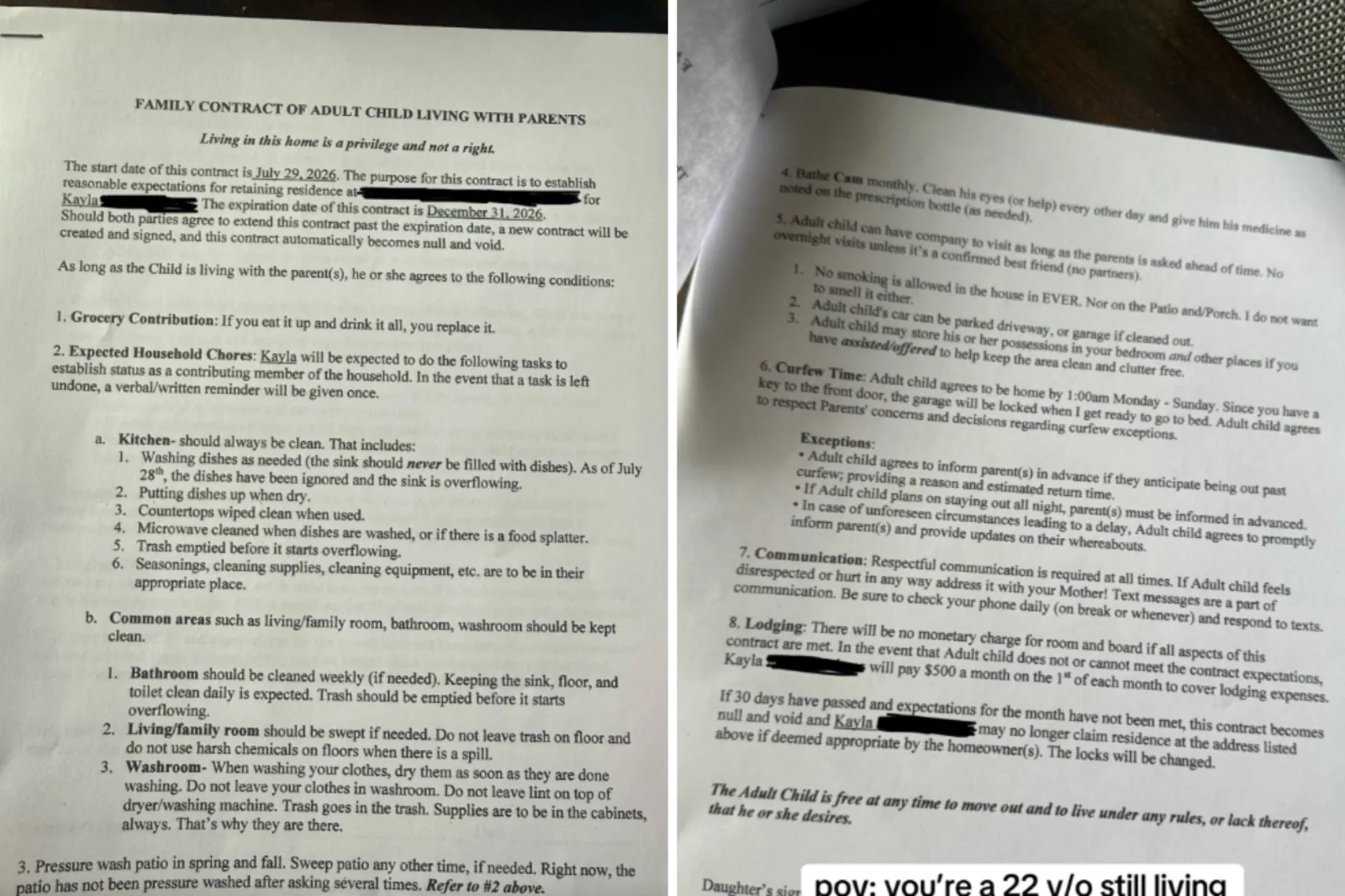
The contract, written up like an official lease between a tenant and landlord, is filled with rules which Kayla can either follow—or pay $500 in rent each month.
Some rules are common sense, such as Kayla having to replace any food or drink she finishes, not leaving trash on the floor, keeping the kitchen clean and taking trash out, and drying her clothes as soon as they are finished in the washing machine.
...
Other rules go into more detail: cleaning the common areas, pressure washing the patio, bathing the dog and cleaning his eyes, and not smoking in or beside the house.
Kayla is also subject to a 1 a.m. curfew without prior communication with her mother, must regularly check her phone and reply to messages from her mother, must ask her mother ahead of time if she can have a guest over, and her partner is not allowed to stay overnight in the home.
The contract divided opinion on TikTok, with some pointing out that Kayla would have to do all these chores on top of her college and work if she moved out, and would be paying rent on top of it.
Kayla told Newsweek that the contract felt "unnecessary" as "I've always kept things clean." While "the chores aren't the issue," she said that she feels like she shouldn't have a curfew at her age.
"I have my own car, I’m barely at home because I work so much, and I recently turned my location off so she can’t see where I’m at," Kayla said. "But I still communicate if I’m going out of state or somewhere far so that she knows."
Related Story

Gen Z Shun White Collar for Skilled Trades—but Which Jobs Pay the Most?
Kayla said that, in her opinion, "some of it is fair" but "most of it is too much"—and is hurt by the fact that her girlfriend is not allowed to stay the night, but a friend would be allowed with her mother's prior permission.
Despite Kayla rarely being home, she said the contract expects her to wash her mother's dishes and take out her trash, and that Kayla has always been the one to care for the dog.
"The curfew is [also] irritating because I never make any noise when coming home. I come through the garage and the garage door silently," she said, suggesting that the contract is more about "control" than rules to live by.
Some wondered whether the contract was her mother's way of encouraging Kayla to move out of home and rent a room or apartment of her own.
"I am intending on moving out, hopefully by December, but January at the latest," Kayla told Newsweek.
If you have a similar family dilemma, let us know via life@newsweek.com. We can ask experts for advice, and your story could be featured on Newsweek.
Contact Newsweek editors on this story: Rebecca Flood and Sam Wilson.
View 0 Comments
Submit Correction
View Editorial & AI Guidelines