
Photo-illustration by Newsweek/Getty

By David Averre
0
Share
Newsweek is a Trust Project member
See more of our trusted coverage when you search.Prefer Newsweek on Googleto see more of our trusted coverage when you search.
America’s strength was once defined by its resolve to resist the world’s empires. For the past century, it has been demonstrated by how many nations follow its lead. In the next chapter of history, U.S. power will be measured by how many powerful countries choose to walk beside it.
America’s brief reign as the sole undisputed superpower is fading. China is challenging its economic and military dominance, Moscow is growing closer and more subservient to Beijing, and middle powers continue to rise. As the balance of power shifts, America’s traditional instruments of persuasion—economic pressure, military prowess and the promise of preferential access to its markets—are becoming less decisive.
There is but one nation standing at the crossroads of this global bifurcation.
Read More on Analysis
India has a population of nearly 1.5 billion, a rapidly expanding economy, formidable military capabilities and ambitions to become a new industrial powerhouse. Add its fierce commitment to independence and a political culture of strategic autonomy into the mix, and New Delhi emerges as a unique force whose choices will carry enormous weight in a new era shaped by competing poles of power.
How Washington manages its relationship with this rising titan will help determine the extent of America’s global influence and prosperity in the world of tomorrow.
A Stirring Giant
In a tacit acknowledgment of the changing world order, Secretary of State Marco Rubio spent much of last week on a diplomatic and commercial tour of Asia.
First, he touched down in the ancient city of Samarkand for discussions with representatives of the five Central Asian "Stans"—Uzbekistan, Tajikistan, Kyrgyzstan, Kazakhstan and Turkmenistan. He was accompanied by more than 200 American business leaders seeking opportunities in a region striving to escape Russia’s shadow and China’s growing economic influence. Rubio then flew to India, bypassing New Delhi for the commercial hub of Mumbai and a meeting with Foreign Minister Subrahmanyam Jaishankar, before touring Reliance Industries’ enormous oil refining complex in Jamnagar.
This might seem a curious courtship for an administration whose relations with India have been choppy, to say the least.
In August 2025, President Donald Trump slapped tariffs of up to 50 percent on Indian goods, accusing New Delhi of helping finance Russia’s war in Ukraine through its purchases of discounted Russian oil—not that this stopped Trump from negotiating his own diesel deal with Putin, of course. Tensions have also flared over American immigration restrictions, trade barriers and Washington’s renewed engagement with Pakistan, India’s bitter regional rival and nuclear-armed neighbor.
This friction belies a relationship quietly growing stronger.
Bilateral goods-and-services trade reached a record $239.6 billion in 2025. The two governments are pursuing closer technological cooperation through their TRUST initiative, while Google has broken ground on a $15 billion artificial intelligence hub on India’s eastern coast. With good reason, too; India is the world’s most populous country and among its fastest-growing major economies, forecast for 6.4 percent GDP growth this year alone. Its vast domestic market, skilled technology workforce and industrial ambitions offer enormous opportunities for American business.
India’s geography may be even more valuable to Washington. The country occupies a commanding position on the Indian Ocean’s vital shipping routes and shares a vast, disputed frontier with China, America’s greatest strategic rival. India, meanwhile, has compelling reasons of its own to fear Beijing’s growing military power and economic might.
"The disputed border, Beijing’s ties with Pakistan and its expanding continental and maritime presence throughout the Indo-Pacific make the balance of power a direct security concern for New Delhi," Monish Tourangbam, fellow at the Centre for Geopolitics and Strategic Studies at the Chintan Research Foundation, told Newsweek.
This means Indo-American military cooperation receives just as much attention as the commercial dimension. In September, 1,200 American and Indian soldiers undertook mountain warfare drills in Uttarakhand near the border with China; one of an increasing number of joint exercises.
"The convergence of Indian and American interests is strongest in maritime security, intelligence sharing, military interoperability, defense technology and resilient supply chains," Tourangbam said. "India’s geography and growing capabilities can help constrain China’s ability to impose its preferences, while American cooperation can help India narrow the material asymmetry that limits its choices."
Viewed from the Hill, it might seem New Delhi is in desperate need of America’s military might and deep pockets. But the United States is dealing with a nation whose foreign policy has been built around resisting precisely the sort of dependence that Washington has often expected of its allies.

...
The World According to New Delhi
New Delhi does not allow wariness of Chinese dominance in the Indo-Pacific to obstruct collaboration with Beijing.
Both countries occupy leading roles in BRICS—the group of major and emerging economies routinely presented as a challenger to the U.S.—and the Shanghai Cooperation Organization, while bilateral trade reached a record $151.1 billion in the last financial year. India also maintains extensive energy and military ties with Russia, and enjoys deep commercial relationships throughout the Middle East, particularly with the Gulf states.
Given these productive international relationships, it’s tempting to view India as something of a geographic and diplomatic bridge between Eastern and Western poles of world power.
"The bridge metaphor is flattering, but it misreads New Delhi," Amitabh Mattoo, professor in the School of International Studies at Jawaharlal Nehru University, told Newsweek. "A bridge is something others walk across. India does not want to be the corridor through which Washington and Beijing manage their rivalry; it wants a seat at the table where the terms of the order are written."
History baked this instinct into Indian political strategy.
Upon gaining independence from Britain in 1947, India’s first prime minister, Jawaharlal Nehru—after whom Mattoo’s university is named—championed a policy of nonalignment. As the Cold War took shape, India’s leaders refused to subordinate their interests to either camp.
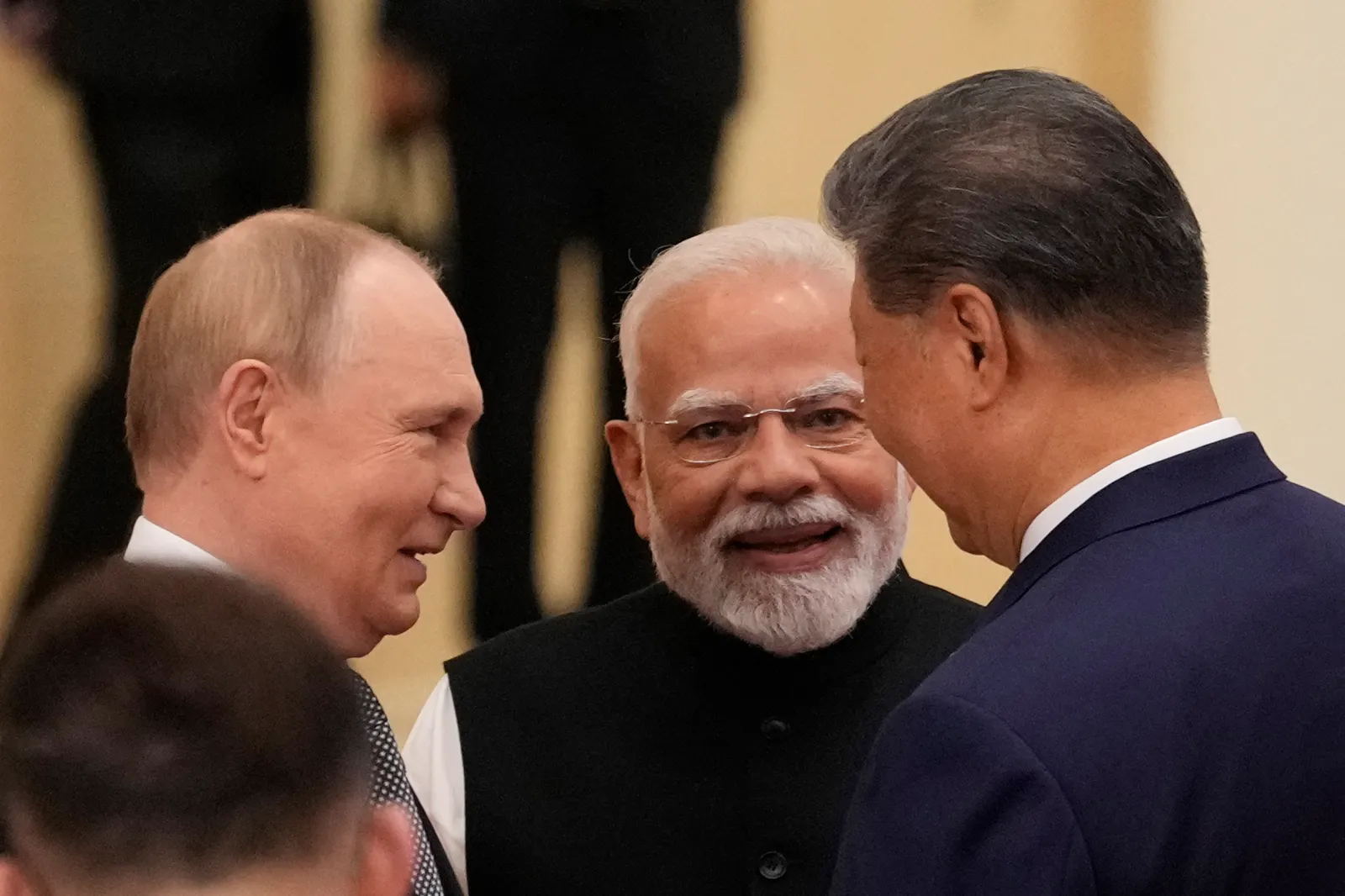
Under incumbent Prime Minister Narendra Modi, that philosophy has evolved into multi-alignment. New Delhi cooperates with Washington while participating in BRICS alongside China and Russia.
"New Delhi’s engagement with Washington, Moscow and Beijing reflects distinct calculations of opportunity, dependence and risk. Multi-alignment gives New Delhi room to pursue these relationships without allowing any one partnership to determine its wider choices," Tourangbam told Newsweek.
"Washington keeps reading strategic autonomy as a bargaining posture, a price to be negotiated down," Mattoo added. "It is not. It is closer to a civilizational instinct, born of colonial memory and reinforced by the experience of Cold War arms embargoes and sanctions."
Yet India’s ambitions still exceed its capabilities.
Despite its enormous economy, annual GDP per person remains around $2,800—barely one-fifth of China’s and roughly three percent of America’s, according to World Bank comparisons. India’s burgeoning industrial sector can’t expand quickly enough to provide enough productive jobs for the booming population, and the military remains heavily dependent on foreign arms.
There are also some dependencies it has failed to eliminate. India imports nearly 90 percent of the crude oil it consumes, and like just about everyone else, is forced to source much of the machinery, electronics and components needed to expand its industrial capacity from China.
Ultimately, India has huge potential, but realizing its ambition will require vast improvements in its industrial and technological capabilities, alongside continued military modernization.
"India will become a formidable power. But it will rise as India, at India’s pace, for India’s purposes," Mattoo told Newsweek.
Therein lies America’s opportunity. Or a trap.
The Power of Letting Go
Washington is already helping India build the power it seeks. The two governments signed a new 10-year defense cooperation framework last October, while their armed forces increasingly cooperate on intelligence and maritime security.
Commercial cooperation is gathering pace, too. In February, American semiconductor giant Micron opened an assembly-and-testing facility in Gujarat, representing approximately $2.75 billion in combined investment from the company and its government partners. But this uptick in military and commercial activity begs a difficult question.
Why invest so heavily in making New Delhi stronger and more prosperous with no promise of loyalty in return?
...
Tourangbam told Newsweek: "New Delhi will continue to pursue relationships with America’s rivals where its interests demand them. For example, defense cooperation with Washington cannot be read as an Indian commitment to join a conflict (with China) over Taiwan."
Such a degree of independence in a partner might be particularly difficult to swallow for a country accustomed to getting what it wants. America’s rise to become the dominant power of the 20th century afforded the White House massive influence over its allies, particularly European governments ravaged by the Second World War whose economies and security have depended heavily on America ever since.
Previous American presidents generally left this unsaid, but Trump has taken every opportunity he can get to remind Europe who’s boss with a vigor bordering on disdain. Nor has he held back from deploying tariffs and threats of pulling out of NATO as leverage.
This approach will not fly with New Delhi.
Related Story

How a South Korean Car Company Changed India Forever
"Expectations of loyalty become untenable when cooperation requires India to subordinate its judgments on Russia, Iran, energy security or regional threats to American priorities," Tourangbam said.
Mattoo took a sharper view: "If America wants to be India’s preferred long-term partner, it should offer predictability rather than loyalty tests: genuine technology transfer, co-production in defense, a trade framework that survives a change of mood in the White House, and respect for India’s right to buy energy where it must. Partners are made by reliability, not by demands."
India has work of its own to do if it wants the benefits America has to offer. Its industrial development is hamstrung by bureaucratic delays and outdated systems, while market restrictions frustrate foreign investment.
Even if both sides make the necessary compromises, Washington must accept a harsh reality: American capital and technology can help build a stronger partner, but they offer no guarantee that India will use its newfound power according to Washington’s wishes.
"The skeptic’s case against America’s support of India is straightforward," Mattoo said. "India will absorb American capital, technology and goodwill, grow stronger, and still decline to stand with Washington on key issues like Russia and Iran. That is a fair description of how India will behave.
"Where the skeptics go wrong is in thinking this makes India a bad bet. An India that is strong, democratic and unwilling to be anyone’s client is precisely what makes Asia multipolar rather than Chinese."
A stronger India has powerful reasons of its own to resist Chinese dominance, protect the Indian Ocean and build an economy less dependent on Beijing. These are interests Washington shares, even if New Delhi refuses to support every American diplomatic initiative or military campaign.
This partnership, then, will serve as a true test of whether the U.S. can accept the limits of its influence in a world it no longer dominates. Preserving a favorable balance of power will increasingly depend on cultivating strong, independent nations whose interests overlap with its own—even when their decisions frustrate, and in some cases openly disregard, those of the White House.
India will follow its own path. America’s willingness to walk beside it will help determine the prosperity and security of both nations in the world to come.
View 0 Comments
Submit Correction
View Editorial & AI Guidelines