
...

By Giulia Carbonaro
Senior Reporter
0
Share
Newsweek is a Trust Project member
See more of our trusted coverage when you search.Prefer Newsweek on Googleto see more of our trusted coverage when you search.
When ordering elite troops to storm a fortified compound in Caracas and capture Venezuelan strongman Nicolás Maduro on Saturday morning, President Donald Trump tapped into a long history of U.S. interventions triggering regime changes in countries across the world—albeit one he had harshly criticized in the past.
The U.S. involvement was not always meant to topple a hated dictator or a brutal authoritarian leader, as the country has historically intervened to prevent the spread of communism—as in the cases of Vietnam and Cuba. But it has also often intervened to back grassroots protests and remove strongmen who were causing international disruptions and posing global threats.
...
Read More on News
Below, readers can find a list of leaders that the U.S. helped to remove or single-handedly toppled across the world in the past century or so—dictators and not.
There is no official or universally agreed-upon list, and the definition of what constitutes a “dictator” varies—and can be manipulated for political reasons. The U.S. involvement has ranged from full-scale invasions to covert support for coups or decisive diplomatic pressure. Still, historians broadly agree on a core set of cases where U.S. actions were instrumental.
Mohammad Mossadegh — Iran (1953)
On August 19, 1953, the CIA helped orchestrate a coup with the U.K. that removed Iran’s Prime Minister Mohammad Mosaddegh from power, in a move meant to strengthen the rule of King Mohammad Reza Pahlavi.
It is important to say that Mossadegh was not, in fact, a dictator. While it was labeled as such by the U.S. and the U.K., he had been democratically elected by Iranian voters.

...
Mosaddegh had just nationalized the country’s oil industry previously operated by British companies, and the coup, which restored the Shah’s authoritarian rule, was widely seen as a way of protecting the British oil industry in the region.
Jacobo Árbenz — Guatemala (1954)
In June 1954, the democratically elected President of Guatemala, Jacobo Árbenz, was removed in a CIA-backed operation after his left-leaning policies alarmed U.S. officials during the Cold War. The coup installed the military dictatorship of Carlos Castillo Armas in his place, triggering decades of political violence in the country.
In a radio broadcast in July of the same year, Árbenz said of the coup: “They have used the pretext of anti-communism. The truth is very different. The truth is to be found in the financial interests of the fruit company and the other U.S. monopolies which have invested great amounts of money in Latin America and fear that the example of Guatemala would be followed by other Latin countries.”
Abd al-Karim Qasim — Iraq (1963)
In February 1963, the CIA supported a coup by the military wing of the Ba’ath Party in Iraq against the left-leaning government led by Abd al-Karim Qasim, whose pro-communist and anti-Western policies were seen as a threat by the U.S.
The coup and Qasim’s assassination helped set the stage for years of authoritarian rule under the Ba’ath Party.
Fidel Castro — Cuba (1961)
In April 1961, the U.S. famously tried to topple Fidel Castro in Cuba with the Bay of Pigs Invasion, which ended up being one of the most clamorous U.S. foreign policy failures. Castro remained in power until handing over power to his successor in 2006 due to illness. He died in 2016.
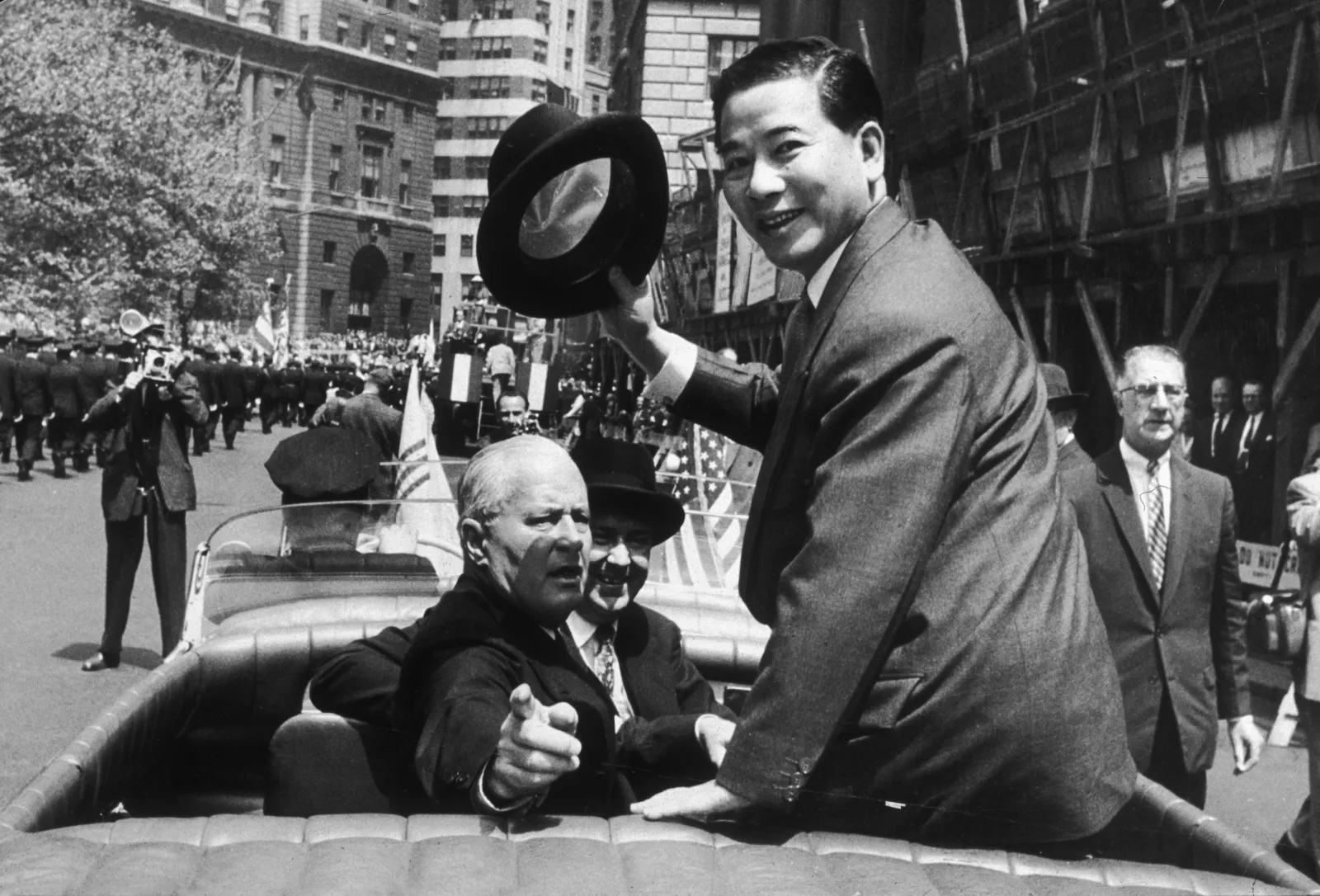
Ngo Dinh Diem — South Vietnam (1963)
Ngo Dinh Diem, the authoritarian leader of South Vietnam once considered by the U.S. a bulwark against communism in the region, was overthrown and assassinated in a CIA-backed military coup after losing confidence in his ability to prosecute the Vietnam War.
Declassified documents later confirmed Washington’s behind-the-scenes role.
...
Hudson Austin — Grenada (1983)
In October 1983, the U.S. removed General Hudson Austin from power in Grenada, only six days after he had ousted and executed prime minister Maurice Bishop in “Operation Urgent Fury.” The ousting ended his military government.
Jean-Claude “Baby Doc” Duvalier — Haiti (1986)
Haiti dictator Jean-Claude Duvalier, nicknamed “Baby Doc”, fled Haiti after nearly 15 years in power when mass protests erupted and the U.S. withdrew its political and military backing.
His departure ended the Duvalier dynasty, which had ruled Haiti as a dictatorship for nearly three decades.

...
Manuel Noriega — Panama (1989)
Manuel Noriega, a military strongman leading Panama and former U.S. intelligence asset, was removed from power after then-president George W.H. Bush launched Operation Just Cause, invading Panama in December 1989.
U.S. troops captured Noriega and transferred him to the United States, where he was tried and imprisoned on drug trafficking charges.
A year earlier, in 1988, the military dictator had been indicted by federal grand juries in Miami and Tampa, Florida, on charges of racketeering, drug smuggling, and money laundering.

...
Saddam Hussein — Iraq (2003)
Hussein ruled Iraq as a dictator for nearly 25 years before being removed during the U.S.-led invasion in 2003.
In December of that year, a coalition including the U.S., the U.K., Australia, and Poland—the so-called “coalition of the willing”—invaded Iraq and captured Saddam Hussein in “Operation Red Dawn”. The dictator was later tried and convicted for crimes against humanity by the Iraqi Special Tribunal and executed by hanging in 2006.

...
Muammar Gaddafi — Libya (2011)
Another coalition involving several countries, among which the U.S., backed the toppling of Muammar Gaddafi in Libya on October 20, 2011, during the Arab Spring uprising. The dictator was killed by rebels in Sirte.
Although American troops did not occupy Libya, U.S. airpower and intelligence were critical to the collapse of Gaddafi’s regime.

...
Nicolás Maduro — Venezuela (2026)
Maduro and his wife Cilia Flores were “captured and flown out of the country” at Trump’s direction as part of the apparently flawless “Operation Absolute Resolve,” which the president followed by his Mar-a-Lago Club in Palm Beach, Florida.
The 63-year-old politician had been running Venezuela for over a decade, during which the country’s GDP shrank by roughly 80 percent and experienced a massive exodus of people. Maduro was widely considered a dictator and an illegitimate leader since he was believed to have stolen the latest presidential election in the country.
Since then, Trump has announced the U.S. will “run” Venezuela until a “safe, proper and judicious transition” can be ensured in the country.
The news cycle is loud. Algorithms push us to extremes. In the middle—where facts, ideas and progress live—there's a void. At Newsweek, we fill it with fearless, fair and fiercely independent journalism.
Common ground isn't just possible—it's essential. Our readers reflect America's diversity, united by a desire for thoughtful, unbiased news. Independent ratings confirm our approach: NewsGuard gives us 100/100 for reliability, and AllSides places us firmly in the political center.
In a polarized era, the center is dismissed as bland. Ours is different: The Courageous Center—it's not "both sides," it's sharp, challenging and alive with ideas. We follow facts, not factions. If that sounds like the kind of journalism you want to see thrive, we need you.
When you become a Newsweek Member, you support a mission to keep the center strong and vibrant. Members enjoy:
Help keep the center courageous. Join today.


View 0 Comments
Submit Correction
View Editorial & AI Guidelines