
...

By Jess Thomson
Science Reporter
0
Share
Newsweek is a Trust Project member
See more of our trusted coverage when you search.Prefer Newsweek on Googleto see more of our trusted coverage when you search.
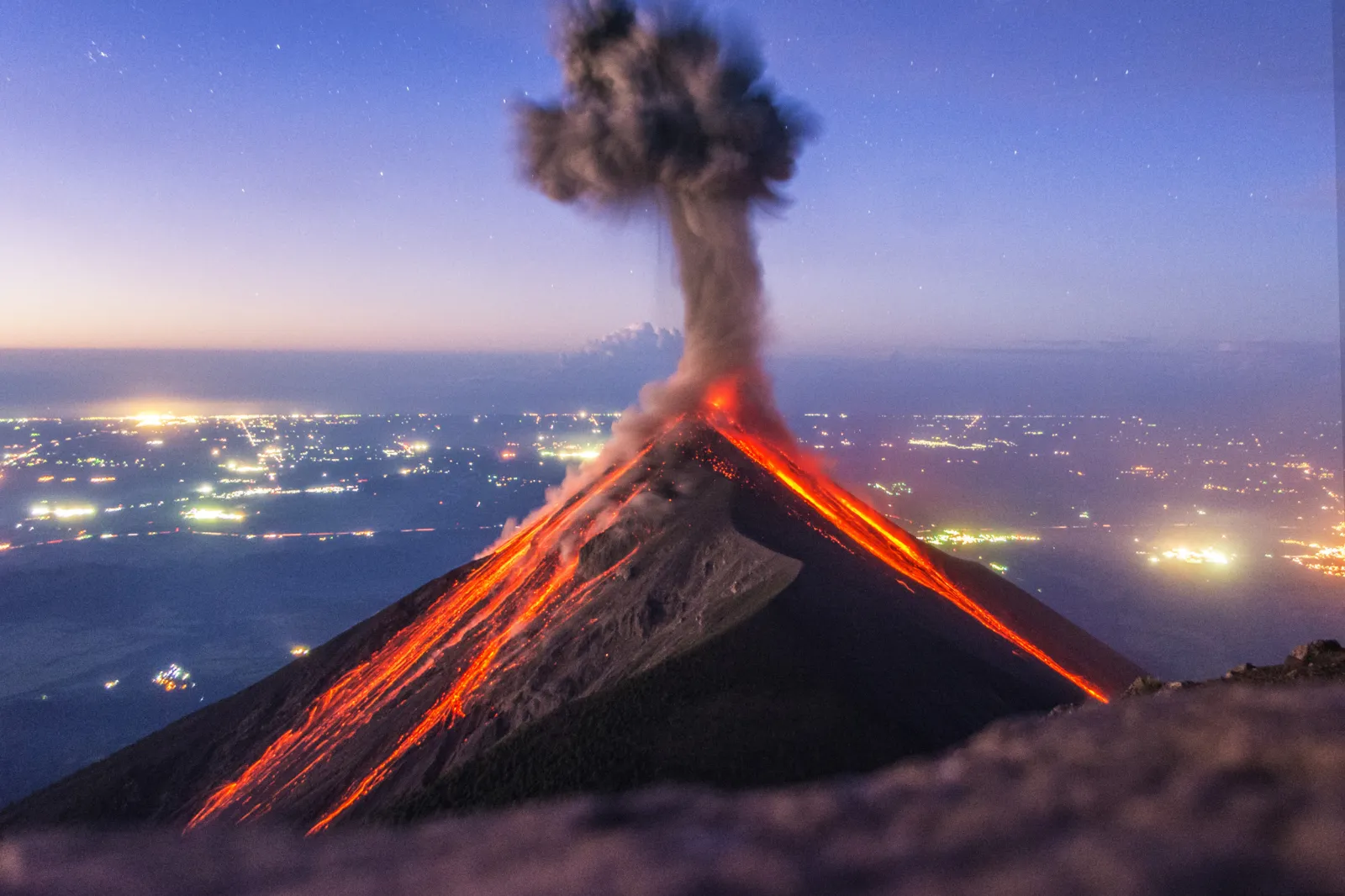
The Fuego volcano in Guatemala began erupting on December 11, marking another addition to the list of volcanoes currently erupting across the globe.
Volcan de Fuego's eruptions have consisted of weak explosions, resulting in a tall cloud of ash above the mountain, as well as lava being flung over 1,600 feet above the crater.
"The Fuego volcano showed an increase in its activity, which in the last minutes has entered an eruption phase[...] The eruption is mostly effusive accompanied by incandescent pulses from the lava source," the Guatemalan Institute of Volcanology (Insivumeh) said in a statement.
Read More
Mauna Loa Eruption on Hawaii’s Big Island Filmed From Space3 min read

Mauna Loa Photos and Video Show Sky on Fire as Lava Pours From Summit4 min read

Violent Supervolcano Appears to Be Rumbling Back to Life3 min read

...
Fuego, also known as Chi Q'aq', overlooks the city of Antigua from around 10 miles away. The mountain stands at around 12,000 feet tall. It is one of the region's most active volcanoes, having erupted multiple times in 2018, in September 2021, and several times this year.
The volcano usually burps out small plumes of gas and ash every 15 to 20 minutes when it's not actively erupting.
No evacuations have been put into place, Rodolfo García, spokesperson for the National Coordinator for Disaster Reduction (Conred), the entity in charge of civil protection, said in a statement.
...
Garcia said that they would continue "monitoring" the activity of the volcano and the risks of ash landslides and lava flows down the slope of the mountain towards population centers.
The Fuego eruption comes just two weeks after the eruption of Mauna Loa in Hawaii, the largest active volcano in the world, on November 27. Lava flows were filmed pouring down the sides of the mountain at speeds of up to 18 miles per hour, but the locals of nearby towns weren't at a high risk of being in the lava's path. Two more unrelated volcanoes then erupted a week later on December 4: Mount Semeru, 400 miles southeast of Indonesia's capital, Jakarta, and Stromboli, off the north coast of Sicily.
Even in the absence of lava flows, volcanoes can be immensely destructive and deadly to locals.
"Even after the eruption has ended, ash left by pyroclastic flows and ash that has fallen from the sky is a hazard because it can be remobilized by rainfall and turned into mudflows, known by the Indonesian name of lahars, that can destroy homes and bridges," David Rothery, a professor of planetary geosciences at Britain's Open University, previously told Newsweek.
An avalanche of rock and ash swept through the community of San Miguel Los Lotes (Escuintla) and part of a road in the neighboring town of Alotenango (Sacatepéquez), killing nearly 200 people—according to official counts—in the June 2018 eruption of Fuego.
Do you have a tip on a science story that Newsweek should be covering? Do you have a question about volcanoes? Let us know via science@newsweek.com.
View 0 Comments
Submit Correction
View Editorial & AI Guidelines